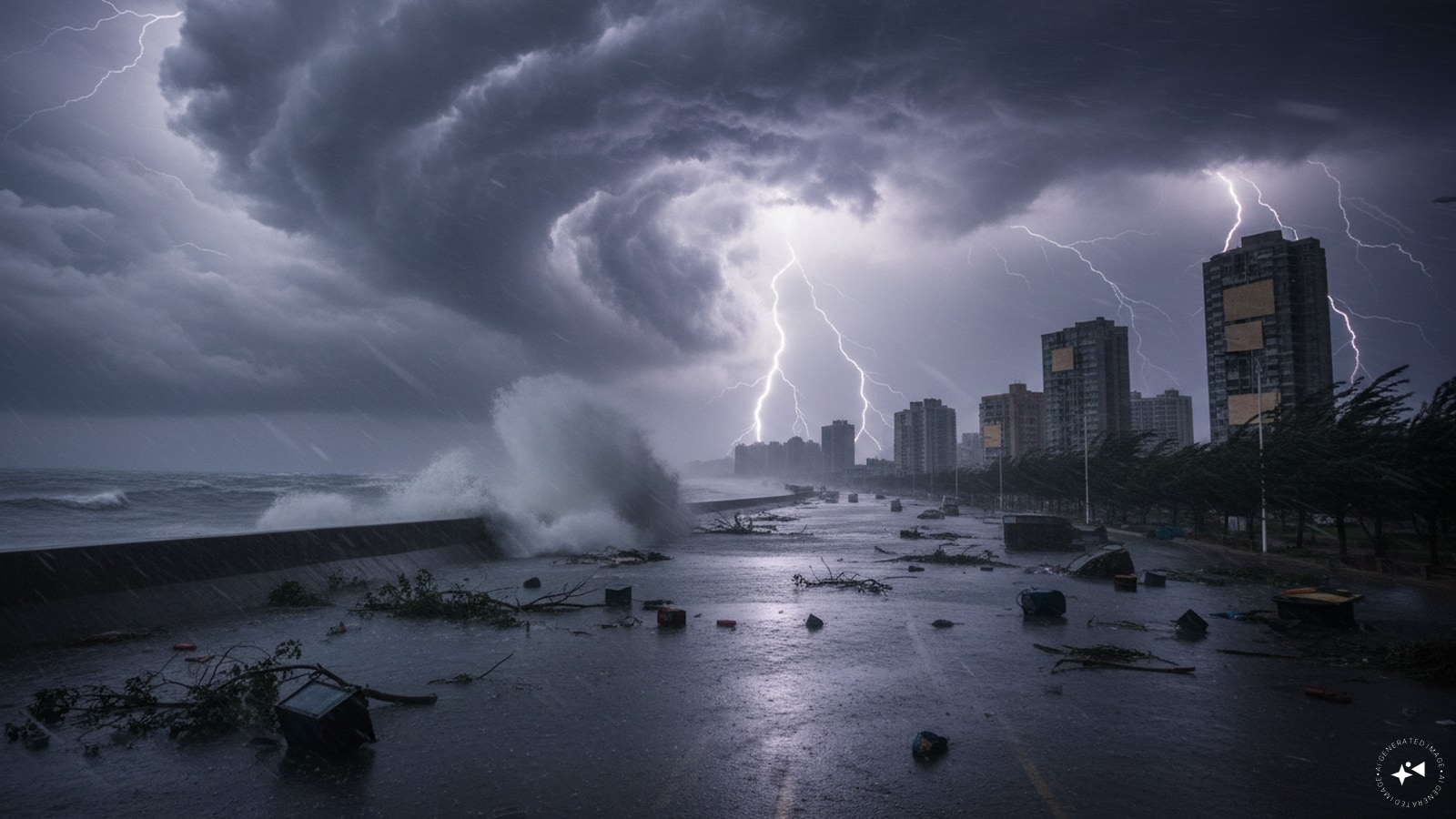
Simultaneous meteorologic shocks exhaust emergency capital and paralyze localized supply chains before physical reconstruction can begin. East Asia is currently experiencing an acute demonstration of this compounding risk cycle. Even as rescue operations continue following Typhoon Maysak—which caused 39 fatalities in southern China's Guangxi region—and severe convective storms in Hubei province that claimed 11 lives, the region faces Typhoon Bavi. Bavi is a cyclonic system spanning roughly 1,000 kilometers in diameter, possessing sustained wind speeds of up to 200 kilometers per hour.
Standard risk modeling frequently treats consecutive weather disruptions as independent, localized incidents. This structural miscalculation ignores the compounding degradation of municipal infrastructure, civil defense reserves, and regional logistics networks. When a secondary catastrophic system impacts an economy before the primary system's damage has been cleared, the resultant civil and economic depreciation scales non-linearly.
The Mechanistic Compound Effect of Serial Cyclonic Events
Evaluating the real systemic risk of Typhoon Bavi requires modeling it not as an isolated meteorological event, but as a secondary stressor applied to an already compromised structural baseload. The damage functions of back-to-back storms operate across three primary layers of structural vulnerability.
1. Saturation Hydraulics and Civil Engineering Thresholds
The primary failure point during concurrent storms is soil mechanics and hydraulic infrastructure capacity. Torrential rainfall from a preceding system fills the upper soil horizons, driving water tables to maximum capacity and rendering the terrain incapable of further infiltration. When the secondary storm arrives, surface runoff approaches 100 percent of precipitation volume immediately.
This mechanism directly causes catastrophic engineering failures. During the passage of Typhoon Maysak, intense localized rainfall overtaxed civil infrastructure, leading to a partial reservoir dam breach in Hengzhou. This engineering failure released high-velocity torrents into urban sectors, causing 26 of the region's 39 reported fatalities. The structural integrity of adjacent retaining walls, earthwork dams, and urban drainage networks across eastern and southern China remains severely compromised. Introducing Typhoon Bavi’s projected rainfall—estimated to reach up to one meter in the mountainous topography surrounding Taipei—into these saturated basins increases the probability of down-gradient flash flooding and structural dam failures, irrespective of local municipal maintenance standards.
2. Supply Chain Interdiction and Maritime Logistical Friction
The spatial scale of Typhoon Bavi creates a vast logistical dead zone across the Taiwan Strait and East China Sea. Spanning approximately 940,000 square kilometers, the storm's physical footprint limits tactical rerouting options for commercial shipping and aviation.
- Maritime Retrenchment: In northern Taiwan's commercial and fishing hubs, including the port of Suao, hundreds of vessels have been forced to return to port and secure hulls in close proximity. This collective mooring prevents immediate maritime transport and elevates the risk of hull-to-hull impact damage within harbors under storm-surge conditions.
- Aviation Groundings: Commercial flight paths connecting Taiwan, Japan, Hong Kong, and mainland China have experienced systemic cancellations. Taoyuan International Airport suspended all Saturday departures, while Japanese carriers grounded dozens of domestic and international flights servicing Okinawa and the Sakishima Islands.
- Agricultural Extraction Pressure: Farmers in the projected path of the storm have initiated emergency crop extractions, harvesting rice and perishable commodities prematurely to avoid total asset forfeiture. This compressed harvesting schedule depresses short-term market valuations due to sudden oversupply, while simultaneously lowering total crop yields due to sub-optimal maturity.
3. Allocation Inertia in Emergency Civil Defense
Personnel and material assets allocated for disaster response are finite. The mobilization of 29,000 military personnel in Taiwan and the deployment of 170,000 emergency personnel across mainland China's Zhejiang province demonstrate the scale of state-level intervention required to mitigate large-scale cyclonic hazards.
However, when emergency forces are actively engaged in primary rescue operations—such as navigating urban floodwaters via watercraft, clearing landslide debris, or managing escaped exotic fauna from damaged infrastructure—the deployment velocity for a secondary emergency drops significantly. The transition from active recovery in the West (Guangxi) to preventive fortification in the East (Fujian and Zhejiang) stretches administrative command networks, creating a logistical bottleneck in asset distribution.
Systemic Vulnerability Vectors Across East Asian Markets
[Systemic Thermal Energy (El Niño + Oceanic Warming)]
                       │
                       ▼
         [Expanded Storm Footprint (Bavi)]
                       │
         ┌─────────────┴─────────────┐
         ▼                           ▼
[Infrastructure Stress]     [Logistical Stagnation]
 - Saturation Runoff         - Port Fortifications
 - Anchor Point Failure      - Flight Grid Asymmetry
The severity of Typhoon Bavi is tied to its physical scale rather than its peak wind velocity alone. Spanning an area nine times larger than Zhejiang province, the system functions as an immense thermal engine drawing energy from elevated sea surface temperatures across the open Pacific. Researchers note that prolonged oceanic residence times allow cyclones to accumulate vast volumes of precipitable moisture. This trend is amplified by underlying global climate variations, such as the transition toward El Niño conditions, which systematically increase both the frequency and volumetric intensity of these events.
This large structural scale alters the risk profile for standard urban assets:
- Aerodynamic Leverage on Civil Infrastructure: High wind velocities generate exponential physical forces against vertical structures. While modern high-rises in Taipei and Shanghai use tuned mass dampers to mitigate harmonic oscillation, secondary residential properties and industrial storage facilities feature lower structural tolerances. Wind gusts projected to reach up to 252 kilometers per hour in Japan's Sakishima Islands can exceed the design load capacities of standard roofing systems and exterior cladding, turning unanchored debris into high-velocity hazards.
- Industrial and Ecological Containment Failures: Severe weather disruptions frequently compromise specialized commercial enclosures. For example, during recent flooding in Guangxi, structural breaches at the Guigang Zoo resulted in exotic animal fatalities and the escape of over 100 animals into surrounding areas. In industrial zones, similar structural breaches can compromise chemical processing units, waste storage ponds, and raw material stockpiles, turning localized physical damage into broader environmental and chemical hazards.
Strategic Operational Directives for Asset Protection
To minimize capital losses during multi-cyclonic events, industrial operators, supply chain managers, and asset owners must shift from reactive emergency management to a structural resilience framework. Relying on real-time meteorological alerts is insufficient when the wider regional infrastructure is already under stress.
First, global logistics planners must treat the East China Sea as a closed transit corridor when a storm's radius exceeds 500 kilometers. Rather than executing short-term adjustments that risk vessel entrapment or extended port delays, cargo streams should be rerouted to deeper inland rail networks or alternative southern maritime paths. This intervention must occur at least 72 hours before the outer rainbands arrive to avoid localized port congestion.
Second, industrial manufacturing facilities in low-lying coastal zones must implement strict dual-stage shutdown procedures. The primary phase requires isolating power generation assets and securing hazardous materials well above historical flood levels, recognizing that saturated soils will accelerate local flooding. The secondary phase requires verifying that on-site drainage systems are structurally sound and clear of debris from recent storms to prevent internal backflow.
Finally, municipal and corporate capital deployment models must adjust their risk formulas for weather infrastructure. Port operators and civil authorities cannot continue designing defensive structures around isolated historical baselines. Capital reserves must be systematically adjusted to account for the higher costs associated with compounding weather events, ensuring that emergency funding and engineering assets remain available even during prolonged, multi-stage disruptions.