The mainstream media loves a "rebirth" story. It is easy. It is comfortable. It follows a predictable script: an ancient tradition is "discovered" by a younger, trendier demographic, and suddenly it is the savior of social interaction. The latest victim of this lazy narrative is mahjong.
Commentators point to the explosion of mahjong clubs in Brooklyn, the "modern" redesigns of tile sets, and the surge in Gen Z interest as proof that the game is back. They are wrong. Mahjong never left; it just stopped being useful to the people currently trying to sell it back to you. What we are witnessing isn't a "new youth" for the game. It is the commodification of a complex social ritual into a hollow aesthetic.
The Myth of the Ancient Chinese Secret
Most articles on this topic start with a hazy, romanticized history of the Qing Dynasty. They want you to feel the weight of centuries. But here is the reality: the version of mahjong currently "trending" in the United States—American Mahjong—is a distinct, high-speed mutation that diverted from the Chinese original nearly a hundred years ago.
When Joseph Park Babcock brought the game to the U.S. in the 1920s, he didn't just export a game; he sterilized it. He simplified the rules to make it "digestible" for a Western audience. By the time the National Mah Jongg League (NMJL) was formed in 1937, the game had been stripped of its fluid, strategic backbone and replaced with a rigid system of "hands" that change every year via a physical card you have to buy.
To call this a "renaissance of an ancient Chinese game" is intellectually dishonest. It is the revival of a mid-century American pastime that happens to use Chinese iconography. If you want to play the "ancient" game, go to a back alley in Chengdu and lose your month's rent in twenty minutes. That is the high-stakes, mathematical warfare the game was built for. The version being played over oat milk lattes in Soho is essentially Bingo with better art direction.
The Gentrification of the Tile
We need to talk about the "modernization" of mahjong sets. You have seen them: neon acrylic tiles, "minimalist" engravings, and price tags that exceed a monthly car payment. These startups claim they are "refreshing" the game for a new generation.
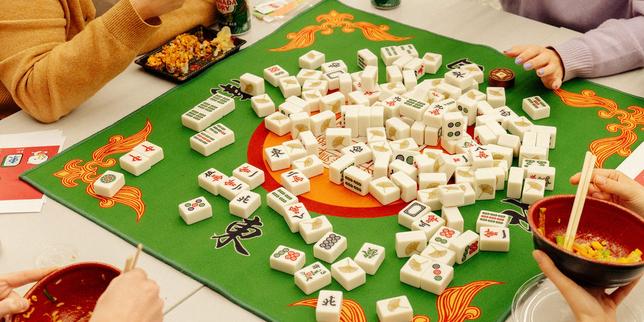
In reality, they are solving a problem that doesn't exist. The classic bone-and-bamboo or high-quality urea resin tiles didn't need a "refresh." They were designed for tactile feedback—the "clack" is part of the mechanics. The "shuffling" of the tiles (the "twittering of the sparrows") is a sensory requirement.
When a brand replaces traditional Chinese characters with "chic" English icons or pastel colors, they aren't making the game more accessible. They are erasing the literacy required to play the actual global game. They are turning a deep cultural artifact into a "shelfie" prop. I have seen collectors spend $400 on a "limited edition" set who couldn't tell you the difference between a Pung and a Chow if their life depended on it.
This is aesthetic gentrification. It takes a practice rooted in immigrant community-building and repackages it as an aspirational luxury good.
Social Connection is a Bad Sales Pitch
The "lazy consensus" argues that mahjong is the antidote to "digital fatigue." The logic goes: we are lonely, we stare at screens, therefore we need tiles.
But mahjong is a terrible game for casual "connection." Unlike poker, where you can bluff and chat, or Catan, where you can negotiate, mahjong—the real version—requires intense, silent calculation. At a high level, you are tracking every discarded tile, calculating probabilities, and reading the "discard rhythm" of three other players.
The "renaissance" isn't about the game's mechanics; it is about the vibe of togetherness. But you can't buy community by purchasing a $300 set and sitting in a room with strangers. The reason mahjong survived in Jewish-American and Chinese-American communities for decades wasn't the tiles. It was the "kibitzing." It was the shared history and the multi-generational transmission of skill.
You cannot manufacture a hundred years of subculture by starting a Slack channel for "Mahjong Lovers."
The Math the Trend-Hoppers Ignore
Let’s look at the actual game theory. Most new players gravitate toward the NMJL (American) style because the "card" tells them what to do. It’s a matching game. It’s linear.
The contrarian truth? If you want the mental benefits these articles claim, you should be playing Riichi Mahjong (the Japanese variant) or Sichuan Bloody Rules.
- Riichi Mahjong: Introduces complex "Yaku" (scoring patterns) and a defensive strategy that makes American Mahjong look like Tic-Tac-Toe. It is a game of risk management and psychological pressure.
- Sichuan Rules: Fast, aggressive, and eliminates the "dead hand" boredom.
The "New Youth" of mahjong isn't touching these variants because they are hard. They require actual study. They don't look as good on Instagram because the tiles are smaller and the focus is on the math, not the mid-century modern table settings.
Stop Calling it a Comeback
Mahjong didn't need saving. In the San Gabriel Valley, in the community centers of South Florida, and in the basements of Manhattan’s Chinatown, the tiles never stopped clicking.
The current hype cycle is a classic example of "Columbus-ing"—the act of "discovering" something that has been vibrant and self-sustaining for decades. The danger of this "renaissance" is that it creates a bubble. When the "aesthetic" of mahjong becomes last year's news, the high-priced startups will pivot to bridge or backgammon, leaving behind a trail of overpriced plastic and half-learned rules.
If you actually care about the game, stop buying the "modern" kits. Go to a Chinatown herb shop, buy a $30 set of heavy green-backed tiles, and find a grandmother who is willing to take your money. Learn the characters. Learn the speed.
Real mahjong isn't a "lifestyle." It is a war of attrition played on a 36-inch square.
Treat it with the respect that a war deserves, or leave the tiles in the box.