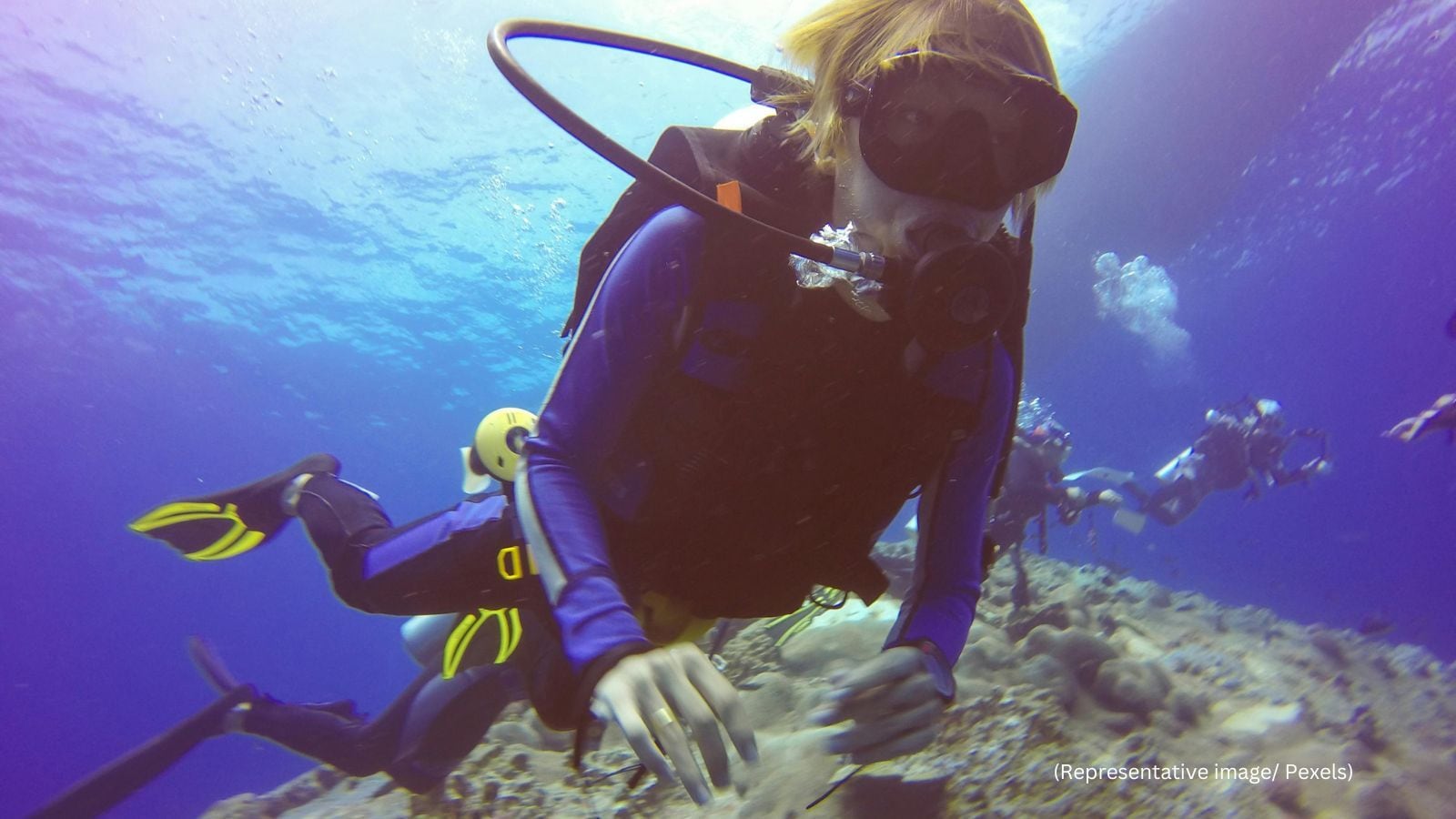
The Indian Ocean holds some of the most spectacular marine life on earth, but a devastating incident in the Maldives serves as a stark reminder that deep-sea exploration carries inherent physical risks. Five Italian tourists lost their lives during a recreational dive trip, sending shockwaves through the global diving community. While local authorities and maritime investigators work to reconstruct the timeline of the tragedy, initial reports heavily suspect oxygen toxicity as the primary cause of the fatalities.
This isn't just a freak accident. It highlights a critical, often misunderstood physiological threshold that every diver must respect. When you breathe compressed air or specialized gas mixes at depth, the physics of pressure changes how these gases interact with your bloodstream. Oxygen, the very element that keeps us alive, transforms into a fast-acting neurotoxin when its partial pressure crosses a specific line.
Understanding what went wrong in the Maldives requires looking past the headlines. It means examining how gas management errors happen, how the body reacts to high-pressure oxygen, and what steps teams must take to prevent a recreational excursion from turning into a recovery operation.
What Happened in the Maldivian Atolls
The group of five Italian nationals was part of a planned deep dive expedition, exploring the steep drop-offs that the Maldives is famous for. Weather conditions were reportedly standard for the season, and the group consisted of certified divers. However, something went catastrophically wrong during their descent or bottom time.
Local coast guard units and rescue vessels recovered the divers after they failed to surface at their designated time. Emergency medical technicians pronounced all five dead at the scene. Early briefings from the local medical examiners indicated no signs of external trauma, equipment destruction from mechanical impact, or predator attacks. Instead, the physiological markers pointed directly to acute central nervous system (CNS) oxygen toxicity.
Investigating a multi-diver fatality is incredibly complex. When a single diver experiences an issue, it's often an isolated health event or a specific gear failure. When five divers perish simultaneously, investigators immediately scrutinize the gas supply, the dive profiles, and the depth limits.
The investigation currently focuses on two main theories. The first is a blending error, where the cylinders were filled with an incorrect ratio of oxygen to nitrogen. The second is a severe depth violation, where the team dove far deeper than the safe operating limit of their gas mixture.
The Chemistry of Breath at Depth
To understand why oxygen turns deadly, you have to look at Dalton’s Law of Partial Pressures. Air is roughly 21% oxygen and 79% nitrogen. At sea level, you breathe oxygen at a partial pressure ($P_{O_2}$) of 0.21 atmospheres (atm).
As you descend into the ocean, hydrostatic pressure increases by one atmosphere for every 10 meters (33 feet) of depth.
$$\text{Total Pressure at Depth} = 1 + \frac{\text{Depth in Meters}}{10}$$
At 30 meters, the total ambient pressure is 4 atm. If you are breathing standard air, the partial pressure of the oxygen you inhale multiplies.
$$P_{O_2} = 4 \text{ atm} \times 0.21 = 0.84 \text{ atm}$$
This is perfectly safe. The human body manages this easily.
The danger zone begins when the $P_{O_2}$ hits 1.4 atm for recreational diving, or a maximum absolute ceiling of 1.6 atm for technical diving. If you use Enriched Air Nitrox—a gas blend favored by divers to extend their bottom times by increasing the oxygen percentage to 32% or 36%—you reach that danger limit much faster.
For example, using Nitrox 36 at a depth of 35 meters pushes your $P_{O_2}$ to 1.62 atm. Cross that line, and you are playing Russian roulette with your central nervous system.
How Oxygen Toxicity Claims a Diver
CNS oxygen toxicity is terrifying because it often strikes without warning. The condition causes an immediate, grand mal seizure. Under version-specific conditions, high concentrations of oxygen block the normal metabolic pathways in the brain, causing hyper-excitability and massive electrical discharges.
On land, a seizure is a medical emergency. Underwater, it's almost universally fatal.
When a diver convulses, their regulator slips from their mouth. They lose consciousness instantly. The body’s reflexive response during a seizure is to take a deep breath. This causes the diver to inhale water, leading to immediate drowning.
Even if their dive buddy is right next to them, rescuing a convulsing diver at depth is incredibly difficult. Forcing a regulator back into a clenched, seizing jaw is nearly impossible. Attempting to bring a seizing diver to the surface too quickly causes pulmonary barotrauma—rupturing the lungs due to expanding air.
Signs sometimes appear before a full seizure happens, though you can't rely on them. Divers use the acronym CONVENTID to remember the warning signs:
- Convulsions (the final stage)
- Visual disturbances (tunnel vision)
- Ear ringing or buzzing sounds
- Nausea or sudden vomiting
- Twitching, usually in the facial muscles or lips
- Irritability or sudden anxiety
- Dizziness and disorientation
If any of these symptoms manifest, the diver must ascend immediately to reduce the partial pressure of oxygen. In the Maldives tragedy, the fact that none of the five divers managed to initiate a controlled ascent suggests the onset was rapid, simultaneous, or occurred at a depth where recovery was impossible.
Evaluating Gas Blending and Human Error
Why did five experienced people succumb to this condition at the same time? It usually comes down to either contaminated or mislabeled gas cylinders.
Many dive operations in remote destinations offer Nitrox to allow tourists more time underwater with the abundant marine life. Nitrox requires precise blending. If a dive shop mistakenly fills tanks with 50% oxygen instead of 32%, and fails to analyze the tank properly before the dive, the consequences are lethal.
A tank filled with 50% oxygen reaches a deadly $P_{O_2}$ of 1.5 atm at just 20 meters (66 feet). A diver expecting to safely cruise at 30 meters would unknowingly cross deep into toxicity territory within minutes.
The standard safety protocol in scuba diving is non-negotiable: The diver must personally analyze the oxygen content of their tank using an oxygen analyzer before every single dive. They must then write the oxygen percentage, the maximum operating depth (MOD), and their initials on a piece of tape affixed to the cylinder.
If a guide or an entire group skips this protocol, relying entirely on the dive center's word, a single blending mistake can wipe out the entire team.
Another possibility is a phenomenon known as "follow-the-leader" syndrome. In strong currents, or when chasing pelagic marine life like sharks or manta rays, a dive guide might inadvertently drop past the planned depth limit. The group follows, eyes locked on the target, ignoring their dive computers until the physiological limit is breached.
Vital Survival Protocols for Deep Excursions
Safety in deep water isn't about luck. It's about strict adherence to physical laws. To avoid the traps that led to the Maldives disaster, your diving habits must be ironclad.
First, analyze every tank yourself. Never breathe from a cylinder unless you personally witnessed the analyzer reading. If a dive operation refuses to let you analyze your gas, walk away from the boat.
Second, know your Maximum Operating Depth and stick to it. Set a conservative depth alarm on your dive computer. If your gas mix dictates a hard ceiling of 33 meters, set your alarm for 30 meters to give yourself a buffer zone.
Third, maintain absolute awareness of your physical state. If you feel a sudden lip twitch, a wave of nausea, or weird tunnel vision, do not pause to think about it. Signal your buddy and start a controlled, safe ascent to a shallower depth. Bringing yourself up even five meters drastically lowers the partial pressure of oxygen, stopping the onset of CNS toxicity.
Finally, dive your own profile. Do not blindly follow a guide or a buddy who is dropping into deep water. Your computer, your gas mix, and your life are your individual responsibility. If the group passes the safe boundary of your gas mix, abort the dive and ascend alone or with your designated buddy. The ocean doesn't forgive complacency.