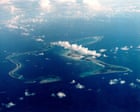
The map in Whitehall smells faintly of tea and old linen, but its borders bleed into the Atlantic. For decades, the Chagos Archipelago has sat quietly on that map—a handful of emerald dots scattered across a vast, indifferent ocean. To most, the islands are a ghost story of exile and coral. To strategists, they are something far sharper. They are the anchor of Diego Garcia, a sprawling military footprint where bombers sleep in reinforced concrete and the pulse of global surveillance beats day and night.
Now, that map is fraying at the edges.
British officials sit behind closed doors in tall, silent rooms, running calculations over and over. They change the variables, shift the numbers, test the weight of incoming tides. Every time they finish, the answer remains identical. There is no translation. There is no linguistic bridge wide enough to carry the old agreements across a new political canyon. The deal struck to hand sovereignty of the islands to Mauritius while retaining the base cannot be rewritten, stretched, or reshaped to fit the silhouette of a returning American presidency.
It simply does not fit.
Consider what happens when an immovable object meets a administration that views every international arrangement through the lens of a balance sheet or a personal challenge. For months, British diplomats tried to construct a diplomatic chassis that could weather any storm in Washington. They built drafts. They sought assurances. They whispered about continuity.
They forgot that the incoming tenants do not care about the architecture of the past.
To understand why this is causing white-knuckled panic in the corridors of power, you have to look past the ink on the paper and see the geography of the Indian Ocean as a chessboard. Diego Garcia is not just a base. It is the invisible hinge of American power projection across the Middle East and South Asia. It is where ships refuel, where intelligence gathers, where the calculus of deterrence is maintained without asking permission from local neighbors.
When London agreed to hand sovereignty of the Chagos Islands to Mauritius—a hard-fought compromise designed to settle a stubborn decolonization dispute at the International Court of Justice—it came with a vital caveat: the military base would remain operational under a long-term lease. To the foreign office team that engineered it, the arrangement was a masterclass in modern pragmatism. It satisfied international law. It kept the Americans happy. It ticked every bureaucratic box.
Then the political winds shifted across the Atlantic.
Suddenly, the people coming into power in Washington do not view international courts with respect; they view them with active suspicion. They do not see a clever compromise over colonial leftovers. They see a voluntary surrender of strategic territory. They see risk where London saw resolution.
British officials working on the file have spent the past several weeks testing every possible permutation. Can we add a clause? Can we sweeten the terms? Can we frame the lease in a way that sounds transactional enough, muscular enough, nationalist enough to satisfy an incoming administration that demands absolute dominance?
The verdict from the working groups is unanimous. No.
You cannot adapt an arrangement born of multilateral consensus to a philosophy that rejects multilateralism entirely. The terminology itself is toxic to the new guard. To them, ceding sovereignty of the land beneath a critical base—even while leasing the base back—is a sign of weakness. It is an invitation for adversaries like China to step into the vacuum, regardless of what Mauritius promises or what legal safeguards are written into the treaty.
The diplomats are trapped between two irreconcilable realities. On one side lies the moral and legal imperative of a post-colonial world, where ignoring international rulings on sovereignty is no longer tenable for a nation that claims to champion the rules-based international order. On the other side lies the brutal, transactional reality of an American ally that holds a veto over British strategic security.
If Britain walks away from the deal with Mauritius, it faces international humiliation, a breach of faith with African allies, and a glaring admission that its foreign policy is little more than an echo of Washington's whims. If Britain pushes ahead with the deal, it risks fracturing its most vital security partnership, alienating an incoming U.S. president who views the handover as a strategic blunder, and potentially casting the future of Diego Garcia into a legal and operational limbo.
There is no middle ground left. The space where diplomacy used to happen has narrowed to a razor's edge.
In rooms overlooking the Thames, coffee cups go cold. Memos are rewritten. Red lines are drawn, erased, and redrawn in frustration. The officials know that time is running out. The treaty cannot be customized. It cannot be painted over to look like an America First victory.
It is what it is: a collision between an old world trying to clean up its historical mess and a new world that refuses to inherit anything it didn't conquer itself. And as the maps are rolled up for the evening, the silence in the room is heavy with the realization that some bridges cannot be built because the chasms are simply too wide.