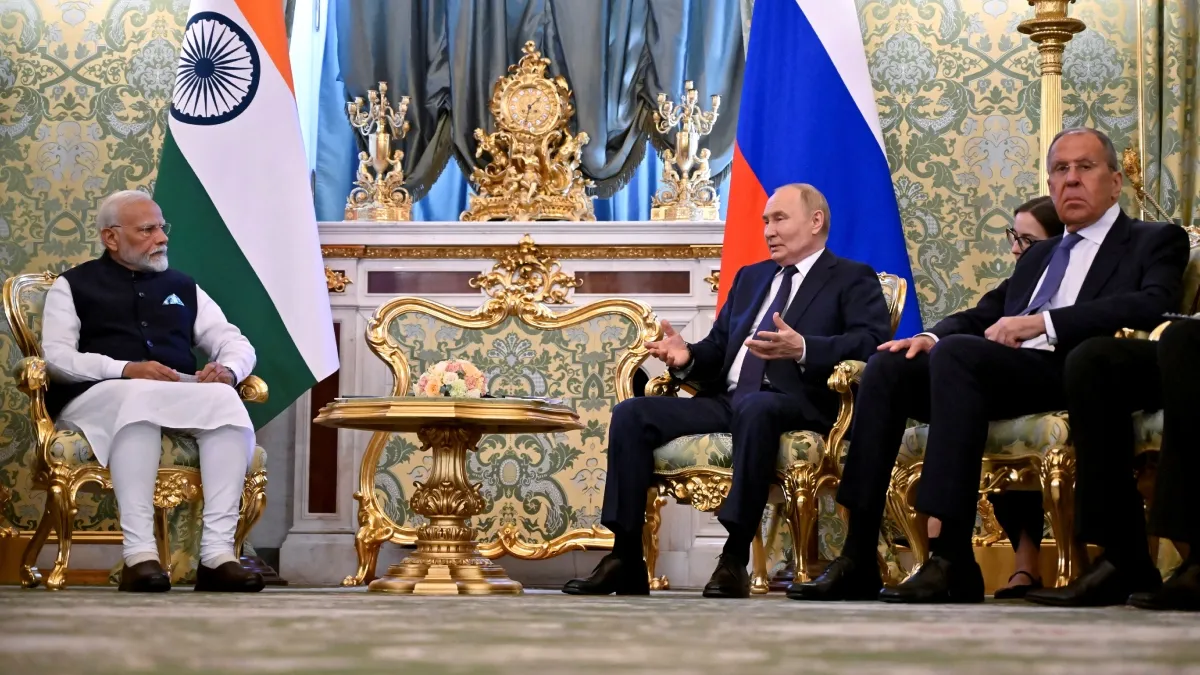
The air in New Delhi during a diplomatic summit doesn’t smell like incense or street food. It smells like ozone and high-grade floor wax. Inside the corridors of power, the silence is heavy, broken only by the rhythmic click of dress shoes on polished marble. When External Affairs Minister S. Jaishankar meets with Thailand’s Deputy Prime Minister Sihasak Phuangketkeow, the cameras capture a flash of smiles and a firm grip between two men in dark suits. To the casual observer scrolling through a news feed, it looks like just another entry in a never-ending ledger of international bureaucracy.
But look closer. Recently making headlines in this space: The LAC Friction Points Calculus and the Mechanics of Sino-Indian Strategic Stabilization.
Diplomacy is often viewed as a game of chess played by giants, yet its true impact is felt by the smallest players in the economy. It’s felt by the freighter captain navigating the Andaman Sea, the tech graduate in Bengaluru looking for a regional opening, and the family in Bangkok waiting for a shipment of affordable pharmaceuticals. This meeting wasn't just a polite exchange of pleasantries. It was a recalibration of the pulse that connects two of Asia’s most vital hearts.
The Ghost of the Monsoon
To understand why India and Thailand are leaning into each other now, we have to look at the geography that binds them. They are neighbors who share no land border, yet they are tethered by an ocean that has dictated their fortunes for two thousand years. Additional insights into this topic are covered by The New York Times.
Imagine a merchant named Arjun. He is a hypothetical composite of the thousands of traders who have crossed these waters since the days of the Chola Empire. In the past, Arjun waited for the monsoon winds to carry his spices to the shores of Siam. Today, the "monsoon" is the shifting wind of global trade routes and the sudden, violent disruptions of supply chains. When the Suez Canal blocks or the Northern routes freeze over, the Indo-Pacific becomes the world’s most critical artery.
Jaishankar and Phuangketkeow aren't just talking about "cooperation." They are building a digital and physical bridge to ensure that when the next global shockwave hits, the flow of goods between New Delhi and Bangkok doesn’t stutter. They discussed the India-Myanmar-Thailand Trilateral Highway—a ribbon of asphalt that aims to do what the monsoon winds once did: connect the Bay of Bengal to the heart of Southeast Asia.
The Invisible Stakes of a Signature
We often think of national security as tanks and silver jets. In the modern era, security is much quieter. It is the security of having enough semiconductors to keep a factory running. It is the security of ensuring that a young professional in Phuket can use a unified payment interface to buy a coffee using an Indian banking app.
During their talks, the two leaders leaned heavily into the "Act East" policy. It’s a phrase that sounds like a dry academic chapter, but its reality is visceral. For India, "Acting East" means acknowledging that its future isn't just in the West or across its northern borders. It is rooted in the deep, humid markets of ASEAN.
Thailand serves as the gateway.
When Jaishankar pushes for increased maritime cooperation, he isn't just thinking about naval patrols. He is thinking about the safety of the undersea cables that carry your Zoom calls and the protection of the shipping lanes that keep the price of fuel from doubling overnight. If the Andaman Sea becomes a theater of friction, every household in the region pays the price in inflation and uncertainty.
The stakes are personal.
The Cultural Mirror
There is a specific kind of recognition that happens when an Indian traveler lands in Bangkok. They see the Garuda on government buildings—the same mythical bird that occupies Indian lore. They hear echoes of Sanskrit in Thai names. This isn't coincidence; it’s a shared DNA.
In their meeting, the leaders didn't ignore this. They spoke of "people-to-people ties." Again, the terminology is sterile, but the reality is a vibrant, chaotic human exchange. It’s about the easing of visas so that a wedding party from Delhi can celebrate on a beach in Krabi. It’s about the Thai student who chooses to study Buddhist philosophy in Nalanda.
These interactions create a layer of "soft power" that no treaty can replicate. When people move freely, ideas move faster. When ideas move, innovation follows. By streamlining how their citizens interact, Jaishankar and Phuangketkeow are essentially upgrading the operating system of their shared history.
The Friction of the Real World
It would be dishonest to suggest that these meetings are all harmony and light. The world is a jagged place. There are overlapping claims, trade imbalances, and the looming shadow of larger superpowers trying to pull smaller nations into their respective orbits.
India and Thailand are navigating a narrow middle path. They are attempting to build a "Multiparity Asia"—a continent where no single power dictates the terms of existence for everyone else. This requires a delicate dance. It requires India to be a reliable provider of security and trade, and it requires Thailand to balance its deep-rooted ties with other regional giants while embracing India’s rising influence.
The conversation in New Delhi touched on the Bay of Bengal Initiative for Multi-Sectoral Technical and Economic Cooperation (BIMSTEC). It’s an alphabet soup of an acronym, but it represents a desperate, necessary attempt to make the Bay of Bengal as integrated as the Mediterranean once was.
http://googleusercontent.com/image_content/273
The Dinner Table Test
How do we measure if these high-level talks actually work?
We don’t look at the joint statements. We look at the dinner table.
If, two years from now, a small business owner in Chiang Mai can source high-quality Indian textiles as easily as if they were from the next province over, the talks were a success. If an Indian farmer can see his produce on the shelves of a grocery store in Nonthaburi without it being stuck in a port for three weeks, Jaishankar and Phuangketkeow have done their jobs.
The meeting ended as all such meetings do: with a final handshake and the departure of motorcades. The wax on the floors was buffed again, erasing the footprints of the delegates. But the ripples of those conversations are moving outward. They are moving through the shipping offices in Mumbai and the tech hubs in Chonburi.
They are moving toward a future where the map of Asia isn't defined by the borders that divide it, but by the roads and digital signals that make those borders irrelevant.
In a world that feels increasingly fragmented, two leaders sat in a room and decided that being apart was too expensive a luxury to afford. They chose the slow, difficult work of building a bridge over the easy path of building a wall. The wind is shifting again in the Indo-Pacific, and this time, the sails are being set together.