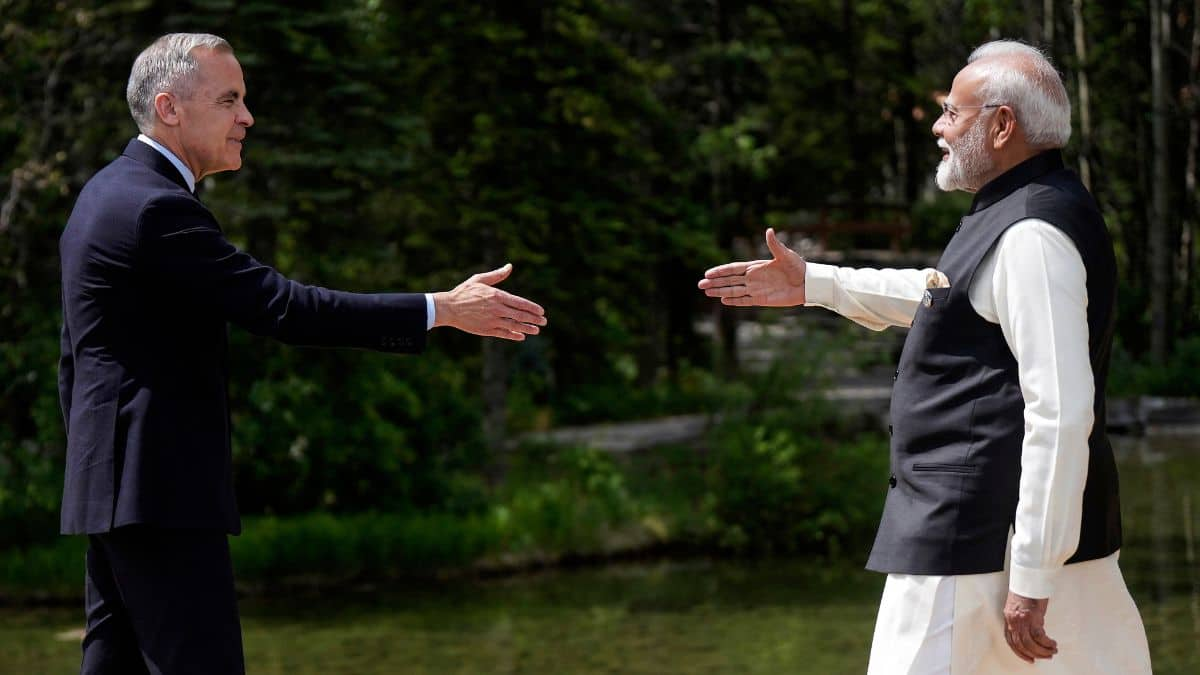
Canadian Prime Minister Mark Carney arrived in Mumbai this week not as a progressive missionary, but as a pragmatic banker looking to diversify a portfolio that has become dangerously over-leveraged toward the United States. His first official visit to India marks the burial of a three-year diplomatic winter, signaling that Ottawa has finally traded its moralizing foreign policy for a cold, hard look at the balance sheets. The mission is clear: repair a fractured relationship to secure critical minerals, energy corridors, and a comprehensive trade deal that his predecessor, Justin Trudeau, effectively set on fire.
For years, the Canada-India relationship was defined by a specific brand of diplomatic friction. The 2023 assassination of Hardeep Singh Nijjar and the subsequent allegations of Indian government involvement brought ties to a point where "rock bottom" seemed optimistic. But as Carney sits down with Prime Minister Narendra Modi in New Delhi, the air has changed. The Canadian government recently signaled that it no longer believes Indian-linked violent activity is continuing on its soil. It is a strategic pivot—a clearing of the deck intended to let the business of statecraft resume without the baggage of diaspora politics.
The Banker Diplomacy
Mark Carney is the first Canadian leader to approach the Indo-Pacific through the lens of a central banker. Having steered both the Bank of Canada and the Bank of England through global crises, he views the world as a series of risks to be managed and assets to be optimized. To Carney, the current state of trade is a market failure.
Currently, two-way trade sits at approximately $31 billion. In the eyes of a technocrat, that number is an insult to the potential of two G20 economies. Carney’s stated goal is to sign a Comprehensive Economic Partnership Agreement (CEPA) by the end of 2026, with an aim to double bilateral trade to $70 billion by 2030.
Unlike the 2018 Trudeau visit—remembered largely for an excessive wardrobe of traditional attire—Carney’s itinerary is stripped of cultural performance. He is skipping Punjab entirely, a move that would have been unthinkable for a Liberal leader in the past. By avoiding the heartland of the Sikh diaspora, Carney is sending a blunt message to New Delhi: Canada is ready to prioritize sovereign interests over internal constituency pressures.
Securing the Middle Power
The visit is part of a broader "Middle Power" strategy that Carney has been road-testing from Davos to Alberta. He argues that the old rules-based order is dead, replaced by a "brutal reality" of great-power rivalry between the U.S. and China. In this environment, a country like Canada cannot afford to be a satellite of Washington, especially as American trade protectionism reaches a fever pitch.
India represents the ultimate hedge. It is the world’s fastest-growing major economy and a primary source of the "human capital" Carney needs to fuel his domestic growth plans. But the interest is mutual. India is hungry for:
- Critical Minerals: Canada possesses the lithium, potash, and uranium necessary for India’s green transition.
- Institutional Capital: Canadian pension funds, some of the largest in the world, already have over $100 billion invested in Indian infrastructure and renewable energy.
- Energy Security: With the global energy market in flux, Canada’s LNG and nuclear expertise are prime bargaining chips.
The Elephant in the Room
The thaw is not without its critics. Domestically, Carney is walking a razor-thin line. Human rights organizations and certain segments of the Indo-Canadian community view this "pragmatic" turn as a betrayal. They argue that by softening the stance on foreign interference, Ottawa is effectively giving a pass to extrajudicial actions in exchange for market access.
Carney’s counter-argument, though rarely stated so undiplomatically, is that isolation has achieved nothing. The standoff didn't make Canadians safer; it only made Canada poorer and less influential. By re-appointing High Commissioners and resuming security channel communications, Carney is betting that engagement provides more leverage than an empty chair at the table.
A Transactional Peace
This is not a "return to normal" because the old normal was built on a foundation of mutual suspicion. This is the birth of a transactional era. The talk in Hyderabad House won't be about shared values or the "tapestry" of multiculturalism. It will be about the One Canadian Economy Act, interprovincial trade barriers, and how to get Canadian pulses and potash into Indian ports faster.
The "Carney Doctrine" suggests that Canada must build its own strength at home to be taken seriously abroad. He has already moved to double defense spending and remove federal carbon taxes that he deemed a drag on industrial competitiveness. In Modi, he finds a counterpart who speaks the same language of national interest and infrastructure-led growth.
The success of this trip won't be measured in communiqués or photo ops. It will be measured in whether a Canadian mining executive can sign a deal in Karnataka without being stalled by a diplomatic spat in Ottawa. It is a high-stakes gamble on the idea that in a fractured world, the only thing stronger than ideology is a mutually beneficial balance sheet.
The era of Canada as the world’s moral arbiter has ended, replaced by a leader who knows that in the global market, you are either a player or a price-taker. Carney has chosen to play.