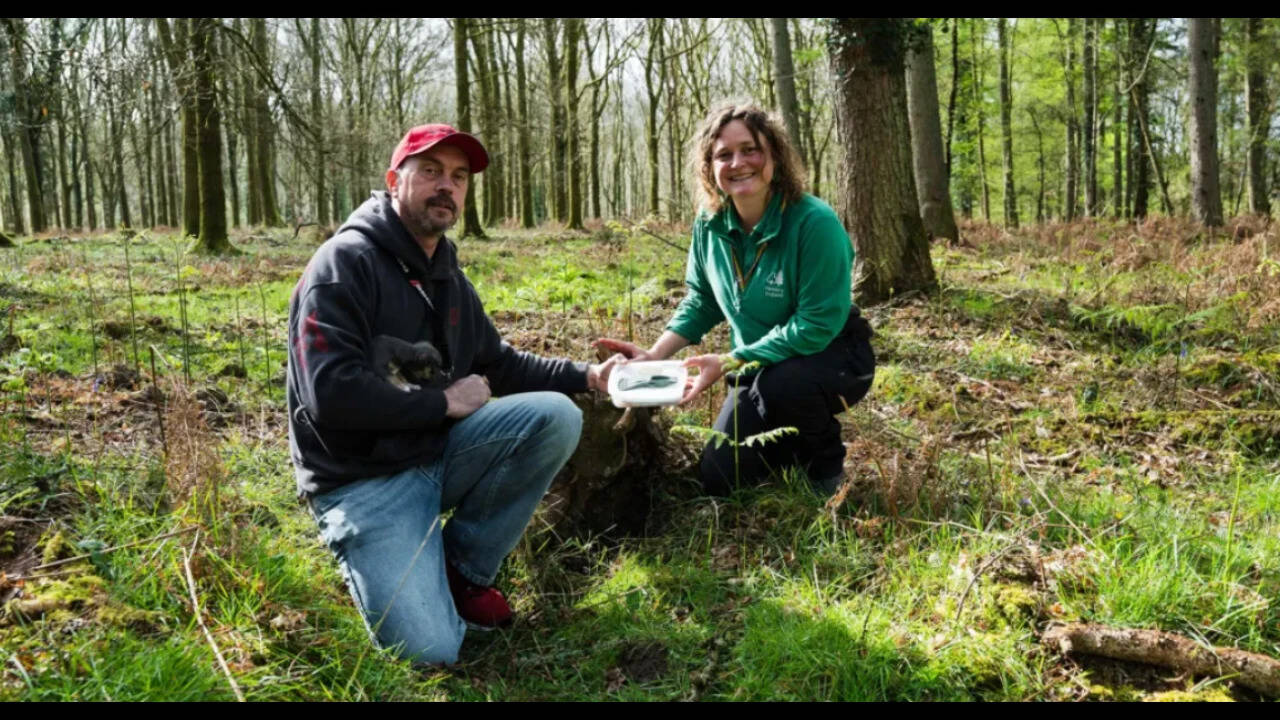
The recovery of a 146-millimeter copper alloy artifact from the root plate of a fallen tree in the Forest of Dean exposes the structural limitations of modern archaeological sampling methodologies. When a pedestrian and a domestic animal recover a Middle Bronze Age palstave axe dated between 1400 B.C.E. and 1275 B.C.E. during a casual walk, the event serves as a stress test for how institutional science locates material culture. Systematic archaeological surveys rely on predictive modeling, shovel test pits, and aerial remote sensing. Yet, random stochastic discovery by non-specialists consistently bypasses the blind spots inherent in institutional resource allocation.
The Metallurgy and Mechanics of the Palstave Design
The recovered object is not a monolithic metal wedge but a complex engineering solution to handle stress distribution. Manufactured during a period when British metallurgy transitioned from primitive flat axes to flanged and stopped variants, the palstave represents an evolutionary leap in kinetic efficiency.
- Alloy Composition: The object consists of copper combined with approximately 10 percent tin. This precise ratio optimizes the Brinell hardness of the casting while maintaining sufficient tensile strength to absorb shock without fracturing upon impact.
- Hafting Architecture: The palstave design incorporates raised flanges and a stop-ridge. This geometry solved a primary mechanical failure point in early metal tools: the tendency of the axe head to slide backward down the wooden haft under heavy compression.
- Casting Sophistication: Production required two-part molds, demanding advanced thermal control, crucibles capable of sustaining temperatures exceeding 1000 degrees Celsius, and specialized knowledge of gate-and-runner systems to eliminate gas porosity in the molten bronze.
The blunt cutting edge, measuring approximately 3 millimeters in thickness, indicates either secondary wear, manufacturing truncation, or specialized functional repurposing. Rather than viewing the tool as a generic instrument for felling timber, operational analysis suggests it functioned as a multi-use resource for woodworking, butchery, and structural clearing, or alternatively as a portable store of liquid capital and social signaling.
The Taphonomy of Random Recovery
Why do high-value metallic artifacts routinely surface via sheer statistical luck rather than targeted excavation? The answer lies in taphonomic processes—the study of how organisms and natural elements decay, preserve, or affect artifacts in the earth.
Forest floors in ancient English woodlands undergo continuous biological and mechanical churning. Tree growth, root plate displacement during windthrow events, and burrowing fauna act as natural excavation engines. In this specific case, root upheaval broke the soil matrix, exposing the distinctive green copper carbonate patina—malachite—to ambient light.
Institutional archaeology cannot economically dig up millions of hectares of forested terrain centimeter by centimeter. Consequently, the discovery pipeline depends heavily on serendipity combined with public reporting infrastructure managed by agencies like Forestry England and contracted entities such as Cotswold Archaeology.
Deposit Typologies: Loss Versus Intentional Concealment
Determining why a high-status bronze artifact was left in an ancient woodland requires evaluating three distinct behavioral hypotheses.
- Accidental Loss: The tool slipped from a worker's harness or bag during transit through the dense canopy of the prehistoric landscape. Given the weight of the object, loss during active labor is plausible but complicated by the value of the material. Bronze was a scarce, recycled commodity; losing an entire palstave represented a significant economic deficit for a Bronze Age household.
- Ritual Deposition: Many Middle Bronze Age metal objects are recovered from non-settlement contexts, including wetlands, forests, and boundaries. Deliberate votive offerings to chthonic deities or territorial markers often involved placing pristine or intentionally blunted tools in isolated environments.
- Cache Sealing: Prehistoric metalsmiths or traders frequently cached inventories for safe storage, intending retrieval that never occurred due to demographic disruption or individual mortality.
The physical context—wedged deep within tree roots—tilts the probability distribution toward natural displacement of an object originally dropped, cached, or incorporated into a shallow ritual deposit centuries prior. Because the immediate stratigraphic layers were disturbed by root growth before formal recording, the exact depositional event remains unrecoverable, underscoring the permanent data loss that occurs when context is decoupled from an artifact prior to professional extraction.
The Conservation Bottleneck
Once an ancient copper alloy object transitions from an anaerobic subterranean environment to an aerobic, high-humidity display case, chemical stability is immediately threatened. Copper alloys buried in acidic forest soils develop a stable patina, but sudden shifts in atmospheric oxygen and moisture can trigger bronze disease—a cyclic chemical corrosion driven by cuprous chloride interaction.
The institutional response requires a precise triage protocol.
- Non-destructive surface analysis and three-dimensional digital modeling via virtual museum archives to capture micro-topographical data without physical degradation.
- Controlled dehydration and stabilization treatment at specialized facilities like the Dean Heritage Centre to halt active oxidation.
- Public curation paired with spatial metadata logging to ensure the exact geographic coordinates of the root plate are permanently mapped against known regional Bronze Age monuments, such as nearby ring cairns.
Integrate public reporting incentives directly into forestry management frameworks to convert casual land users into an active, distributed archaeological sensor network, while simultaneously deploying automated soil-disturbance monitoring in high-probability prehistoric zones.