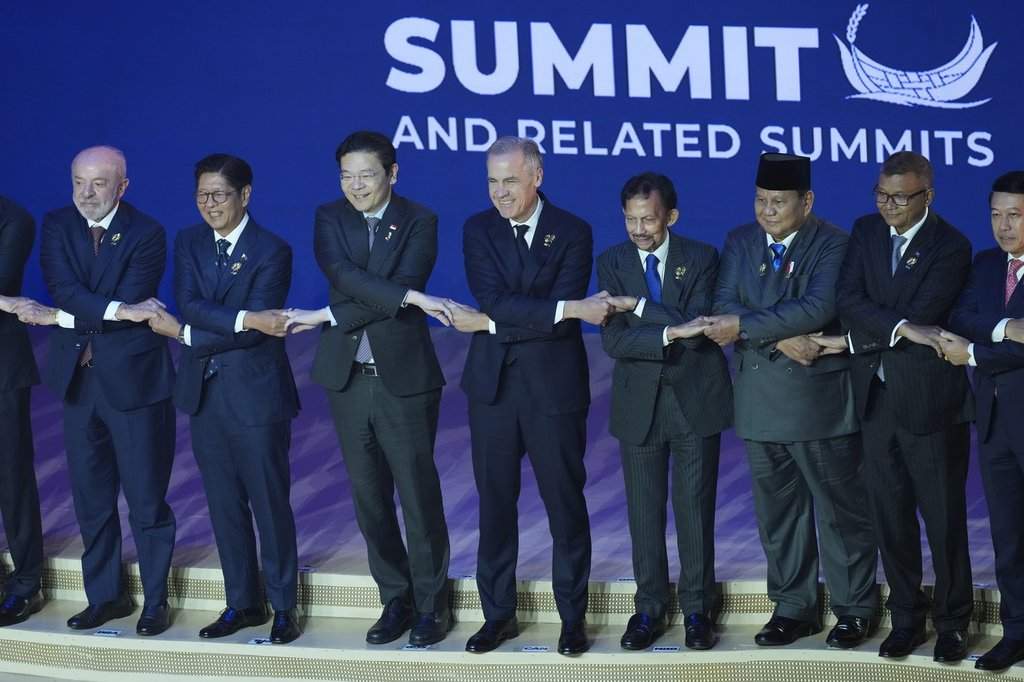
The Association of Southeast Asian Nations (ASEAN) operates under a strict institutional constraint known as the consensus-and-non-interference doctrine, yet its continued exclusion of Myanmar’s military junta from high-level summits exposes a calculated shift toward diplomatic quarantine. By repeatedly denouncing state-sponsored violence while extending the political ban on Senior General Min Aung Hlaing and his cabinet, Southeast Asian leaders are executing a low-cost, high-friction containment strategy designed to protect regional legitimacy without triggering bloc fragmentation.
Standard geopolitical reporting treats these summit communiqués as repetitive diplomatic theater. That interpretation misses the underlying structural mechanics. When a regional organization lacks a centralized enforcement apparatus, economic sanctioning power, or a collective security mandate, diplomatic status becomes its primary coercive currency. Understanding the Myanmar crisis requires dissecting how ASEAN converts symbolic exclusion into institutional leverage, why the Five-Point Consensus remains deadlocked, and where the operational limits of this containment model lie.
The Institutional Trilemma of Regional Diplomacy
To evaluate ASEAN’s posture toward Naypyidaw, one must first map the three competing pressures that govern every summit decision. Regional policymakers are attempting to balance three incompatible objectives simultaneously:
- Preserving Institutional Credibility: Major external trading partners—specifically the United States, the European Union, Japan, and Australia—condition high-level engagement and trade architecture on ASEAN demonstrating basic governance standards. Allowing a military regime that overthrew an elected government and actively bombs civilian infrastructure to chair or attend summits destroys the bloc's diplomatic standing.
- Preventing Bloc Fragmentation: ASEAN requires unanimous agreement for formal policy shifts. Member states hold divergent strategic interests regarding Myanmar. Maritime states like Indonesia, Malaysia, and Singapore favor hardline diplomatic isolation to protect the bloc's international brand. Mainland states like Thailand, Laos, and Cambodia prioritize border stability, refugee containment, and cross-border trade, making them structurally resistant to total severing of ties.
- Avoiding Precedent for Internal Interference: Every ASEAN member state guards its domestic sovereignty fiercely. Establishing a mechanism to expel a member or intervene directly in domestic governance creates a precedent that authoritarian and semi-authoritarian governments within the bloc refuse to accept.
Extending the ban on Myanmar's political leadership is the sole equilibrium point that satisfies all three constraints. By restricting Myanmar to "non-political representation"—inviting a civil servant rather than a junta minister—ASEAN avoids formal expulsion while denying the State Administration Council (SAC) the international recognition it desperately seeks.
Deconstructing the Five-Point Consensus Bottleneck
The core operational framework governing ASEAN’s response is the Five-Point Consensus, drafted in April 2021. The framework demands an immediate cessation of violence, constructive dialogue among all parties, mediation by an ASEAN special envoy, humanitarian assistance delivery, and a visit by the envoy to meet all stakeholders.
More than five years after its inception, implementation remains near zero. This failure is not accidental; it is the result of a fundamental misalignment of incentives between the bloc and the military junta.
- Asymmetric Cost Functions: For ASEAN, prolonged conflict in Myanmar imposes negative externalities—refugee flows, transnational crime syndicates, scam compounds, and reputational drag. For the SAC, complying with the Five-Point Consensus imposes an existential cost. Engaging in inclusive dialogue with the National Unity Government (NUG) and Ethnic Armed Organizations (EAOs) requires the military to surrender its monopoly on state power, which directly threatens the physical survival and economic assets of its senior officer corps.
- The Sequencing Trap: The consensus framework assumes that a ceasefire precedes political negotiation. On the ground, the kinetic reality operates in reverse. Resistance forces and EAOs have captured significant border territories, shifting the military balance against Naypyidaw. Neither the junta nor the opposition will halt offensive operations while territorial control remains fluid.
- The Special Envoy Deficit: Rotating the ASEAN chairmanship annually resets the special envoy role every twelve months. A single year is insufficient to build back-channel trust, map shifting battlefield alliances, or establish durable humanitarian corridors. Before an envoy masters the operational terrain, the mandate transfers to a successor with different national priorities.
The Architecture of Diplomatic Quarantine
Because ASEAN cannot force compliance inside Myanmar, it has pivoted to manipulating the external environment around the regime. This strategy relies on three distinct operational mechanisms.
Denial of Sovereign Legitimacy
Military juntas rely heavily on external validation to stabilize domestic rule, secure sovereign credit, and finalize bilateral arms and infrastructure deals. By barring Min Aung Hlaing from the ASEAN Summit and related East Asia Summit meetings, regional leaders strip the SAC of its primary venue for international normalization. The empty chair at summit tables serves as a continuous signal to global financial institutions and foreign ministries that Naypyidaw remains a pariah administration.
Decoupling Humanitarian Aid from State Control
Standard international aid models route resources through the host government's ministries. In Myanmar, doing so allows the military to weaponize food and medical supplies, directing aid to loyalist enclaves while starving resistance-held territories. ASEAN’s recent operational adjustments focus on utilizing the AHA Centre (ASEAN Coordinating Centre for Humanitarian Assistance on disaster management) alongside cross-border mechanisms to deliver aid without granting the junta distribution control. This remains heavily contested, as the SAC routinely blocks transit permits for international observers.
Strategic Hedging by Neighboring States
While the formal ASEAN communiqué projects unified condemnation, bilateral execution varies sharply based on geography. Thailand, sharing a 2,400-kilometer border with Myanmar, cannot afford total diplomatic severance. Bangkok must manage trade flows, energy imports (natural gas from Myanmar powers significant portions of western Thailand), and sudden surges of displaced persons. Consequently, Thailand frequently runs parallel, informal diplomatic tracks with Naypyidaw while publicly endorsing the ASEAN summit ban. This dual-track reality is not hypocrisy; it is geographic necessity.
Operational Blind Spots and Strategic Limitations
A rigorous assessment requires identifying where ASEAN’s current strategy fails to alter ground realities. Diplomatic isolation has clear structural ceilings.
First, the ban does not degrade kinetic capacity. Exclusion from diplomatic summits in Jakarta, Vientiane, or Kuala Lumpur does not stop the Myanmar Air Force from conducting airstrikes. The junta sources fuel, spare parts, and munitions through bilateral channels—primarily Russia, China, and state-linked intermediaries—that operate entirely outside ASEAN’s jurisdiction.
Second, informal economies insulate the regime. Western financial sanctions and ASEAN diplomatic isolation push Myanmar's economy deeper into illicit and informal networks. Online scam centers, illegal rare-earth mining, and narcotics production along the Mekong sub-region generate substantial off-ledger revenue streams that bypass formal banking scrutiny, reducing the junta's sensitivity to macroeconomic pressure.
Third, China’s parallel diplomacy supersedes ASEAN centrality. Beijing views Myanmar through the lens of its China-Myanmar Economic Corridor (CMEC), which provides vital overland access to the Indian Ocean. When conflict near the Yunnan border threatened Chinese infrastructure and empowered cross-border cyber-scam syndicates targeting Chinese citizens, Beijing intervened directly—brokering temporary ceasefires between the junta and northern EAOs like the Three Brotherhood Alliance. This demonstrated that hard power and economic leverage held by a single neighbor outweigh the collective diplomatic statements of a ten-member regional bloc.
Tactical Realignment for Regional Policymakers
Continuing to extend the summit ban without modifying the underlying operational toolkit will yield diminishing returns. To transition from passive containment to active conflict management, regional diplomats and external partners must execute four specific adjustments:
- Institutionalize a Permanent Special Envoy Office: Abandon the annual rotation of the Myanmar envoy. Establish a multi-year mandate staffed by dedicated technical experts in ceasefire monitoring, border security, and humanitarian logistics to eliminate the annual loss of institutional memory.
- Formalize Quiet Engagement with Non-State Actors: ASEAN diplomats must expand structured, off-the-record channels with the National Unity Government and major Ethnic Armed Organizations. Because these groups now administer vast swathes of Myanmar’s borderlands, any humanitarian corridor or transnational crime crackdown negotiated solely with Naypyidaw is operationally obsolete.
- Target Transnational Criminal Infrastructure: Shift regional security cooperation toward dismantling the scam compounds and illicit financial networks operating in Myanmar’s border zones. Framing the crisis around regional cyber-fraud and human trafficking—issues that directly harm citizens across all ASEAN states—creates a shared security interest that overrides traditional non-interference objections.
- Synchronize Border Management Protocols: Establish a coordinated framework among Myanmar's immediate neighbors—Thailand, Laos, India, and China—to standardize refugee protection, cross-border aid delivery, and border security, preventing the junta from playing neighboring capitals against one another.