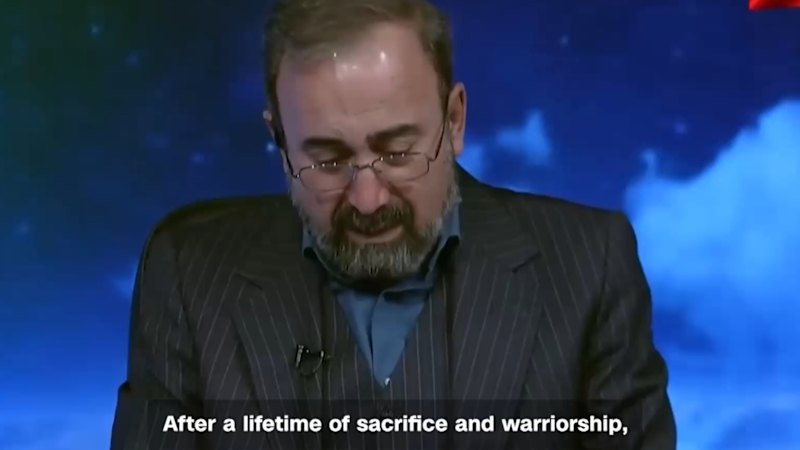
The televised announcement of a supreme leader’s death in a highly centralized state is not a news event; it is a synchronized operational protocol designed to preempt power vacuums. When a state media presenter displays visible emotion—such as weeping—while delivering the notice of Ali Khamenei's passing, it serves as a calculated psychological anchor. This performance aims to bridge the gap between the loss of a "divine" figurehead and the cold, mechanical necessity of the Assembly of Experts' selection process. In an environment where the state holds a monopoly on legitimate violence and information, the transition of power relies on the successful execution of the Continuity of Sovereignty framework.
The Tripartite Architecture of Iranian Power Transitions
Stability during an Iranian leadership transition depends on the alignment of three distinct power centers. If any of these pillars oscillate, the risk of systemic collapse increases exponentially.
- The Clerical-Legal Pillar (The Assembly of Experts): This body of 88 clerics holds the formal constitutional mandate to elect the next leader. Their role is to provide the "De Jure" legitimacy. The speed of their decision-making is a direct metric of internal consensus; a delay longer than 72 hours signals a breakdown in elite bargaining.
- The Praetorian Pillar (Islamic Revolutionary Guard Corps - IRGC): As the primary stakeholders in the Iranian economy and internal security, the IRGC provides the "De Facto" power. They do not seek to rule directly but require a leader who will protect their sprawling industrial-military complex.
- The Bureaucratic-Media Pillar (IRIB): This is the signaling apparatus. The crying presenter is the tip of a spear intended to manufacture a national mood of collective bereavement, which psychologically inhibits immediate dissent or celebration among the populace.
Signal Processing and the Utility of Televised Grief
Information theory suggests that in high-stakes political environments, the medium is frequently the most reliable data point. The decision to broadcast a presenter in a state of emotional distress is a deliberate choice by the Islamic Republic of Iran Broadcasting (IRIB) directorate, which reports directly to the Office of the Supreme Leader. This is not an uncontrolled outburst; it is a "Social Proof" mechanism.
By witnessing a state official weep, the viewer is presented with a behavioral heuristic: the loss is catastrophic, the grief is universal, and the appropriate response is mourning, not mobilization. This creates a "Spiral of Silence" for those who might otherwise see the death as an opportunity for reform or revolt. If the state appears vulnerable yet emotionally united, it complicates the risk-reward calculus for potential protestors.
The Succession Bottleneck: Formal vs. Informal Power
The Iranian constitution provides a clear roadmap for the interim. Article 131 mandates that a council consisting of the President, the Speaker of Parliament, and the Head of the Judiciary must manage the country and organize an election within 50 seconds—metaphorically speaking—though the legal limit is 50 days. However, the true friction exists in the informal negotiations.
The Candidate Selection Function
The probability of a candidate’s success ($P_s$) can be modeled as a function of three variables:
- $C$ (Clerical Seniority): The candidate's standing within the Qom theological hierarchy.
- $L$ (Loyalty): The historical track record of the candidate’s alignment with the IRGC’s strategic interests.
- $X$ (The Khamenei Factor): The perceived "blessing" or grooming received from the predecessor prior to death.
$$P_s = f(C, L, X)$$
The death of Ebrahim Raisi in 2024 significantly altered this equation, removing the primary "groomed" successor and forcing the system into a more volatile, competitive state. The presenter’s tears act as a dampener on this volatility, signaling to the public that the system remains intact even as the elite scramble to solve the $P_s$ equation behind closed doors.
Geopolitical Friction and External Perception
The international community interprets state-mandated mourning through a lens of "Strategic Stability." For Western intelligence agencies and regional rivals, the primary concern is not the emotion of the presenter but the response of the security apparatus.
- Border Security: High-alert status at borders indicates a fear of external opportunistic intervention.
- Digital Kill-Switches: Throttling of internet speeds during the mourning period is a standard defensive measure to prevent the coordination of "anti-events"—celebrations or protests that contradict the televised narrative.
- Proxy Synchronization: Statements from Hezbollah, the Houthis, and PMF militias are coordinated to project an image of a regional "Axis" that remains un-decapitated despite the loss at the center.
The mechanism of "Managed Grief" is also an export product. By projecting an image of a heartbroken nation, the state attempts to delegitimize external calls for regime change, framing them as insensitive to a "sovereign national tragedy."
The Security Dilemma of the Interregnum
The period between the announcement of death and the swearing-in of a successor is the "Interregnum," the most dangerous window for any autocratic system. The risk is not necessarily a popular uprising, but "Elite Defection." If a faction within the IRGC or the clerical establishment believes their interests are not represented by the emerging frontrunner, they may leverage the chaos to seize assets or initiate a soft coup.
The role of the state media during this window is to maintain the illusion of a "Unitary Actor." Any crack in the broadcast—a missed cue, a contradictory report, or a lack of uniformity in the grief—serves as a green light for internal rivals to move. Therefore, the crying presenter is an insurance policy against the perception of weakness.
Economic Implications of the Transition Protocol
Markets despise uncertainty, but the Iranian economy operates under a different set of pressures. The rial typically experiences immediate volatility upon such news, driven by domestic capital flight. The state’s counter-move involves:
- Market Freezes: Temporary suspension of certain trading platforms to prevent a total currency collapse.
- Gold Liquidity: The use of state gold reserves to stabilize the informal exchange rate.
- Command Economy Signals: Directives to state-linked conglomerates to maintain production levels to signal normalcy.
The televised mourning helps facilitate these economic interventions by keeping the population in a state of "Stasis." A mourning public is a compliant public, which reduces the immediate demand for physical assets as people wait for the "dust to settle."
The Digital Battlefield: Narratives and Counter-Narratives
While state TV broadcasts tears, the digital landscape becomes a theater of war. The Iranian government utilizes its "Cyber Army" to flood social media with hashtags of mourning, while the diaspora and internal dissidents use the same platforms to share videos of quiet celebration or calls to action.
The effectiveness of the crying presenter is increasingly diluted by the "Two-Screen Phenomenon." A citizen may watch the state-sanctioned grief on the television while simultaneously scrolling through videos of the 2022-2023 protests on their smartphone. This creates a cognitive dissonance that the state must manage through more aggressive digital censorship and physical surveillance.
Strategic Realignment and the Path Forward
The announcement of the death of a Supreme Leader marks the end of an era but not necessarily the end of a system. The machinery of the Islamic Republic is designed to survive individuals. The strategic move for the regime is to ensure that the transition feels like an "Evolution" rather than a "Rupture."
The immediate tactical priority for the state is the "Sanctification of the Deceased." By elevating the late leader to the status of a martyr who "died in service," the state creates a "Sacred Mandate" for the successor. Anyone who opposes the successor is framed not just as a political rival, but as an enemy of the deceased leader's legacy.
Expect the following sequence of events to unfold with surgical precision:
- A massive, multi-city funeral procession designed to demonstrate "The Mandate of the Masses" to international cameras.
- The rapid endorsement of a candidate by the IRGC leadership to signal that the "De Facto" power has made its choice.
- A "Unity Cabinet" reshuffle designed to co-opt potential defectors before they can organize.
The transition will be finalized not when the tears stop, but when the new leader issues their first directive to the IRGC. The crying on screen was merely the "Initialization Phase" of a complex, pre-programmed survival algorithm. To understand the future of the region, one must look past the moisture on the presenter's face and focus on the movement of the heavy divisions around Tehran.
Analyze the latency between the official announcement and the first public appearance of the Assembly of Experts' favored candidate; any gap exceeding 48 hours indicates that the "Grief Protocol" is failing to mask deep-seated structural fractures.


