The transition of a localized viral outbreak from a contained cluster to an exponential transmission chain depends on a quantifiable mathematical relationship: the effective reproduction number ($R_t$) multiplied by the systemic lag in institutional response time. When Ugandan health officials confirmed an increase in Ebola virus infections to seven cases, media reporting focused primarily on the absolute number. This focus misinterprets the operational reality. In epidemiological management, the absolute case count is merely a trailing indicator. The critical metrics are the transmission velocity, the identification of distinct generation lines, and the variance in contact-tracing saturation. Containing an outbreak requires viewing the situation not as a static medical emergency, but as a dynamic supply-chain and logistics problem governed by predictable biological variables.
The Triad of Filovirus Containment Operational Friction Points
Evaluating the trajectory of an Ebola virus outbreak requires analyzing three interdependent operational variables: the incubation detection window, the contact-tracing network ratio, and the community-wide velocity of isolation. If any of these variables break down, institutional containment efforts can fail.
                  [Index Case / Cluster]
                            │
              ┌─────────────┴─────────────┐
              ▼                           ▼
    [Incubation Window]         [Contact-Tracing Ratio]
     (Diagnostic Lag)            (Saturating Transmission)
              │                           │
              └─────────────┬─────────────┘
                            ▼
              [Velocity of Isolation Barrier]
                            │
                            ▼
                  [Chain Interruption]
The Incubation Detection Window
The Ebola virus presents an incubation period ranging from 2 to 21 days. During this window, individuals are asymptomatic and non-infectious, creating a significant statistical blind spot for surveillance systems. The operational challenge begins at the onset of symptoms, when the clinical presentation—fever, fatigue, and muscle pain—frequently mimics endemic pathogens like Plasmodium falciparum (malaria) or typhoid fever.
This symptom overlap causes a diagnostic lag. Every day an Ebola-positive patient is misdiagnosed or managed under standard outpatient protocols increases exposure within healthcare facilities and households. Minimizing this lag requires deploying rapid molecular diagnostics, such as real-time reverse transcription-polymerase chain reaction (rRT-PCR) assays, directly to peripheral triage points rather than relying on centralized reference laboratories.
The Contact-Tracing Network Ratio
Contact tracing is a network-saturation problem. For every confirmed case, epidemiologists must map a network of first-degree (direct physical contact) and second-degree (shared environment or fomites) exposures. To calculate the required operational scale, containment teams use a basic expansion multiplier:
$$C_n = \bar{k} \cdot I_n$$
Where:
- $C_n$ represents the total pool of active contacts requiring daily monitoring.
- $\bar{k}$ is the mean number of unique human exposures per infectious individual within the specific socio-demographic context.
- $I_n$ is the number of active index cases.
When cases rise to seven, if $\bar{k}$ equals 40 due to dense communal living or traditional funeral practices, the surveillance apparatus must monitor 280 individuals daily for 21 days. If the contact-tracing ratio falls below 100% saturation, unmonitored transmission chains develop outside the containment perimeter, leading to unexpected clusters in adjacent geographical zones.
The Velocity of Isolation Barrier
The final pillar is the speed at which symptomatic individuals are moved into strict bio-secure isolation. The time from symptom onset to isolation directly dictates the volume of secondary transmissions. If this velocity is low, the effective reproduction number remains above 1, causing the outbreak to expand.
[Symptom Onset] ──(Diagnostic Lag)──> [Confirmation] ──(Logistical Lag)──> [Strict Isolation]
└───────────────────────────────── Total Exposure Window ─────────────────────────────────┘
Accelerating this process requires clear logistical workflows: designated transport vehicles with physical barriers between compartments, pre-staged Personal Protective Equipment (PPE) supplies, and dedicated Ebola Treatment Units (ETUs) placed close to identified clusters to reduce transit times.
Systemic Vulnerabilities in Localized Healthcare Infrastructure
An outbreak does not occur in a vacuum; it interacts directly with the existing structural limitations of local healthcare systems. When a filovirus enters an environment with limited resources, it puts intense pressure on two main points: nosocomial amplification pathways and supply chain logistics for protective equipment.
Nosocomial Amplification Pathways
Inadequate clinical triage protocols can transform healthcare facilities from treatment centers into primary vectors for amplification. Without strict physical separation at the initial point of care, Ebola patients share waiting areas, latrines, and clinical staff with general patient populations.
This risk is compounded by the reuse of non-disposable medical equipment or insufficient sterilization infrastructure, such as malfunctioning autoclaves or inadequate chlorine solution concentrations. When healthcare workers become infected due to these exposure pathways, it depletes the specialized medical workforce and reduces public trust in formal medical institutions, driving symptomatic individuals away from clinical care.
Supply Chain Logistics for Protective Equipment
Maintaining a bio-secure environment requires an uninterrupted supply of specialized equipment, including:
- Fluid-resistant coveralls and gowns.
- Double-gloving setups using nitrile medical gloves.
- Particulate respirators (N95 or FFP2) paired with full-face shields.
- Sodium hypochlorite concentrates for decontamination.
The logistics challenge stems from high burn rates. A single ETU patient can require up to 10 complete PPE changes per day for the clinical team caring for them. For seven active cases, a dedicated staff of 30 health workers can consume 300 PPE sets daily.
If regional supply hubs operate on standard restock cycles rather than predictive demand modeling, localized shortages can occur within 48 to 72 hours. This leaves personnel with two difficult options: ration care or reuse single-use items, both of which increase transmission risk.
Mathematical Realities of Outbreak Scaling
To understand why seven cases demand an aggressive institutional response, one must analyze the underlying mathematics of viral propagation. The growth rate of an outbreak is determined by the specific virus strain and its interaction with population density and human behavior.
Sudan Ebolavirus vs. Zaire Ebolavirus Metrics
The operational strategy must adapt to the specific viral species causing the outbreak. The genus Ebolavirus includes distinct species with different biological characteristics.
| Metric | Zaire Ebolavirus | Sudan Ebolavirus |
|---|---|---|
| Historical Case Fatality Rate (CFR) | Approximately 60% – 90% | Approximately 40% – 60% |
| Approved Vaccine Efficacy | High (e.g., Ervebo rVSV-ZEBOV) | Limited/Experimental |
| Therapeutic Monoclonal Antibodies | Approved (Inmazeb, Ebanga) | Investigational Only |
| Primary Transmission Efficiency | High via bodily fluids | High via bodily fluids |
The absence of an approved, widely deployed vaccine for the Sudan species shifts the containment burden entirely onto non-pharmaceutical interventions. While a Zaire outbreak can leverage ring vaccination—vaccinating all contacts around an index case to create a human firewall—a Sudan outbreak requires strict adherence to physical containment, rapid isolation, and behavioral modifications.
The Reproduction Differential
The base reproductive rate ($R_0$) represents the transmission potential of a pathogen in a fully susceptible population without intervention. For Ebola variants, this value typically ranges between 1.5 and 2.5. The goal of health officials is to reduce the effective reproduction number ($R_t$) below 1, where the outbreak naturally decays.
$$R_t = R_0 \cdot (1 - x) \cdot e^{-\gamma \cdot \Delta t}$$
Where:
- $x$ is the percentage of the population effectively isolated or protected by behavioral changes.
- $\gamma$ represents the rate of containment execution.
- $\Delta t$ is the efficiency of the institutional response time.
If an intervention strategy fails to account for high-density environments or traditional gathering practices, the value of $x$ remains low, allowing the virus to spread efficiently even if absolute case numbers initially appear small.
Structural Barriers to Public Health Compliance
Effective containment depends as much on behavioral and social dynamics as it does on clinical protocols. Public health interventions often run into deep-seated socio-cultural practices and systemic distrust, both of which can disrupt containment strategies.
The Funeral Transmission Vector
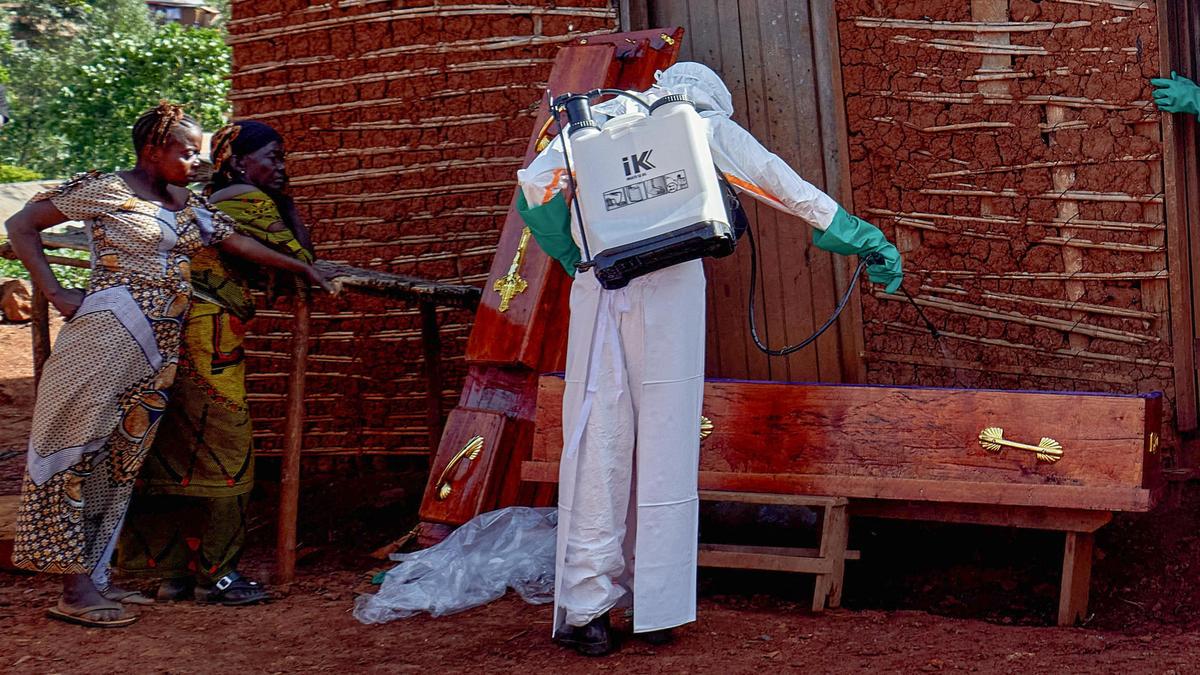
Traditional burial customs often involve washing, touching, and dressing the deceased. In individuals who have died from Ebola, the viral load in skin and bodily fluids reaches its highest concentration, making the corpse highly infectious.
[Traditional Burial Practices] ──> [Direct Contact with Deceased] ──> [Super-Spreader Event]
                                                                              │
                                      ┌───────────────────────────────────────┴───────────────────────────────────────┐
                                      ▼                                                                               ▼
                        [Geographical Dispersion]                                                       [Multi-Household Infection]
Imposing Safe and Dignified Burials (SDB) protocols—where trained teams handle and bury the body in sealed body bags—interferes with these long-standing cultural duties. If containment teams implement these measures insensitively, communities may hide sick relatives or conduct secret night burials. This drives transmission underground, bypassing the surveillance network entirely.
Institutional Distrust and Information Friction
Deploying security forces, setting up checkpoints, and isolating community members can create friction between the population and public health authorities. If communities view containment measures as punitive rather than medical, communication breaks down.
This distrust leads to low compliance with contact-tracing teams, underreporting of symptoms, and evasion of medical triage. Mitigating this risk requires involving trusted local leaders, elders, and religious figures directly in the containment strategy, translating epidemiological needs into culturally acceptable practices.
Strategic Resource Allocation Framework
Containing an outbreak with seven confirmed cases requires shifting from a reactive model to a predictive, resource-allocated strategy. To prevent further expansion, regional and international health authorities must execute three specific interventions.
Decentralized Diagnostics and Triage Parity
Centralized laboratory networks create delays that allow transmission chains to expand. Resources must be allocated to establish point-of-care isolation and testing units at provincial health hubs.
- Actionable Protocol: Equip peripheral clinics with GeneXpert automated molecular diagnostic platforms capable of processing Ebola assays within hours.
- Operational Goal: Reduce the time from sample collection to definitive diagnosis to under six hours, minimizing the window of unmitigated exposure in general wards.
Stratified Contact Risk Management
Not all contacts carry equal transmission risk. Resources should be prioritized based on exposure intensity to maximize the impact of surveillance teams.
- High-Risk Category: Individuals with direct physical exposure to the bodily fluids of a symptomatic patient or deceased individual. This group requires mandatory 21-day supervised isolation or twice-daily in-person clinical evaluations.
- Low-Risk Category: Individuals who shared a physical room without direct contact. This group can be monitored via passive reporting systems or daily phone checks, preserving personnel for high-risk tracking.
Supply Chain Pre-Positioning and Burn-Rate Modeling
Relying on standard distribution channels during an active outbreak leads to stockouts of critical supplies. Health logistics teams must implement demand-driven inventory strategies.
- Actionable Protocol: Establish a dynamic supply chain model that maintains a rolling 14-day safety stock of PPE, disinfectants, and supportive care medications at each active treatment site.
- Operational Goal: Automatically trigger emergency supply shipments from central stores when regional stock levels drop below a 7-day reserve, factoring in local transit and road infrastructure constraints.