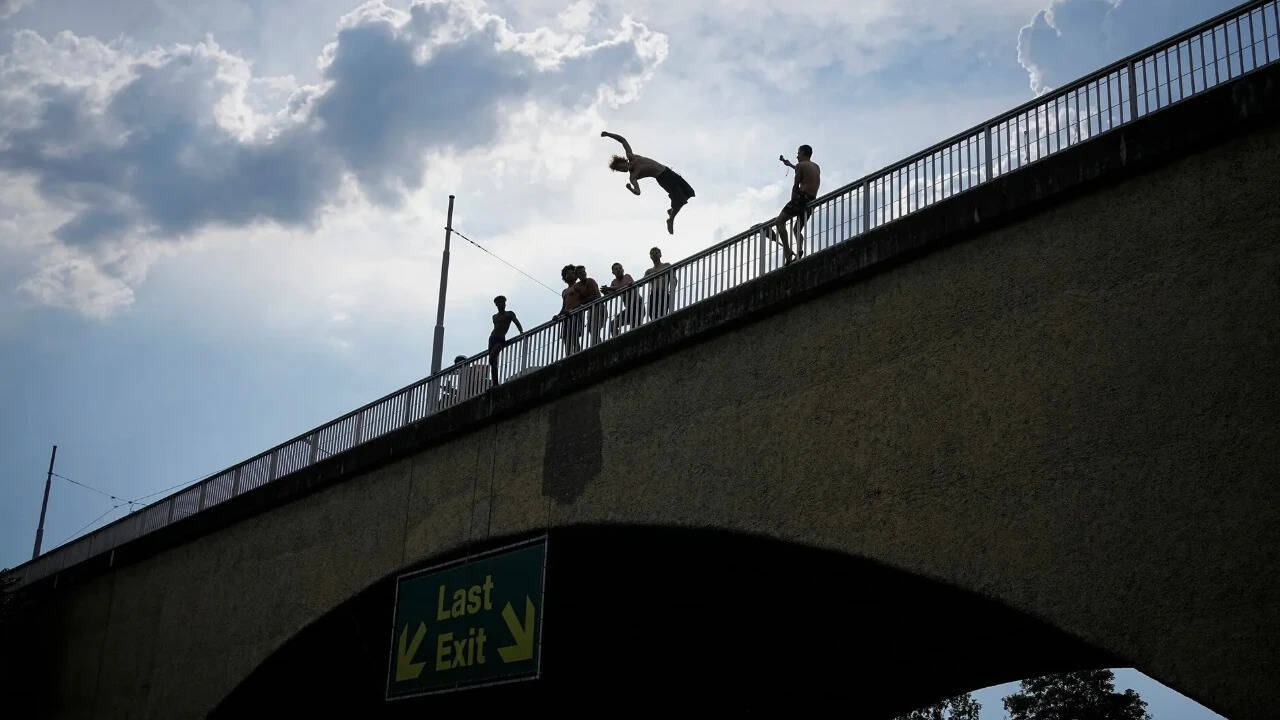
The recording of unprecedented June temperatures across Switzerland and the broader European continent represents a catastrophic failure of legacy infrastructural assumptions. Media narratives often treat extreme heatwaves as localized weather events requiring temporary behavioral adjustments. This fundamentally misdiagnoses the threat. Sustained thermal anomalies in historically mild climates act as sudden, high-stress endurance tests on physical infrastructure, energy generation limits, and human economic productivity.
When a region built to withstand deep winter freezes is rapidly subjected to prolonged periods exceeding 35 degrees Celsius, the resulting friction destroys capital. The systems governing European transport, power distribution, and labor output were engineered around a statistical distribution of weather that no longer exists.
Understanding the compounding failures triggered by these heatwaves requires deconstructing the physical and economic mechanisms at play.
The Atmospheric Physics of Sustained Stagnation
The driver of these acute thermal spikes is not general, gradual warming, but the specific localized mechanics of atmospheric blocking. Under normal conditions, the polar jet stream operates as a fast-moving river of air, propelling weather systems west to east across the continent. When this current destabilizes and weakens, it begins to meander in massive planetary waves known as Rossby waves.
A blocking pattern, often an Omega block, occurs when a high-pressure system becomes trapped between two low-pressure systems, effectively anchoring the high-pressure zone over a specific landmass like Central Europe.
This creates a persistent thermal dome. The physics of this dome dictate two simultaneous warming mechanisms. First, the high-pressure system forces air downward in a process called subsidence. As the air sinks, it compresses, and the thermodynamic laws of adiabatic heating dictate that the air mass increases in temperature without the addition of external heat. Second, the high-pressure system prevents cloud formation, allowing maximum solar irradiance to bake the ground. The dry ground then acts as a thermal radiator, heating the boundary layer of the atmosphere from below.
The duration of this stagnation is the primary variable determining economic damage. A three-day thermal spike causes acute discomfort. A fourteen-day Omega block initiates systemic infrastructure degradation.
Infrastructural Stress Mechanics
European infrastructure suffers from a specific vulnerability: it is optimized for a narrow, historically validated temperature band. Operating outside this band degrades material integrity exponentially.
Thermal Expansion in Rail Networks
The Swiss Federal Railways (SBB) and surrounding European rail networks rely on Continuous Welded Rail (CWR). This technology eliminates the gaps between rails to allow for high-speed travel and lower maintenance. To prevent extreme expansion and contraction, engineers pre-tension the steel rails to a "Stress-Free Temperature" (SFT), typically calculated as the median of the historical local temperature range.
When ambient air temperatures reach 35 degrees Celsius, direct solar radiation can push the actual steel temperature to 50 or 60 degrees Celsius. Steel has a fixed coefficient of thermal expansion. Once the rail temperature exceeds the upper bound of its engineered tension range, the expansive force seeks a release. Because the rail is welded and immobilized longitudinally, the force converts to lateral movement. This results in track buckling, commonly referred to as "sun kinks."
To mitigate catastrophic derailments, rail operators must implement severe speed restrictions when temperatures cross specific thresholds. This introduces massive latency into logistics networks. Passenger trains run late, but more critically, freight corridors bottleneck. Supply chains dependent on just-in-time delivery face immediate desynchronization.
Base Load Energy Curtailment
The power generation grid experiences a dual-sided shock during a thermal dome: supply capacity drops at the exact moment demand spikes.
Air conditioning and commercial cooling systems draw maximum load during peak afternoon heat. Simultaneously, the physical plants generating the electricity face operational limits dictated by thermodynamics and environmental regulation.
Nuclear and large-scale thermal power plants, which form the base load of neighboring networks like the French grid, require massive volumes of cold water for cooling. They draw from local rivers, run the water through heat exchangers, and discharge it back into the waterway. Environmental regulations strictly cap the maximum allowable temperature of discharged water to prevent the mass die-off of aquatic ecosystems.
When a heatwave raises the baseline temperature of river water, power plants reach their discharge temperature cap faster. Operators are forced to power down reactors or drastically curtail output. In Switzerland, which relies heavily on hydroelectric power, prolonged heat often correlates with low precipitation and accelerated evaporation, drawing down reservoir levels. The grid must therefore import power exactly when surrounding nations are also curtailing generation. This causes spot electricity prices to spike, destroying operating margins for energy-intensive industries.
The Economic Depreciation Curve of Human Capital
The most immediate financial impact of a thermal anomaly is the degradation of labor productivity. Human physiology acts as a biological engine that must constantly vent waste heat. The efficiency of this venting dictates the volume of physical or cognitive work a human can output.
The accurate metric for tracking this is the Wet Bulb Globe Temperature (WBGT), which accounts for ambient temperature, humidity, wind speed, and solar radiation. Humidity is the limiting factor. The human body cools itself primarily through the evaporation of sweat. As absolute humidity rises, the air's capacity to absorb additional moisture falls.
When the WBGT exceeds 26 degrees Celsius, occupational heat stress begins to compound. ISO standard 7243 provides specific guidelines for work-rest regimens based on these metrics. In heavy physical labor—construction, agriculture, logistics—sustained exposure requires mandatory cooling breaks, directly reducing active labor hours.
Economic output does not decline linearly with rising heat; it falls off a cliff. Research indicates that for every degree Celsius the temperature rises above 25 degrees, productivity drops by approximately 2%. In a prolonged heatwave, an entire national workforce operates at a functional deficit. Cognitive tasks are equally vulnerable. Errors in complex decision-making, code compilation, and financial modeling increase significantly in un-air-conditioned environments, an issue prevalent in European commercial real estate which historically eschewed heavy HVAC installations.
Pricing Thermal Risk into Capital Allocation
Reacting to extreme heat events with emergency municipal protocols—distributing water, opening cooling centers—is a failure of long-term planning. The frequency and intensity of these thermal anomalies are shifting from tail-risk events to predictable operational headwinds.
Capital allocators, supply chain managers, and civic engineers must formally price thermal volatility into their models.
Shift Logistics to Asynchronous Operations: Freight and heavy transport must transition to nocturnal schedules during the summer months. Moving rail and road freight between 22:00 and 06:00 avoids the peak solar irradiance that triggers thermal expansion limits in infrastructure.
Decentralized Cooling Redundancy: Commercial real estate must abandon the assumption that natural ventilation is sufficient for European summers. Retrofitting legacy buildings requires high-efficiency, localized heat pump systems rather than centralized, water-intensive cooling towers. Facilities failing to upgrade will face steep "brown discounts" in commercial leasing markets as tenant productivity metrics drop.
Water-Independent Energy Generation: The vulnerability of nuclear and hydro base loads to ambient water temperatures necessitates a rapid scaling of distributed solar paired with grid-scale storage. Solar irradiance peaks precisely when thermal demand peaks. Expanding capacity here directly offsets the thermal curtailment of legacy power plants.
Organizations that treat heatwaves as isolated anomalies will consistently suffer margin compression, delayed logistics, and capital destruction. The baseline has moved. Strategic advantage now belongs to those who engineer their operations for a fundamentally harsher thermal reality.