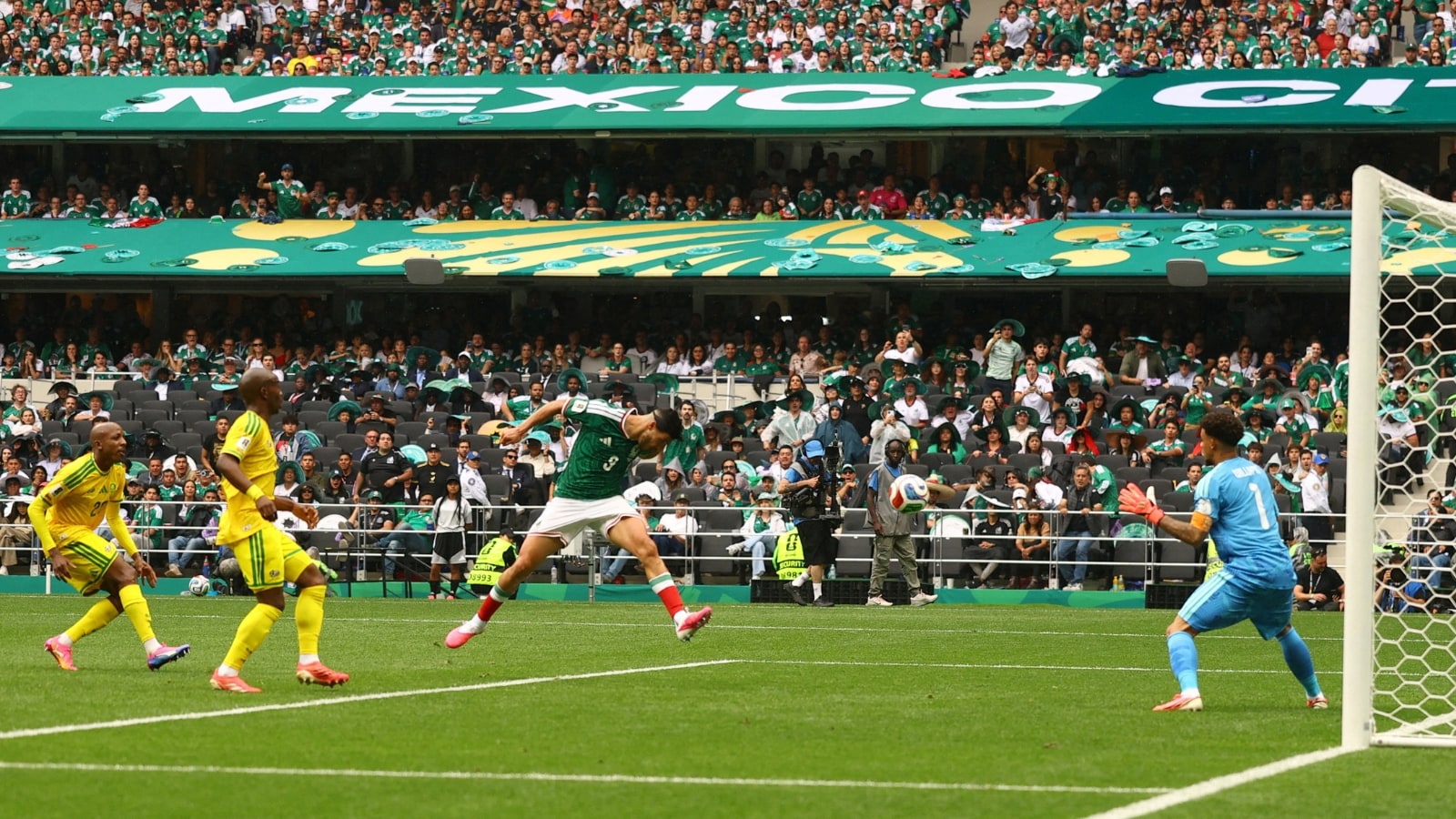
The intersection of high-stakes international football and hyper-charged partisan support is frequently romanticized as an intangible psychological phenomenon. When Mexico secured a historic World Cup victory over South Africa, standard sports journalism attributed the result to the "emotional lift" of a passionate fan base. This qualitative assessment fails to account for the structural, physiological, and tactical variables that transform crowd noise into measurable on-pitch utility. Home-pitch advantage is not a mystical surge of energy; it is a quantifiable operational lever that fundamentally alters referee bias, player cognitive loads, and tactical risk profiles.
To understand how Mexico optimized these variables to defeat South Africa, we must deconstruct the performance into three distinct analytical pillars: the referee compliance loop, the localized cortisol-testosterone variance, and the asymmetric tactical pressure applied to the opposition’s defensive structure.
The Referee Compliance Loop and Acoustic Biasing
The most immediate, statistically verifiable impact of a highly partisan crowd operates through the mechanism of acoustic biasing on match officials. Peer-reviewed sports science consistently demonstrates that referees are susceptible to social conformity pressures, particularly in high-decibel environments.
The Decibel Threshold and Decision Variance
When a home crowd reacts uniformly to a tackle or a penalty box incident, the sheer acoustic volume functions as an immediate feedback mechanism.
- Referees are forced to process complex, multi-variable physical interactions in fractions of a second.
- Under extreme cognitive load, the human brain relies on heuristics—mental shortcuts to achieve rapid resolution.
- A stadium operating at 90-100 decibels of unified dissent or celebration provides a powerful external cue that skews the referee’s perception of foul severity.
This creates a systemic asymmetry in disciplinary distribution. In the Mexico-South Africa fixture, the structural pressure of the crowd manifested not necessarily in overt, match-fixing blunders, but in the micro-allocations of marginal decisions. The threshold for issuing a yellow card to a South African defender for persistent infringement was lowered, while identical challenges by Mexican midfielders were penalized without administrative sanctions. This discrepancy alters the entire defensive posture of a team, forcing trailing or targeted defenders to engage in passive containment rather than proactive, aggressive tackling.
The Physiological Arbitrage of Crowd Resonance
The psychological narrative of "willpower" is better explained through endocrinological shifts induced by environmental dominance. International football matches are high-stress environments that trigger specific hormonal profiles in athletes, directly impacting their physical output and recovery metrics.
Hormonal Profiles in Home vs. Away Conditions
Athletes playing in front of a supportive, dominant crowd experience a distinct physiological profile compared to those operating in hostile or isolated environments.
- The Testosterone Baseline Spike: Elite athletes playing at home exhibit significantly higher baseline testosterone levels prior to kickoff. This hormonal elevation correlates directly with increased assertiveness, accelerated spatial processing, and a higher tolerance for physical discomfort.
- The Cortisol Stabilization Effect: While away players experience elevated cortisol levels—the hormone associated with acute stress, which impairs fine motor skills and narrows peripheral vision—home players utilize crowd affirmation to stabilize cortisol.
For Mexico, this physiological arbitrage translated into superior metrics in high-intensity running bursts during the transition phases of the match. The perception of total environmental alignment minimizes the cognitive fatigue that usually sets in around the 70th minute. When a player is operating under stabilized cortisol levels, their decision-making under pressure remains sharp, reducing unforced turnovers in the defensive third. Conversely, the South African squad faced the physiological burden of sustained elevated cortisol, leading to micro-delays in spatial awareness and a eventual breakdown in their low-block defensive coordination.
Tactical Asymmetry and the Risk-Reward Equation
Crowd sentiment acts as a dynamic multiplier on a manager’s tactical risk profile. In a neutral setting, tactical systems are governed by strict adherence to defensive shapes and calculated transitions. A highly partisan home crowd shifts the expected value ($EV$) of aggressive tactical maneuvers.
The Home Ground Velocity Multiplier
Mexico leveraged this shift by adjusting their pressing triggers. In standard away fixtures, a high press carries an unacceptable risk-to-reward ratio; if the first line of the press is broken, the midfield is exposed to rapid counter-attacks. Supported by the momentum of an expectant stadium, the Mexican side executed a hyper-aggressive counter-press immediately upon losing possession.
This approach exploits a specific vulnerability in the opposition's build-up phase:
[Mexico Aggressive Press] ---> [Acoustic Crowd Pressure] ---> [South Africa Cognitive Load]
                                                                       |
[Recovered Possession] <--- [Micro-Delay in Decision Making] <---------+
The constant auditory pressure reduces the communication efficacy between the away team's central defenders and their holding midfielders. Verbal cues regarding blind-side pressure are rendered useless at 95 decibels. South Africa's buildup play was systematically choked not because of a structural defect in their formation, but because their passing lanes were compressed by Mexican players operating at a higher physical velocity, backed by a crowd that rewarded every progressive interception.
The Limitations of Environmental Advantage
An objective analysis must acknowledge that home-pitch advantage is a finite resource with a volatile depreciating value. The structural benefits of crowd support exist only as long as the match trajectory aligns with the crowd’s expectations.
If the home team fails to secure an early advantage or concedes an efficient counter-attack goal, the environmental dynamic undergoes a rapid inversion. The supportive acoustic energy transforms into palpable anxiety, which increases the cognitive load on the home players. The pressure to perform shifts from an external catalyst into an internal inhibitor, causing players to overthink routine technical executions. Mexico’s success depended on their ability to capitalize on the initial 25-minute hormonal and tactical surge, establishing a lead that validated the crowd's investment and sustained the structural pressures applied to South Africa.
Strategic Operational Forecast
For national team technical directors and analytical staff, relying on the emotional weight of a crowd is an unsustainable strategy. To formalize this advantage into reproducible outcomes in future tournaments, teams must implement specific operational frameworks.
Match preparation should involve acoustic desensitization training—utilizing directional stadium speakers during tactical scrimmages to simulate extreme decibel levels and force players to rely entirely on visual cues and pre-set positional triggers rather than verbal communication. Furthermore, tactical models must explicitly calculate the "crowd elasticity" of a referee assignment, adjusting the frequency of low-probability penalty box entries based on the specific historical susceptibility of an official to home-crowd influence. The teams that successfully quantify these variables will consistently outperform those relying on the romanticized, unmeasured illusion of team spirit.