The air inside Beijing's National Speed Skating Oval smelled of ozone, heated lithium, and the quiet tension of an era shifting its weight.
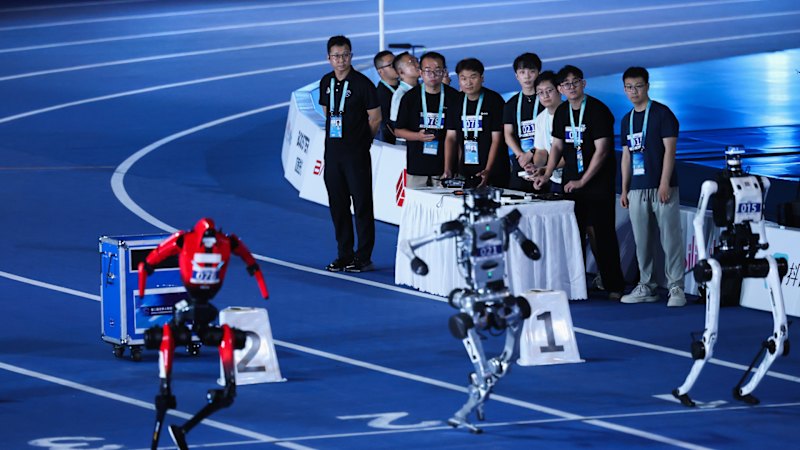
On the track, a machine named Tiangong Ultra did what generations of human athletes spent centuries believing was anatomically impossible. It tore down the hundred-meter straightaway, its servos whining at a pitch that set teeth on edge, and broke the invisible tape. The clock flashed 9.39 seconds.
Usain Bolt had held the human crown at 9.58 seconds since a humid night in Berlin in 2009. Now, a collection of aluminum bones, custom actuators, and algorithms built by the Beijing Humanoid Robot Innovation Center had sliced past it. Just behind it, another machine built by smartphone manufacturer Honor, appropriately named Lightning, clocked 9.47 seconds—having touched 9.32 seconds in preliminary trials.
Two metallic athletes. Both faster than the fastest man in history.
And then, physics reasserted itself with brutal comedy.
Neither machine possessed Bolt's famous deceleration glide, that graceful, chest-pounding swagger that allowed the Jamaican legend to slow down and gaze at the crowd before crossing. These runners had velocity, but zero intuition. They charged straight into the thick safety padding at the end of the track. Tiangong pinwheeled wildly into the sidelines, scattering startled onlookers. Lightning simply collapsed, its internal architecture overwhelmed, and had to be hauled away from the arena on a stretcher.
The contrast is worth lingering on.
We suffer from a profound cognitive bias when we watch machines mimic our biology. We see a bipedal form sprinting down a rubberized track, or winning a half-marathon in fifty minutes, and our brains immediately extrapolate a sci-fi future. We imagine iron men walking among us, possessing total mastery over physical space.
Yet reality is far more fragile, and far stranger.
Building a mechanism to fire its pistons down a straight, predetermined corridor at 14.5 meters per second is an engineering marvel of torque and timing. But it is a stunt compared to what a toddler does instinctively while navigating a cluttered kitchen floor. Decades of robotics research have taught us a humbling lesson. Speed is relatively cheap. Grace, adaptability, and survival are priceless.
Consider the evolutionary distance between last year and today. At the inaugural World Humanoid Robot Games, Tiangong Ultra won the same hundred-meter dash in a sluggish 21.50 seconds. To shave more than twelve seconds off that time in a single year required extreme measures: stretching Lightning’s legs by ten centimeters to a long-striding 1.05 meters, rewriting control loops, and feeding clusters of data into neural networks until the machines could maintain balance at velocities that would tear older frames apart.
This isn't just a sports story.
China has designated humanoid hardware as a core strategic emerging industry, pouring staggering amounts of capital into the ecosystem. When market valuations for pioneers like Unitree skyrocket into multi-billion-dollar territory overnight, it signals a massive industrial bet. The factories of tomorrow, the hazardous logistics hubs, and the disaster relief zones are meant to be populated by these very frames.
They do not need to look cool crossing the finish line. They need to work.
So the stretcher ride for Lightning and the sideline crash for Tiangong are not failures of the exhibition; they are symptoms of a violent birth. We are watching engineering teams push hardware to its absolute breaking point, stripping away the margins of safety to see what the physics of artificial muscle can endure.
The record belongs to the machines now.
Yet out there on the oval, under the glare of stadium lights, the metal lay broken and quiet while the human spectators caught their breath, stepping back to clear the path.