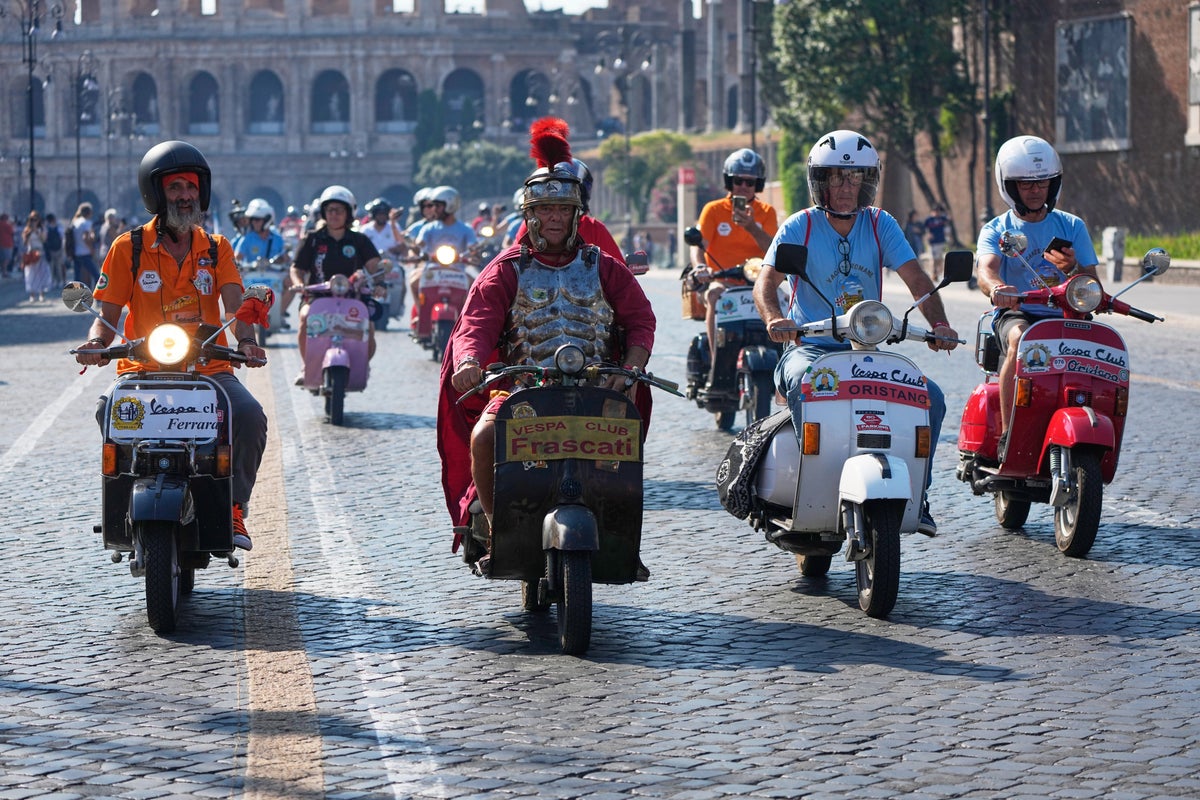
The cobblestones of Rome do not merely sit; they vibrate. For centuries, they have absorbed the weight of empires, the marching boots of legions, and the heavy tread of history. But on a crisp spring morning, the vibration is different. It is a low, collective hum that starts in the spine before it ever reaches the ears. It smells of burnt two-stroke oil, gasoline, and nostalgia.
If you stand at the edge of the Piazza Venezia, the sound hits you first. A mechanical murmur. Then comes the color—a tidal wave of mint green, pastel blue, alabaster, and fiery red spilling over the hills.
More than fifteen thousand Vespas have descended upon the Eternal City. They have come from the mist-heavy roads of Germany, the coastal highways of the UK, the neon corridors of Tokyo, and the sun-baked tracks of Australia. It is an anniversary, yes. A celebration of decades spent buzzing through the arteries of global culture. But to view this as a mere corporate milestone or a massive club meetup is to miss the entire point of why these small, stamped-steel machines matter.
This is not a convention. It is a pilgrimage of the beautifully impractical.
The Steel Wasp in the Ruins
To understand why fifteen thousand people would ride a scooter across continents just to park it in a Roman square, you have to understand Enrico Piaggio. In 1946, Italy was a nation wearing the physical and psychological scars of World War II. The roads were shattered. The economy was in ruins. The aviation factories that once built warplanes were silent, forbidden from manufacturing instruments of destruction.
Piaggio looked at his empty plant in Pontedera and realized Italians did not need airplanes. They needed to move. They needed to go to work, to rebuild, to find love amid the rubble. He tasked aeronautical engineer Corradino D’Ascanio with creating a vehicle that was cheap, reliable, and accessible.
D’Ascanio hated motorcycles. He found them bulky, dirty, and difficult to ride. So, he designed a vehicle from the ground up using airplane logic. He put the engine on the rear wheel to eliminate the greasy chain. He created a front spar inspired by aircraft landing gear. He designed a front shield to keep mud off the rider’s trousers. When Piaggio saw the prototype, with its wide rear section and narrow waist, he exclaimed, "Sembra una vespa!"—It looks like a wasp.
A legend was baptized.
What followed was not just a boom in manufacturing; it was a psychological liberation. The Vespa became the first democratic vehicle of the post-war era. It did not care about your social class. If you had a few thousand lire, you possessed the keys to the world.
The Geography of Obsession
Consider a hypothetical rider named Jean-Pierre. He is fifty-two, a carpenter from Lyon. He did not put his 1964 Vespa GS on a trailer to get to Rome. He rode it. Through the winding, cold passes of the Alps, his fingers freezing against the handlebars, the tiny eight-inch wheels catching every pothole along the route.
Why do it? Why subject a middle-aged body to the elements on a machine that tops out at forty-five miles per hour on a good day?
"Because on a highway in a modern car, you are a spectator," Jean-Pierre might tell you over an espresso near the Colosseum, his face lined with road dust. "You sit in a climate-controlled box, watching the world pass by like a film. On a Vespa, you are in the movie. You smell the pine trees in Tuscany. You feel the temperature drop when you enter a valley. When it rains, you are wet. When the sun shines, you are alive."
This is the invisible thread linking the thousands of riders filling the streets of Rome. The gathering represents an incredible cross-section of humanity. There are pristine, concourse-level restorations worth more than a luxury sedan, parked right next to battered, rust-streaked daily commuters that look like they survived a war zone.
The sheer logistics of the event are dizzying. The Vespa World Days event turned the Roman countryside into a sprawling village of tents, workshops, and stages. A temporary city within a city, populated entirely by people who speak different languages but share an identical vocabulary of engine clicks, carburetor adjustments, and spark plug gaps.
The Art of the Slow Journey
Our modern world is obsessed with friction. We want everything faster, smoother, more automated. We want algorithms to predict our desires and vehicles to drive themselves while we stare at screens.
The Vespa is the ultimate rebellion against this frictionless existence.
It requires effort. You must manually mix oil into the fuel of the older models. You must shift gears with your left wrist, twisting the handlebar in a dance of clutch and cable. There are no airbags. There is no traction control. If you do not pay attention to the road, the road will intimately introduce itself to you.
Yet, this friction creates a profound sense of presence. When the swarm moved through the historic center of Rome, passing the Roman Forum and circling the Circus Maximus, it did not look like traffic. It looked like a ballet. The riders do not zoom past the monuments; they glide, waving to pedestrians, shouting greetings across lanes to strangers they have never met and will never see again.
The locals do not complain about the gridlock. In Rome, the Vespa is part of the architecture, as vital to the landscape as the travertine stone of the Trevi Fountain. It is the machine that gave the city its modern rhythm. It is the cinematic shorthand for Italian romance, forever crystallized by Audrey Hepburn and Gregory Peck weaving through traffic in Roman Holiday.
The Sound of Survival
By afternoon, the swarm converges on the open spaces of the Capannelle racecourse. The engines are switched off, one by one. The sudden silence is heavy, filled only by the ticking of hot cooling fins and the chatter of thousands of tired, ecstatic travelers.
There is a vulnerability in this subculture. Many of the people gathered here know that the world is changing. Environmental regulations are tightening. Two-stroke engines, with their signature blue smoke and sweet, oily scent, are an endangered species. The future belongs to electricity, to silent motors and zero emissions. Even the Vespa itself has evolved, with modern, clean four-stroke engines and fully electric models dominating current showroom floors.
But here, on the Roman asphalt, the past and the future do not fight. They sit side by side. A brand-new Elettrica is parked next to a 1951 Faro Basso, its headlight mounted low on the front mudguard. The riders of both are sharing a bottle of wine on the curb.
They understand that the magic of the machine does not lie in the specific mechanics of the internal combustion engine. It lies in what the machine represents: an open invitation to wander.
As the sun begins to dip below the Roman horizon, painting the sky in shades of terracotta and violet, a single rider kicks his starter pedal. The engine catches with a sharp, metallic pop-pop-pop. Another joins. Then ten. Then a hundred.
The swarm is waking up again, ready to scatter back across the corners of the earth, carrying a piece of the Roman air with them in their exhaust.