Every time two commercial aircraft clip wings on a tarmac, the aviation press follows the exact same lazy script. They post a grainy cell phone video, throw the word "terrifying" in the headline, and immediately start speculating about whether a pilot missed a hold-short line or an air traffic controller had a momentary lapse.
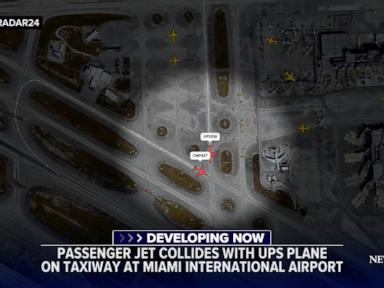
When a passenger jet collided with a UPS cargo plane on a taxiway at Miami International Airport, the predictable outrage machine went right back to work. Viewers were fed a simple, comforting lie: this was a rare, isolated glitch caused by human error, everyone walked away fine, and the system works.
That narrative is complete garbage.
Wingtip strikes and ground incursions at major hubs like Miami are not anomalies. They are the predictable, mathematical result of cramming massive modern aircraft into asphalt infrastructure designed for a bygone era, all while prioritizing departure slots over physical clearance margins. If you think the problem is a distracted captain or a tired ground controller, you are looking at the symptom and completely ignoring the disease.
The Myth of the Safe Taxiway
Most travelers assume that the most dangerous part of flying happens at 35,000 feet, or perhaps during the final seconds of a crosswind landing. In reality, the concrete maze between the gate and the runway threshold is where commercial aviation bleeds money and flirts with disaster every single day.
Consider the physics and geometry of a modern hub. Miami International Airport is one of the busiest cargo and international passenger gateways in the Western Hemisphere. On any given afternoon, you have heavy widebodies—Boeing 767s, 777s, and Airbus A330s—sharing narrow, intersecting taxiways with regional jets and narrowbodies like the 737.
Here is what the mainstream coverage completely misses: wingspans have grown faster than concrete.
Over the last thirty years, aircraft manufacturers have stretched wingspans and added massive winglets to squeeze every drop of fuel efficiency out of modern jet engines. A Boeing 737 MAX has a wingspan of nearly 118 feet. A Boeing 767-300—the backbone of the UPS fleet—spans over 156 feet. Meanwhile, the taxiway centerlines at legacy airports like Miami were laid out decades ago, constrained by terminal buildings, perimeter roads, and existing runways that cannot simply be pushed outward without shutting down operations and spending billions of dollars.
When two planes pass each other on parallel or intersecting taxiways, the margin for error is often measured in single-digit feet. Pilots sitting sixty feet forward of their own wingtips cannot actually see the ends of their wings from the flight deck. They are relying entirely on painted yellow lines, complex verbal clearances from ground control, and the assumption that the aircraft ahead of them or beside them is parked precisely on its mark.
I have sat in countless operational safety debriefs over the past fifteen years, and the pattern is always identical. Management wants to point at a crew member and say, "You strayed four feet left of the centerline." They never want to ask why a four-foot deviation on a congested taxiway results in millions of dollars of sheared composite winglets and grounded jets.
Why "Human Error" Is an Executive Escape Hatch
Whenever an incident like the Miami collision hits the news, you will hear the phrase "human error" repeated like a religious mantra. It is the favorite scapegoat of airline executives, airport authorities, and regulators.
Why? Because human error is cheap to fix on paper. If you blame the pilot, you issue a safety bulletin, mandate a twenty-minute computer-based training module, and declare the problem solved. If you blame the ground controller, you point to staffing shortages and promise more hiring.
Blaming the infrastructure, however, requires admitting that our busiest hubs are operating beyond their safe geometric limits.
Let's look at the mechanics of a taxiway collision through the lens of Swiss Cheese Model risk management, popularized by psychologist James Reason. In aviation, accidents only happen when multiple layers of defense fail simultaneously. On the ground at Miami, those layers are razor-thin:
- Visual Overload: At night or during a typical South Florida rainstorm, a taxiway becomes a sea of blue, green, amber, and red lights. Distinguishing a specific hold-short bar from background terminal lighting requires intense cognitive focus right at the moment crews are running checklists, calculating takeoff performance, and communicating with dispatch.
- Radio Congestion: Ground control frequencies at major hubs operate at a breakneck pace. Instructions are rattled off at 180 words per minute. A single clipped transmission or a blocked microphone—where two pilots key their mics at the exact same second—can leave an aircraft moving across an active intersection without clear confirmation.
- Schedule Compression: Airlines live and die by on-time departure metrics (D0). Ground crews, tug drivers, and flight crews are under relentless, unspoken pressure to push back the second the cabin door closes and taxi aggressively to beat departing thunderstorms or congested airspace windows.
Imagine a scenario where a UPS widebody is holding short on a secondary taxiway, waiting for a slot to cross a runway, while a passenger jet is cleared to taxi behind it. If the cargo jet's tail or wingtip overhangs the clearance boundary by just six feet—perhaps because the crew stopped slightly early to avoid blast from another aircraft—the passenger jet following the painted yellow centerline will slice right into it. Both crews followed their training. Ground control issued a standard clearance. Yet metal still bends.
Dismantling the Questions Travelers Actually Ask
When clips of planes colliding on the tarmac go viral, the public naturally floods search engines with anxious questions. Most of the answers they find online are sanitized PR talking points. Let's look at what people are actually asking and strip away the corporate spin.
"How could pilots possibly hit each other when they have windows and radar?"
This question fundamentally misunderstands how commercial aircraft operate on the ground. First, weather radar is turned off on the ramp because its microwave radiation can injure ground workers; it cannot detect stationary objects ten feet away anyway. Second, commercial airliners do not have backup cameras, parking sensors, or blind-spot monitors like a modern SUV.
From the captain's seat of a large jet, you are sitting two stories above the pavement, looking down at a steep angle. You cannot see your nose gear. You cannot see your engines. You certainly cannot see your wingtips, which are swept backward far behind your peripheral vision. Pilots navigate on the ground by keeping the yellow centerline directly between their feet and trusting that the airport authority painted those lines with enough clearance for their specific aircraft's wingspan classification—known in FAA terminology as the Airplane Design Group (ADG). When airport planners allow larger ADG aircraft onto legacy taxiways through operational waivers and special procedures, that trust breaks down.
"Are tarmac collisions increasing, or are we just seeing more videos?"
Both. Smartphone cameras in every window seat mean nothing happens on a ramp without ending up on social media within ten minutes. However, the data from the Federal Aviation Administration (FAA) and the National Transportation Safety Board (NTSB) confirms that surface incidents—including runway incursions and taxiway collisions—have become one of the most stubborn, unresolved hazards in commercial aviation.
Following a string of high-profile close calls across major U.S. hubs, the FAA convened a dedicated safety summit specifically to address surface risks. The problem is simple: air travel demand recovered faster than air traffic control staffing and airport concrete expansion. You cannot pour new taxiways overnight, so the system absorbs the extra volume by compressing spacing on the ground.
"Should I avoid airlines or airports where these crashes happen?"
Avoiding a specific airline because of a taxiway clip is completely pointless. In Miami, American Airlines, Delta, United, UPS, FedEx, and dozens of foreign carriers all share the exact same pavement, follow the exact same ground controllers, and navigate the exact same bottlenecks.
If you want to understand your actual risk, look at the airport's layout, not the paint on the tail of the plane. Land-locked legacy airports—Miami, JFK, LaGuardia, Chicago O'Hare, Boston Logan—are boxed in by cities, highways, or water. They cannot expand outward. Consequently, their taxiway networks are dense, complicated, and unforgiving compared to massive, sprawling modern hubs like Denver or Dallas/Fort Worth, which were built on wide-open plains with generous separation between parallel taxiways.
The Uncomfortable Trade-Off Nobody Wants to Make
If you want to eliminate wingtip collisions at airports like Miami tomorrow, the solution is straightforward. You do not need artificial intelligence, futuristic cockpit displays, or another round of pilot retraining.
You just need to enforce strict, single-direction taxiway flows and increase the required separation buffers between heavy aircraft.
Here is the catch—and the reason it will never happen voluntarily: safety buffers destroy capacity.
If Miami International Airport prohibits two large aircraft from passing each other on adjacent taxiways and doubles the spacing between taxiing jets, the airport's hourly departure rate plummets. Flights get delayed by forty-five minutes sitting on the ramp. Connections are missed. Cargo packages miss their overnight sorting windows. Ticket prices go up because airlines have to burn more fuel idling on the ground and pay crews for extra block hours.
The aviation industry has made a calculated, silent bargain. Because low-speed taxiway collisions almost never result in fatalities—the aircraft are moving at walking or jogging speeds, typically 10 to 20 knots—the industry tolerates a low-level background hum of clipped wings and scraped fuselages as the cost of doing business at maximum capacity.
It is an economically rational decision until the day a wingtip slices into a fuel tank instead of another winglet, or until a ground worker happens to be standing in the wrong spot when two 300,000-pound machines make contact.
How to Protect Yourself When Ground Operations Go Wrong
Since neither the airlines nor the FAA are going to voluntarily cut airport capacity by twenty percent to widen taxiway buffers, you have to take ownership of your own safety during the most chaotic phase of any flight.
Forget the standard passenger habit of putting on noise-canceling headphones and falling asleep the second you buckle your seatbelt. The twenty minutes between pushback and takeoff—and the fifteen minutes between touchdown and the gate—require your full situational awareness.
- Keep Your Shoes On and Your Belt Tight Until the Engines Shut Down: Most passengers unbuckle the moment the plane turns off the runway, eager to stand up and grab their bags. In a sudden ground collision, an unbuckled passenger becomes a projectile. A 15-knot stop sounds slow until your forehead hits the hard plastic tray table in front of you.
- Treat Taxiing Like Takeoff: Keep your personal items stowed under the seat in front of you until the aircraft is completely parked at the gate and the seatbelt sign is turned off. Loose laptops and heavy backpacks flying down the aisle during a sudden ground stop cause real injuries and block evacuation routes.
- Never Assume a Ground Collision Is Harmless: If you feel a sudden jolt, hear the unmistakable screech of tearing aluminum, or see smoke outside your window, do not wait for a polite announcement from the flight deck to start paying attention. Locate your nearest exit row—counting the seatbacks between you and the door—and be ready to move without your luggage if an evacuation is ordered.
Stop Buying the PR Spin
The next time a video surfaces showing a passenger jet and a cargo plane tangled together on a taxiway in Miami, Chicago, or New York, ignore the talking heads debating whether the pilot missed a sign.
Look at the concrete underneath the wheels. Look at the wingspans crammed wingtip-to-wingtip across aging asphalt. Look at the schedules demanding that thousands of flights move through bottlenecks built for half the traffic.
The pilots in those cockpits are not reckless amateurs forgetting how to steer. They are professionals navigating a rigged game where the margins have been shaved down to inches to keep the global supply chain and the airline schedules moving on time. Until airports physically separate heavy traffic or accept fewer flights per hour, metal will keep hitting metal—and the industry will keep blaming the people in the front seats for running out of room.