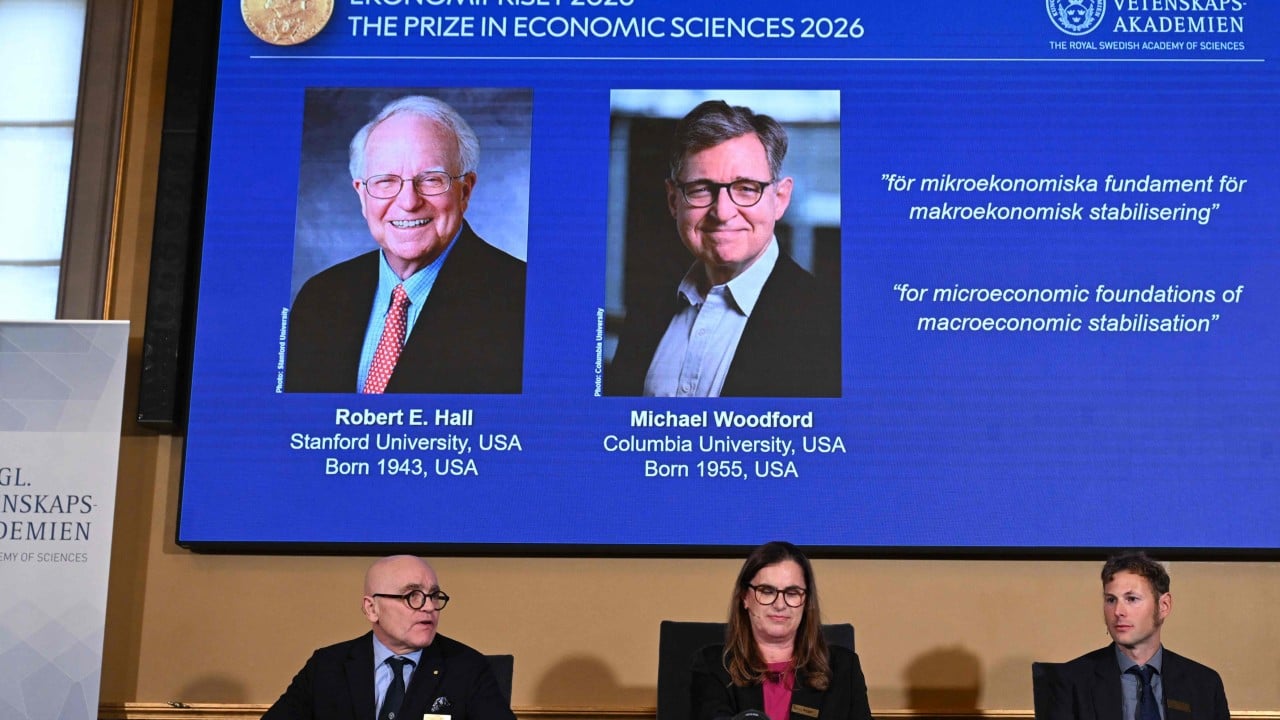
Modern macroeconomics spent decades treating the aggregate economy as a monolithic machine, adjusting interest rates and fiscal levers based on top-down historical correlations. The 2026 Sveriges Riksbank Prize in Economic Sciences, awarded to Robert E. Hall and Michael Woodford, formalizes a structural shift away from that approach. Their collective body of work demonstrates that macroeconomic stability cannot be engineered from top-down aggregates alone. It requires rigorous microeconomic foundations, mapping how individual household consumption decisions and forward-looking expectations transmit shocks through the entire financial system.
The Information Asymmetry of Aggregate Consumption
Traditional Keynesian frameworks relied on historical consumption functions, assuming that current disposable income dictated current spending. Policymakers treated consumers as passive agents who reacted predictably to tax cuts or stimulus checks. Robert Hall fundamentally fractured this assumption in his seminal 1978 paper by introducing the random walk hypothesis of consumption. For another look, see: this related article.
Hall proved that if consumers are forward-looking and optimize their utility over their lifetimes, changes in consumption are inherently unpredictable using current income data. Households base their expenditures not on what they earn today, but on their permanent income—their lifetime expected wealth. Because new information about future earnings arrives unpredictably, consumption changes randomly.
This creates a severe operational blind spot for central banks and fiscal authorities. If household consumption follows a random walk based on unobservable expectations, standard stabilization policies aimed at fine-tuning short-term demand are flying blind. A tax rebate viewed as temporary will be saved rather than spent, rendering fiscal multipliers ineffective. Hall dismantled the mechanical link between current income and current expenditure, forcing economists to look inside the black box of household decision-making. Similar insight on this trend has been provided by Reuters.
The Expectation Transmission Mechanism
While Hall mapped how households process information over time, Michael Woodford resolved the missing link in monetary policy transmission: how expectations about future policy actions dictate present economic behavior. Prior to Woodford's work, monetary policy was analyzed primarily through direct liquidity effects—how changing the short-term interest rate immediately altered borrowing costs.
Woodford integrated general equilibrium theory with New Keynesian economics, demonstrating that the potency of a central bank depends almost entirely on how it manages future expectations rather than its immediate control of the overnight rate. Because prices and wages exhibit nominal rigidities, current economic activity is driven by the entire path of expected future interest rates.
If a central bank cuts rates today but markets expect it to raise them aggressively tomorrow to combat inflation, the stimulative effect today is neutralized. Conversely, forward guidance—credible communication about future policy trajectories—becomes a primary monetary instrument. Woodford provided the mathematical framework that allows central bankers to model how credibility, communication, and market anticipation shape output and inflation stabilization.
The Mechanics of New Keynesian Stabilization
The integration of Hall's insights on consumption behavior and Woodford's framework on expectations gave rise to the modern New Keynesian DSGE (Dynamic Stochastic General Equilibrium) models. These models operate on three fundamental pillars:
- Optimizing Microfoundations: Every macroeconomic variable is derived from explicit optimization problems solved by individual households and firms, rather than arbitrary statistical curves.
- Nominal Rigidities: Prices and wages do not adjust instantaneously. This friction creates a channel through which monetary policy can exert real effects on employment and output in the short run.
- Rational Expectations: Agents use all available information to forecast the future, meaning monetary and fiscal policy interventions are immediately evaluated by the private sector for their long-term credibility.
The failure of stagflation-era policies in the 1970s occurred precisely because these microfoundations were ignored. Governments attempted to exploit a stable trade-off between inflation and unemployment that existed only on historical paper, ignoring how rational agents would adapt their behavior to policy manipulation. Hall and Woodford's architecture ensures that stabilization policy accounts for behavioral adaptation, preventing central banks from inadvertently triggering runaway inflation while trying to smooth out output gaps.
Operational Limitations and Modeling Bottlenecks
Despite the analytical superiority of New Keynesian microfounded models, practitioners must navigate distinct operational boundaries. These frameworks are not infallible forecasting tools.
First, the assumption of rational expectations imposes a cognitive burden that real-world agents rarely meet. Households and firms possess bounded rationality and heterogeneous information sets. When financial crises occur, panic-driven behaviors often diverge sharply from equilibrium optimization models.
Second, parameter estimation remains vulnerable to structural breaks. If financial markets undergo structural transformations—such as the digital asset transition or sudden shifts in global supply chains—the microeconomic parameters estimated from historical data lose predictive validity.
Third, monetary transmission channels are asymmetrical. While raising interest rates aggressively cools aggregate demand through predictable debt-servicing channels, lowering rates to zero or negative territory often encounters liquidity traps where traditional policy loses traction, requiring unconventional balance-sheet interventions.
Strategic Allocation of Stabilization Levers
Central bankers and fiscal authorities operating in complex economic environments must transition from reactive fine-tuning to structural risk management. The operational takeaway from Hall and Woodford's framework is clear: policy efficacy is a function of credibility and institutional design, not discretionary stimulus volume.
To optimize economic stabilization during exogenous shocks, central banks must prioritize communication clarity over interest rate magnitude, anchoring long-term inflation expectations to prevent second-round price shocks. Simultaneously, fiscal policy must target liquidity-constrained households whose marginal propensity to consume is high, rather than broad-based transfers that rational agents will absorb into savings.
This video provides additional context on the announcement and implications of the 2026 Nobel Prize in Economic Sciences awarded to Robert Hall and Michael Woodford.