Urban light pollution acts as a severe structural bottleneck for high-resolution astronomical imaging. The growth of artificial illumination—expanding exponentially at annualized rates between 7% and 10% globally—has systematically degraded urban sky clarity, pushing consumer astrophotography from a backyard hobby to a complex infrastructure challenge. Most major metropolitan centers operate within Bortle 7 to Bortle 9 classifications, where the Sky Quality Meter (SQM) values drop below 18.0 mag/arcsec². Under these conditions, the signal-to-noise ratio ($SNR$) required to capture faint deep-sky structures like nebulae or galaxies becomes mathematically intractable due to the overwhelming background photon noise from city grids.
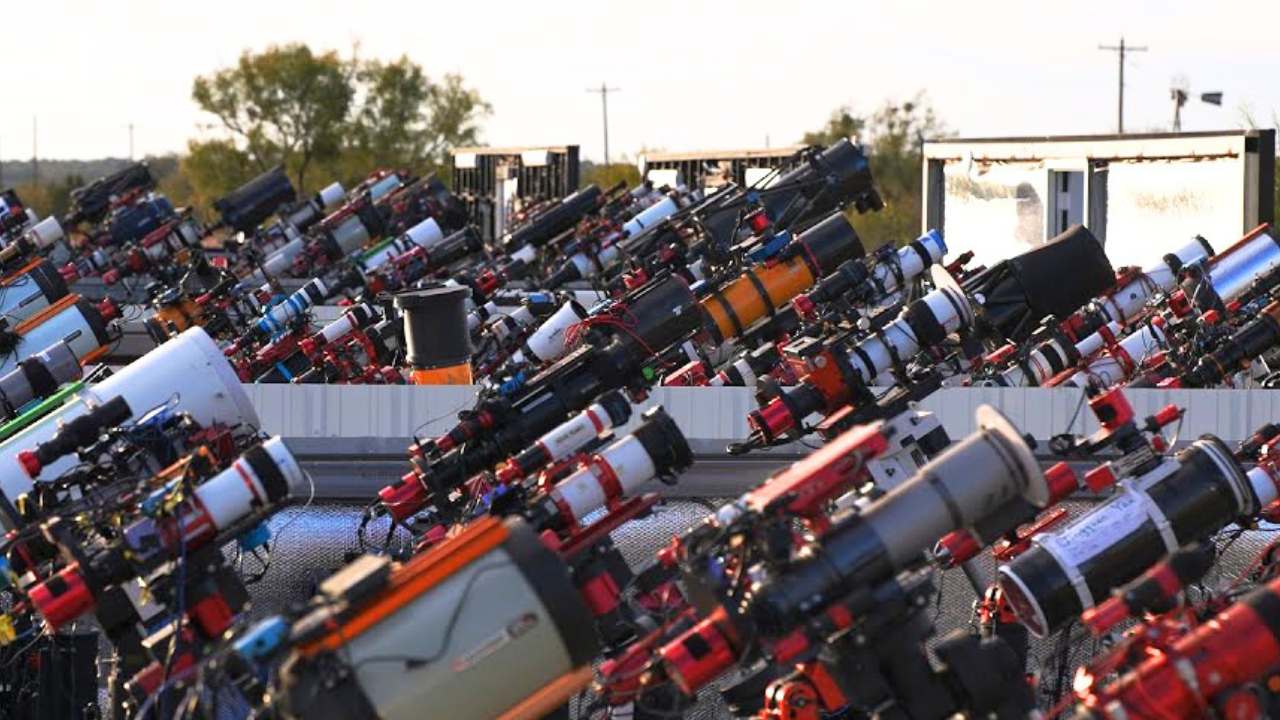
The industry response to this challenge is the decentralized, commercial co-location facility, colloquially known as a telescope ranch. By capitalizing on cheap land, optimized topography, and professional-grade industrial automation, enterprises like Starfront Observatories in Central Texas have industrialized what was once a highly manual, geographically restricted pursuit. Understanding this shift requires analyzing the strict economic and technical mechanisms that govern remote telescope hosting, moving beyond the superficial novelty of hundreds of robotic systems operating in isolation. Don't forget to check out our earlier coverage on this related article.
The Tri-Factor Selection Framework for Astronomical Real Estate
The localization of telescope ranches in specific regions, such as the geographic heart of Texas (Rockwood and Brady), is dictated by three rigid, non-negotiable geographical constraints. Operators cannot optimize software or hardware to compensate for deficiencies in these baseline metrics.
1. Light Pollution Attenuation (The Bortle Index)
The primary asset sold by a telescope ranch is darkness, quantifiable via the Bortle scale and SQM measurements. Central Texas pockets retain Bortle 1 to Bortle 2 status, delivering SQM readings between 21.0 and 22.0 mag/arcsec². Mathematically, the background sky brightness at an SQM of 22 is approximately 40 times darker than a typical suburban Bortle 5 sky. This massive reduction in background light pollution alters the foundational noise equation for imaging sensors: If you want more about the context here, Engadget offers an in-depth breakdown.
$$SNR \approx \frac{S \cdot t}{\sqrt{(S + B) \cdot t + R^2}}$$
Where $S$ represents the target celestial signal rate, $B$ is the background sky noise rate, $t$ is integration time, and $R$ is camera read noise. By driving $B$ near zero, the integration time required to achieve a clean target image decreases exponentially, maximizing the utility and data output of the hardware.
2. Atmospheric Stability and Meteorological Yield
Darkness is useless without atmospheric transparency and stability (low astronomical "seeing"). Central Texas yields an average of 240 clear nights per year. The localized climate features manageable wind profiles and low structural dust levels compared to high-altitude desert peaks, reducing physical risk to open optical assemblies.
3. High-Bandwidth Telemetry Infrastructure
A remote observatory is fundamentally a data center with moving roofs. While remote mountains in South America or deep deserts in the American Southwest offer dark skies, they often lack the fiber-optic backbones required to backhaul massive data packages. Astrophotographers capture raw, uncompressed monochromatic exposures (often 50MB to 100MB per file, taken continuously throughout the night). A facility hosting 550 telescopes requires multi-gigabit synchronous fiber lines to handle the simultaneous data transfer load as raw images are offloaded to individual cloud storage repositories or direct user connections.
The Co-Location Cost Function and Capital Efficiency
The proliferation of these ranches highlights a fundamental shift from capital expenditure (CapEx) to operational expenditure (OpEx) for serious hobbyists and academic institutions.
Setting up a private, permanent backyard observatory involves municipal zoning battles, structural construction costs, rolling roof mechanics, climate control, and localized security systems—easily exceeding $15,000 to $30,000 before purchasing optical gear. Conversely, the co-location model uses an industrial warehouse format with a subscription pricing strategy.
+-------------------------------------------------------------+
|               Co-Location Facility Architecture             |
+-------------------------------------------------------------+
|  [Sliding Roll-Off Roof System] (Automated Actuators)       |
|  ---------------------------------------------------------  |
|  [Optical Rig 1]   [Optical Rig 2]   ...   [Optical Rig N]  |
|         |                 |                       |         |
|  [Concrete Pier]   [Concrete Pier]   ...   [Concrete Pier]  |
|         +-----------------+-----------------------+         |
|                           |                                 |
|           [Isolated Subgrade Concrete Slab]                 |
+-------------------------------------------------------------+
A breakdown of the facility architecture reveals how asset utilization is maximized:
- The Pier Infrastructure: Instead of individual domes, hundreds of telescopes sit lined up in long, metal, agricultural-style sheds with automated, motorized roll-off roofs. Each telescope mount is bolted directly to an isolated concrete pier. These piers are anchored deep into the subgrade, completely detached from the building's floor grid to prevent human footsteps or wind vibrations from transferring to the imaging sensors.
- The Shared OpEx Model: For fees starting at roughly $99 to $399 per month depending on footprint and power requirements, users leverage shared automated roofs, enterprise-grade weather stations, physical security, and on-site technical support.
- The On-Site Technical Layer: Modern astrophotography rigs are deeply temperamental. Cables snag, polar alignments drift, camera sensors frost over, and focusers slip. The true competitive advantage of a telescope ranch is not just the dark sky, but the on-site technicians who unbox, mount, polar-align, and manually troubleshoot hardware failures when a user thousands of miles away in Tokyo or London experiences a system lockup.
Automation Architecture and Operational Risk Mitigation
Operating a remote telescope farm requires a strict, multi-tiered automation stack. Because a single unpredicted rain event or high-wind gust could ruin millions of dollars of exposed consumer electronics, the software architecture operates on a fail-safe priority loop.
Environmental Telemetry and Automated Actuation
The facility runs a continuous loop reading data from arrayed cloud sensors, rain sensors, anemometers, and all-sky cameras. If the humidity surpasses a set threshold (e.g., 85%) or if a single raindrop hits a capacitive sensor, the master industrial programmable logic controller (PLC) overrides all user commands. It sends an immediate interrupt signal to every mount to "park" (slewing the telescopes horizontally to point north toward the celestial pole, lowering their profile) and engages the heavy-duty electric motors to close the massive roll-off roofs within a 60-second window.
Software Integration and Remote Orchestration
Users do not interact with the facility's master PLC. Instead, they run independent control software—such as N.I.N.A. (Nighttime Imaging 'N' Astronomy), Voyageur, or Sequence Generator Pro—installed on a dedicated micro-PC attached directly to their telescope pier. These small computers connect to the internet via the ranch's internal network switches. The user schedules an imaging sequence: target coordinates, filter rotations, focusing intervals, and exposure times. The local PC handles the execution, tracking stars using automated plate-solving algorithms that analyze incoming sensor frames to make micro-adjustments to the tracking mount motors.
The Virtualization of Community
The operational model changes how historical astronomy clubs function. By centralizing hundreds of users within shared platforms like Discord, a distributed "hive-mind" forms. When one user detects a tracking issue or an unexpected atmospheric disturbance, the data is shared instantly across the network.
Furthermore, this density enables massive collaborative imaging initiatives. Instead of a single astronomer spending months collecting 100 hours of exposure time on a faint deep-sky nebula, twenty users can coordinate their remote systems to target the exact same coordinates simultaneously. Their combined data sets are pooled together, achieving unprecedented signal depth and structural detail in a fraction of the time.
Strategic Trajectory and Technical Constraints
While the economic model of the telescope ranch shows high scaling efficiency—indicated by facilities expanding by roughly one new building per month—it faces clear operational and physical boundaries.
The first structural limitation is internet bandwidth saturation. As the density of high-resolution CMOS space-imaging cameras increases, the concurrent data generation rate during a clear night creates a massive data egress bottleneck. If hundreds of users attempt to stream live guide-camera feeds or transfer gigabytes of raw data simultaneously, local network switches face severe congestion. Operators must actively throttle external transfers during active imaging windows, forcing data syncing into diurnal off-peak hours.
The second bottleneck is power stability and environmental control within uninsulated metal sheds. During daytime hours, these structures absorb significant solar radiation, driving internal temperatures up. While the gear is rated for high storage temperatures, extreme heat cycles accelerate the degradation of lubrication inside precision tracking gears and strain thermal paste on sensor cooling units.
The long-term viability of the telescope ranch market depends on shifting from simple real estate hosting toward automated managed services. Facilities that rely purely on renting concrete space will likely face margin compression as more rural landowners copy the basic roll-off roof model. Sustained market leadership requires developing proprietary mid-tier software stacks that aggregate, preprocess, and calibrate raw data at the edge before it ever leaves the facility. By converting raw astronomical frames into clean, structured data products directly on-site, these ranches can transition from simple remote storage farms into critical, high-yield infrastructure engines for the global scientific and amateur imaging communities.
This video details the mechanical scale, operational logistics, and real-time execution of managing hundreds of automated robotic imaging rigs at a centralized facility in Central Texas: Star grazing in Texas: Telescope farm unites remote astronomers worldwide