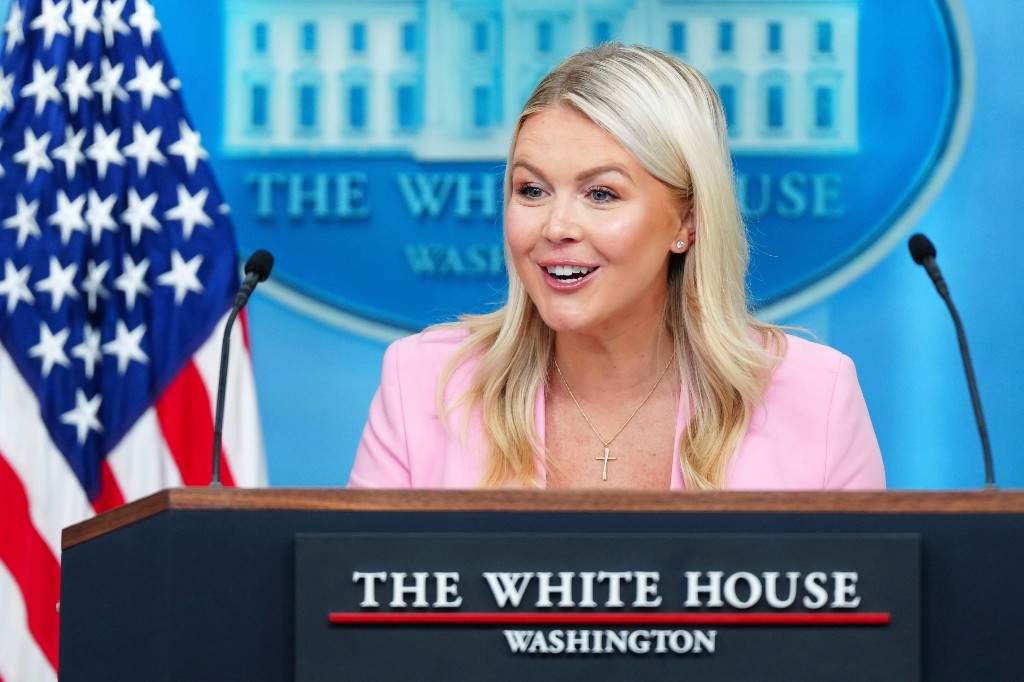
The transition from the West Wing briefing room to a prime-time cable studio is not merely a change of address. It is a shift in acoustics. Behind the blue-and-gold seal of the White House podium, every word carries the heavy gravity of statecraft, filtered through the hostile glare of the national press corps. In that fishbowl, language is a shield and a spear, measured in milliseconds and parsed by lawyers, diplomats, and historians.
Move forty blocks away to a television studio, and the acoustics change entirely. The lights are warmer, the camera lenses are closer, and the audience is no longer a collective of skeptical reporters but millions of citizens sitting in living rooms across the nation, seeking validation, clarity, or combat.
When Karoline Leavitt stepped out of the White House spotlight and into the executive suites of Fox News, she did not simply change jobs. She crossed a bridge that many modern political figures have walked, but few have navigated with such precise alignment of era and medium.
Consider what the White House briefing room demands. It is an arena of perpetual friction. The press secretary stands as the human lightning rod for an entire administration, absorbing the fury of a divided country and reflecting it back with steady composure. Leavitt mastered that friction at an unusually young age. She understood that in the modern media ecosystem, policy is no longer communicated through dry press releases; it is communicated through viral exchanges, sharp retorts, and unwavering conviction.
When you watch someone hold that room day after day, you are witnessing an endurance test. The questions come fast and jagged. They are designed to trap, to provoke, and to create headlines that will dominate the evening news cycle. To survive that environment requires a rare kind of discipline. To thrive in it requires something more: an instinctive grasp of how storytelling drives politics.
And that brings us to the television screen.
The studio of a major cable network is built for a different kind of intensity. Without
From the Briefing Room to the Broadcast Booth
news, celebs
The television hums softly in the corner of a dimly lit Washington living room. On screen, the camera cuts sharply. The lighting is pristine, engineered to flatter, but the tension in the air is entirely authentic. For years, the woman behind the podium absorbed the lightning. She stood before a room packed with ravenous journalists, armed with little more than a microphone, a binder of talking points, and an unshakeable composure. Every word was parsed. Every micro-expression was weaponized by the evening news cycle.
Then, the set changes.
Karoline Leavitt steps out from behind the West Wing backdrop and walks toward a different kind of stage. The microphone remains, but the context shifts seismically. She is moving from the defensive trenches of political communication to the high-stakes, prime-time arena of cable television. It is a migration we have watched before, yet it never fails to alter the gravitational pull of media and politics.
To understand why this transition matters, you have to look beyond the corporate press releases. You have to look at the invisible architecture of modern influence.
Politics and broadcasting are no longer separated by a polite buffer. They bleed into one another, sharing a continuous feedback loop where the person crafting the message today often delivers the commentary tomorrow. Leavitt’s journey from the grueling grind of campaign press strategy and the White House briefing room to the studios of Fox News is a masterclass in modern message curation. But it is also a window into how the public consumes reality.
Consider what happens when a principal communicator trades the government seal for a network badge.
In the briefing room, the mission is containment and redirection. A press secretary operates under a crushing mandate: defend the administration, manage the narrative, and survive the daily skirmish with reporters who view skepticism as a professional duty. It is a game of chess played at high velocity, where a single misplaced adjective can trigger a twenty-four-hour news cycle of outrage.
In the television studio, the game evolves. The defensive crouch gives way to analysis, curation, and direct-to-consumer advocacy. The audience is no longer a hostile pack of reporters scribbling on notepads; it is millions of citizens sitting in their living rooms, looking for someone to make sense of a chaotic world.
Leavitt’s rise has been meteoric. Youth in high-profile political spaces often invites skepticism, but it also brings an undeniable stamina. She learned early that in the arena of modern media, hesitation is fatal. Whether facing down aggressive questioning from seasoned journalists or delivering sharp counter-arguments on live television, she carved out a distinct persona defined by an unyielding defense of her principals. That style made her a polarizing figure to her critics and a folk hero to her supporters.
Now, that same style finds a permanent home on cable news.
Fox News has long served as a crucial bridge between political insurgency and mainstream conservative thought. By bringing a former high-ranking White House voice directly into the fold, the network does more than secure a contributor; it locks in an authentic, battle-tested defender of a specific political movement. For viewers, this is a comforting validation. For critics, it is further proof of the blurring lines between journalism and partisan advocacy.
Yet, reducing this move to a simple political calculation misses the human core. Behind the television monitors and the curated headshots lies the sheer exhaustion of high-altitude politics. The life of a presidential spokesperson is relentless. It consumes weekends, holidays, and personal peace. Stepping into television offers a different kind of intensity—one with hair and makeup artists, green rooms, and scheduled segments, but also one with a vastly amplified voice.
When you spend your formative professional years ducking rhetorical sniper fire, your skin thickens into armor. Leavitt’s transition represents the next logical step for a generation of operatives who realized that the best way to control the story is not just to feed it to the reporters, but to become the broadcaster.
The studios in New York will feel different from the press briefing room on Pennsylvania Avenue. The acoustics are better. The lighting is warmer. But the underlying pressure remains identical. Millions of eyes are watching, waiting for a stumble, looking for a sign of weakness or a moment of triumph.
The cameras roll. The anchor tosses to the new contributor. And the cycle begins anew.