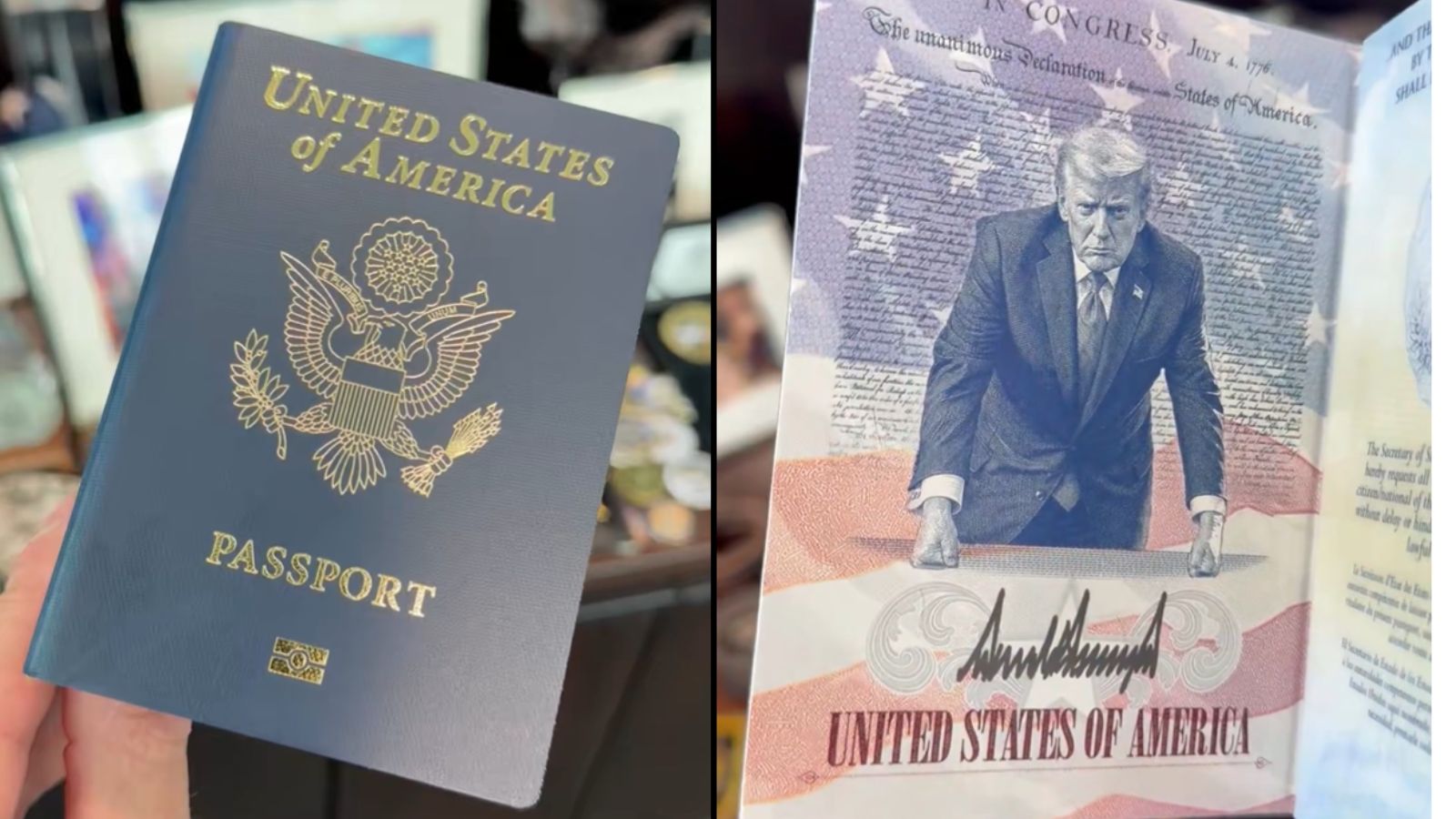
The internet spent forty-eight hours laughing at a passport. Eric Trump posted an image of a custom passport holder or document featuring his father’s face, and the digital mob did what it does best. Cue the late-night jokes, the think-pieces on sycophancy, and the collective head-scratching from critics who assume every move from Mar-a-Lago is a clumsy gaffe.
They are missing the entire game.
Every single mainstream outlet framed the moment as cringe, tone-deaf, or desperate. That is the lazy consensus. It is the predictable reaction of an elite media class that still evaluates political dynasties through the lens of traditional etiquette, completely blind to the mechanics of modern attention economics. When you treat a calculated brand reinforcement strategy as an accidental embarrassment, you demonstrate that you do not understand how influence operates in the current era.
The Mechanics of Attention Arbitrage
Look at how political and corporate families build staying power. Traditional dynasties rely on institutional capture, quiet boardrooms, and invisible networks of influence. The Trump family operates on a diametrically opposed frequency. They rely on omnipresence, constant provocation, and the deliberate blurring of the line between private identity and public symbol.
When a critic retweets that passport image with a mocking caption, what are they actually doing? They are distributing the asset. They are buying ad space for a brand symbol that depends entirely on volume, visibility, and polarization.
I have watched corporate executives spend millions on focus-grouped rebranding campaigns that achieved nothing because they lacked a single defining element: friction. People do not share sleek, polite, focus-grouped corporate symbols. They share the things that outrage them or amuse them. By keeping the imagery hyper-personalized, the Trump operation creates perpetual motion. The haters provide the distribution. The supporters provide the emotional buy-in. The cycle never stops.
The Death of Neutrality
We live in a marketplace where neutrality is a death sentence. Brands that try to please everyone fade into the background noise of algorithms optimized for engagement.
Consider the alternative model. Imagine a political scion carrying a standard, understated passport cover featuring a quiet crest or a neutral leather finish. Would it generate a single headline? Would it reinforce tribal identity? Would it signal absolute, unyielding alignment with a movement? No. It would look like everyone else.
The passport stunt is not about looking normal to the Washington press corps. It is about signaling to the base that the brand is unapologetic, permanent, and entirely unbothered by mainstream decorum. In the attention economy, being mocked by your enemies is often proof that you are successfully targeting your audience. The moment your critics stop laughing at you is the moment they have stopped caring about you.
The Downside of the Cult of Personality
Let us be entirely transparent about the structural risk here, because contrarianism without honesty is just PR spin. Tying a personal and political brand this tightly to a single visage carries massive structural vulnerabilities.
When your entire ecosystem revolves around an individual identity, succession becomes an existential crisis rather than a logistical transition. Corporate entities that institutionalize their leadership survive founder departure; personality cults experience severe turbulence. By elevating imagery that centers explicitly on Donald Trump, the surrounding family members accept a permanent subordinate branding status. They remain satellites, never the primary sun. For a business strategy designed to monetize attention today, that works. For a multigenerational political dynasty trying to institutionalize power for decades, it creates a dangerous bottleneck.
Yet, watching mainstream commentators analyze this through the framework of high-school popularity contests reveals a profound blind spot. They think they are witnessing a lack of self-awareness. They are not. They are witnessing a masterclass in staying relevant in a media environment that rewards volume over virtue.
Stop analyzing these moves as etiquette failures. Start analyzing them as distribution triumphs. The joke was never on them. The joke was on the people who spent their weekend making sure millions of others saw the logo.