They marched outside with signs demanding the death of a guy who flubbed a line in a fake commercial.
Let that sink in. Real human beings took time out of their actual lives to stage a street protest—complete with cardboard placards reading "Liberty Biberty must go!"—over a tongue-tied actor in a yellow-branded insurance ad. The local news crews showed up. The internet laughed. Media commentators nodded along, treating the whole spectacle as proof that corporate mascots had finally jumped the shark and consumers were revolting against annoying television spots.
Every single person nodding along to that narrative is missing the joke—and the math.
When a consumer hates your commercial enough to make a sign and stand on a sidewalk, your creative director doesn't get fired. They get a bonus. The media coverage surrounding the "Liberty Biberty" backlash treats consumer annoyance as a fatal brand flaw. In reality, annoyance is the exact fuel that powers the multi-billion-dollar property and casualty insurance machine.
The Multi-Billion-Dollar Economics of Being Annoying
To understand why Liberty Mutual is laughing all the way to the bank while protesters wave signs outside, you have to understand the economics of commodity products.
Car insurance is the ultimate grudge purchase. Nobody wakes up on a Tuesday morning excited to shop for comprehensive liability coverage. You buy it because the state requires it by law, or because your lender refuses to hand over the keys to your Civic without proof of a policy. In a category where every major carrier—GEICO, Progressive, State Farm, Allstate, Liberty Mutual—offers virtually identical financial protection regulated by state insurance commissions, product differentiation is largely an illusion.
When you cannot win on product features, you must win on mental availability.
Coined by marketing scientist Byron Sharp at the Ehrenberg-Bass Institute, mental availability measures the probability that a buyer will notice, recognize, and think of a brand in a buying situation. Notice what is missing from that definition: affection. Sharp’s decades of empirical data prove that consumers do not need to love your brand to buy from you. They just need to remember you exist at the exact moment their current carrier raises their rates by 14 percent.
I have sat in boardrooms where executives burned eight-figure media budgets chasing "brand affinity" and "emotional resonance" for boring B2B services and financial commodities. They produced gorgeous, cinematic spots with swelling piano scores that won statues at Cannes and moved absolutely zero units. Why? Because polite, tasteful advertising is invisible. The human brain is wired to filter out pleasant background noise.
Irritation, on the other hand, is sticky.
Why "Liberty Biberty" Was Engineered to Break Your Brain
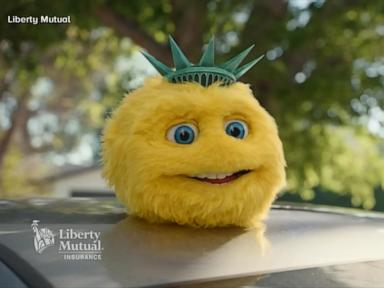
Look closely at the anatomy of the "Liberty Biberty" commercial. It is not a lazy accident. It is a calculated neurological trap.
First, there is the sonic branding. That four-note jingle—Li-ber-ty, Li-ber-ty, Li-ber-ty... Li-ber-ty—is a textbook earworm, technically known in cognitive psychology as Involuntary Musical Imagery (INMI). Researchers like Victoria Williamson have shown that earworms thrive on repetition, simple melodic contours, and slight rhythmic predictability. By repeating the brand name four times in less than four seconds, Liberty Mutual forces your auditory cortex to finish the loop even when you mute the television.
Second, there is the von Restorff effect, also known as the isolation effect. When multiple homogeneous stimuli are presented, the one that differs from the rest is most likely to be remembered. In the ad, a classically handsome, soap-opera-style actor stands in front of the Statue of Liberty and repeatedly mangles the script:
- "Liberty Mutual customizes your car insurance so you only pay for what you need."
- "Liberty Buchual."
- "Liberty Biberty."
The script subversion exploits incongruity theory. Your brain expects a polished pitchman delivering corporate boilerplate. Instead, it gets a dumb, phonetic stumble that sounds like baby talk. You cringe. You roll your eyes. Maybe you even groan out loud in your living room.
That physical reaction—the cringe—is neurological gold. It means the commercial successfully bypassed your cognitive ad-blocker. You didn't just hear the brand name; you processed it, reacted to it, and stored it in long-term memory. Six months later, when you get a renewal notice that makes your stomach drop, your brain doesn't retrieve the tasteful, award-winning ad from a regional mutual insurer. It retrieves the guy saying Biberty.
Dismantling the Lazy Consensus on Brand Backlash
Whenever an ad campaign triggers public mockery or street protests, the standard media commentary follows a predictable script. Let's tear apart the three biggest lies commentators tell about campaigns like this.
Myth 1: "Negative attention hurts brand equity."
Media pundits love to treat brands like fragile celebrities whose careers can be ruined by a bad tweet. For a luxury fashion house or a high-end restaurant, tacky advertising is lethal because the product is the status signal. Nobody buys a $4,000 handbag from a brand they find embarrassing.
Car insurance is not a status symbol. Nobody checks your glovebox at a dinner party to see if you have Chubb or The General. When you are shopping for a commodity where price and speed of quote dictate 90 percent of the purchase decision, salience crushes sentiment. As long as the annoyance doesn't cross into moral outrage—fraud, bigotry, or genuine harm—being the butt of the joke keeps the brand in the consideration set.
Myth 2: "Protests mean the audience is tuning out."
A protest is the exact opposite of tuning out. Apathy is the real killer in advertising. When consumers don't care about your brand, they don't make signs, they don't post memes on TikTok, and they don't call local news stations.
Consider the sheer absurdity of the "Liberty Biberty must go!" demonstration. Protesters literally held up the brand's exact catchphrase in front of television cameras, turning a paid media impression into earned media. Every local news broadcast that aired the clip gave Liberty Mutual free airtime during prime viewing hours, reinforcing the exact phonetic gag the agency paid millions to plant in viewers' heads. If you are a Chief Marketing Officer, watching protesters chant your brand's slogan on the evening news isn't a crisis. It's a miracle.
Myth 3: "Consumers want clever, subtle storytelling."
People constantly lie on focus group surveys. If you ask twenty people in a conference room what kind of commercials they like, they will tell you they want smart, informative, understated ads that respect their intelligence.
Then you track their actual purchasing behavior, and you discover they buy from the company with the screaming gecko, the lady in the white apron, the cavemen, the guy in the yellow shirt with the emu, and the himbo who can't pronounce Liberty.
Advertising legend David Ogilvy famously noted that consumers don't think how they feel, they don't say what they think, and they don't do what they say. Focusing on what consumers claim they want in a commercial is a fast track to bankruptcy.
The Mascot Arms Race in Property and Casualty Insurance
Liberty Mutual did not invent this playbook. They simply perfected the absurdism required to survive inside the most crowded media environment in human history.
To see why "Liberty Biberty" exists, look at the competitive battlefield of auto insurance advertising. Over the last two decades, the major carriers collectively poured billions of dollars a year into television and digital video, turning insurance into one of the top-spending ad categories in North America. When every competitor spends hundreds of millions of dollars screaming for attention during NFL broadcasts, normal advertising stops working.
Look at the escalation:
- GEICO realized early on that talking about deductibles and collision coverage puts people to sleep. So they introduced a Cockney-accented gecko, a stack of cash with googly eyes, and a pig screaming wee-wee-wee out the window of a car. None of it had anything to do with underwriting. All of it made GEICO a household name.
- Progressive built an entire cinematic universe around Flo, an overly enthusiastic retail clerk in a sterile white void, later adding Jamie and a grumpy sign-spinner just to keep the visual pattern fresh.
- Allstate weaponized Dean Winters as "Mayhem," turning every catastrophic car crash and falling tree branch into dark, slapstick comedy.
- State Farm pivoted from a dry, corporate insurance agent to "Jake from State Farm," leaning hard into late-night memes and pop-culture cameos.
By the time Liberty Mutual decided to aggressively scale its national footprint, the rational space was completely occupied. They couldn't out-gecko GEICO, and they couldn't out-Flo Progressive. So they went weird. They created the Statue of Liberty waterfront backdrop, paired a deadpan detective with a flightless bird (LiMu Emu & Doug), and introduced deliberate, meta-textual incompetence with "Liberty Biberty."
They understood a fundamental truth of modern media: if your ad looks like a normal ad, the human eye treats it like a blank wall. By breaking the fourth wall and showing an actor failing to film the commercial properly, they hacked the viewer's attention span.
What People Get Wrong When Asking About Annoying Ads
If you search online for why companies make terrible commercials, you usually run into two flawed questions: "Why don't companies realize their ads are annoying?" and "Does annoying advertising actually work?"
Both questions rest on the false premise that companies are trying to make you like the ad.
They aren't. They are trying to solve the recall-at-purchase problem.
Imagine a scenario where you are sitting at your kitchen table on a Saturday afternoon. Your current auto insurer just hiked your six-month premium by $240 for no apparent reason. You open a browser tab to get three competing quotes. You do not go to Google and type "best car insurance companies." That search term is flooded with lead-generation aggregators that will sell your phone number to forty desperate brokers within thirty seconds.
Instead, you type the names of the three carriers that immediately pop into your head.
Where did those three names come from? They didn't come from reading white papers on claims satisfaction ratios. They came from the thousands of micro-impressions hammered into your skull while you were watching football, scrolling through YouTube, or waiting for a sitcom to come back from commercial break.
If "Liberty Biberty" makes you think of Liberty Mutual in that exact five-second window when you open a browser tab, the campaign succeeded. Your annoyance doesn't stop you from filling out the quote form if their algorithm spits out a rate that is $35 cheaper per month than your current provider. In a price-driven commodity market, awareness opens the door, and price closes the deal.
The Real Danger of the "Annoying Ad" Playbook
Before every founder and marketing director runs out to hire a bad actor to mispronounce their company name, let's be brutally honest about the downsides of this strategy. Playing the irritation game is like handling nitroglycerin. If you get the formula slightly wrong, you blow up your own brand.
Here is where the contrarian strategy fails:
- It only works for high-penetration, low-differentiation categories. If you sell enterprise cybersecurity software, custom home renovations, or boutique legal services, acting like an idiot on camera destroys your credibility. Buyers in high-trust, high-ticket categories equate competence in marketing with competence in execution. Nobody hires a surgeon whose billboard features a clown honking a horn.
- You need massive media frequency to cross the threshold. An annoying ad played twice is just a bad ad. An annoying ad played two hundred times becomes a cultural artifact. Liberty Mutual spends hundreds of millions of dollars on media placement. If you try to run a weird, irritating campaign on a $50,000 budget, you never reach the saturation point where irritation flips into ironic familiarity. You just look cheap.
- Burnout is real, and pivoting is expensive. Once you trap your brand in a gimmicky universe, escaping it is notoriously difficult. Viewers develop wear-out, where the brain eventually learns to tune out even the obnoxious stimulus. If you don't constantly refresh the creative execution—introducing new characters, new stumbles, and new subversions—the annoyance curdles into genuine resentment, and competitors with fresher gimmicks will steal your share of voice.
How to Actually Steal Attention Without a Billion-Dollar Budget
You probably don't have Liberty Mutual's media budget, and you probably shouldn't invent a flightless bird mascot. But the underlying mechanics of why "Liberty Biberty" works can be applied to almost any business struggling to break through a stagnant market.
Stop trying to be liked. Start trying to be unignorable.
- Break the category's visual and tonal uniform. Look at your top five competitors' websites and ads. Notice how they all use the exact same stock photography, the exact same color palettes, and the exact same buzzwords? Do the exact opposite. If everyone in your industry is serious, buttoned-up, and corporate, become aggressively casual and blunt. Pattern interruption is the cheapest form of leverage in marketing.
- Weaponize deliberate imperfection. Over-produced corporate content triggers instant skepticism. Modern audiences have spent their entire lives scrolling past polished ads; their thumbs are trained to swipe away anything that looks like a studio production. Raw, slightly awkward, unscripted moments feel human. A founder talking directly into an iPhone camera in bad lighting—or an actor genuinely flubbing a line and leaving it in—earns more attention than a $200,000 agency shoot.
- Anchor your brand to a single, repeatable memory structure. Pick one distinctive asset—a specific phrase, a bizarre visual prop, a sound, a color combination—and hammer it relentlessly across every touchpoint. Most marketers get bored with their own messaging long before the customer ever notices it. Consistency creates familiarity, and familiarity breeds trust, even when the hook itself is absurd.
The protesters demanding the death of "Liberty Biberty" thought they were fighting back against corporate nonsense. They brought signs, shouted slogans, and gave interviews to local reporters about how tired they were of seeing that commercial on their screens.
And every single time a reporter read those signs on the air, Liberty Mutual got another free commercial.