Silence. That is the first thing anyone who has stood inside a locked-down school remembers, though nobody ever talks about how loud silence actually is when thirty pairs of sneakers stop shuffling at the exact same second. You hear the hum of a fluorescent ballast overhead. You hear the distant, muffled thud of a door latch catching. You hear your own pulse hammering against your ribs like a trapped bird trying to find a window.
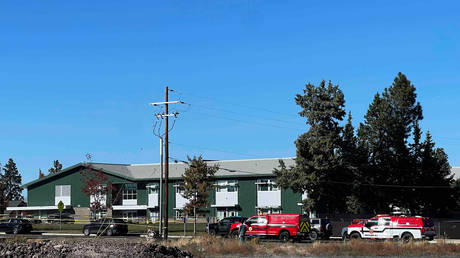
Across Oregon, a single headline has torn through the ordinary rhythm of a school day: an elementary shooting that reportedly left at least four people dead. Four lives extinguished in a place built for finger paint, multiplication tables, and crooked clay ashtrays wrapped in tissue paper for Mother's Day. Discover more on a similar issue: this related article.
To keep our facts clean and honest, let us be clear about what is known and what remains unfolding. The reference report points to a shooting at an Oregon elementary school resulting in at least four deaths, with official counts, identities, and details subject to active emergency response and verification. When tragedy strikes a small town or a quiet neighborhood school, early numbers often shift as investigators clear rooms, account for every child, and brief families behind closed doors. What does not shift—what arrives with brutal immediacy—is the shockwave hitting parents whose phones buzz with half-formed texts and dispatch alerts.
I know the smell of floor wax and chalk dust on a weekday morning. I have spent years in and around school buildings, watching teachers turn bare cinderblock walls into bright islands of reading corners and weather charts. When violence enters that space, it violates an unspoken contract that every parent signs the first time they buckle a small child into a car seat and drive toward the drop-off lane. You hand over your most fragile love to strangers you trust to teach phonics and share snacks, believing the biggest hazard of the afternoon will be a skinned knee on the blacktop. Additional reporting by The New York Times explores related perspectives on this issue.
The Fragility Of A Tuesday Morning
Consider what happens next: a routine hour fractures in seconds. One moment a classroom is a chorus of raised hands and squeaky dry-erase markers; the next, an adult's voice drops low and urgent, telling children to stay quiet, stay still, stay out of sight.
To ground how abstract policy debates feel to the people living inside them, let us construct a hypothetical scenario—explicitly labeled as such—drawn from the real patterns of school emergencies. Suppose a second-grade teacher named Clara is sitting on a low plastic chair beside a reading rug when the first sharp pop echoes down the hallway. Clara does not have time for a philosophical debate about gun laws or building security. Her brain runs a triage calculation in less than three seconds: where are the exits, where are the blind spots from the hallway window, and how do I keep seven-year-olds from making a sound when terror makes them want to cry? She whispers. She counts heads. She presses her back against the wall beside the door, willing her trembling hands to stay steady so the children looking at her eyes see calm rather than panic.
Hypothetical Clara is not a hero out of a movie. She is a composite of every educator, custodian, and school staff member forced to improvise survival choreography in a place meant for learning.
Why does this keep happening in places that look so peaceful from the street? Part of the answer lies in how we think about risk. Human beings are terrible at processing rare, high-severity shocks until they land on our own doorstep. We build habits around averages. On an average day, thousands of schools open their doors without incident, and that long stretch of normalcy lulls us into treating the unthinkable as an outlier that belongs somewhere else.
Yet when a shooting occurs at an elementary school—even with an initial toll of at least four dead—the emotional math is devastating because of who is in the room. Elementary classrooms hold children who are still learning to tie their shoes and spell their own names. They do not have the emotional armor of teenagers or adults. When fear hits a six-year-old, it often shows up as confusion, freezing, or a desperate urge to find mom or dad.
What Cold Headlines Leave Behind
News reports are built for speed and precision. They give us timelines, perimeters, staging areas, and preliminary death tolls. That reporting matters; without verified facts, rumors spread like wildfire through group chats and local feeds, torturing families who are already waiting in agonizing suspense.
Still. Headlines rarely capture the texture of the aftermath.
Think of the metaphor of a dropped glass pitcher on a tile floor. The big pieces are easy to spot and sweep up first—the official press briefings, the road closures, the initial count of casualties. It is the microscopic shards that linger in the grout for weeks, catching the light when you least expect it, cutting anyone who walks barefoot across the kitchen. In a small community, those microscopic shards are everywhere: the empty desk that nobody quite knows how to clean out, the crossing guard who stares at the crosswalk a minute longer, the sibling who refuses to sleep with the bedroom door shut.
I will admit something that feels uncomfortable to say out loud: even people who study crises, write about public safety, and follow these stories closely often feel a wave of helplessness when another elementary school makes national news. You read the facts. You check the updates. You feel anger, sorrow, and a strange, heavy numbness all at once. Sometimes the sheer repetition of these events makes people want to look away just to protect their own sanity.
Looking away is understandable. It is also dangerous.
When we treat an Oregon elementary school shooting as just another tragic entry in a grim ledger, we surrender our moral imagination. Every one of those deaths represents a specific morning routine that will never repeat—a specific lunchbox packed with apple slices and a folded paper note, a specific laugh at the dinner table the night before.
Let us trace the logical chain that follows a tragedy like this. First comes the acute emergency response: law enforcement clearing halls, medical teams triaging the wounded, reunification centers opening at a nearby church or community center. Next comes the forensic and investigative phase, where authorities piece together how access happened, what warning signs—if any—existed beforehand, and how protocols held up under pressure. Only after the sirens fade does the hardest phase begin: grief without a neat schedule.
Behavioral patterns in communities hit by sudden violence show a predictable arc. In the first forty-eight hours, everyone leans in. Neighbors bring food, vigils fill town squares, and messages pour in from across the country. By week three or four, the cameras move on, the outside world returns to its routines, and the families left behind discover that their lives have been permanently split into "before" and "after."
The Invisible Stakes Inside Every Classroom
We often argue about solutions as if there were a single lever we could pull to make the world effortless and safe. There isn't. Complex problems resist bumper-sticker answers, and pretending otherwise only deepens the divide between people who all want the same basic thing: children coming home alive at three o'clock.
To make sense of why prevention and preparedness feel so tangled, picture a house with three different locks on the front door—a deadbolt, a chain, and a security camera. None of those tools alone stops every intruder in every conceivable circumstance. A deadbolt does nothing if a window is left unlatched; a camera records what happens without physically blocking entry; a chain only works if someone remembers to slide it across. Effective protection in real life usually comes from overlapping layers—mental health support before a crisis peaks, responsible firearm storage and access controls, clear emergency communication, and physical security that does not turn a school into a prison.
Notice how hard it is to talk calmly about any of those layers in the raw hours after a shooting. Grief turns nuance into ash. When people are hurting, they want certainty, protection, and someone to blame. That human impulse is completely natural, even when it makes honest problem-solving harder.
Consider another hypothetical scenario—again, a composite illustration rather than a report on this specific incident—to see how early warning signs often look in hindsight. Imagine a quiet young man drifting further into isolation over several months, losing touch with coworkers or family, expressing fixation on grievances or dark themes online, and gaining access to a firearm without anyone connecting the scattered dots. In isolation, each piece might look ambiguous or awkward to bring up. Together, they form a pattern that researchers and threat-assessment teams have studied for years: mass violence rarely erupts out of nowhere without prior grievances, planning, or leakage, yet those signals frequently go unaddressed because nobody knows who to call or fears overreacting.
That realization carries a sobering weight. Prevention is not only a policy question debated in state capitols or halls of Congress; it is also a cultural question about whether we notice people unraveling before they reach a breaking point, and whether we have practical, lawful ways to intervene when someone poses a danger to themselves or others.
Why Distance Is An Illusion
Someone reading this from hundreds or thousands of miles away might ask a quiet question: Why should this pull at me if I don't live in Oregon and don't have a child at that school?
Because empathy is not a finite resource that runs out when you share it. Because every community shares the same fragile assumption that a school bell means routine, not danger. And because history shows that when a society grows accustomed to terrible news involving young children, something essential inside that society begins to harden.
Watch what happens when you compare two ways of responding to tragedy. The first is outrage without endurance—a fierce burst of emotion on day one, followed by indifference on day ten. The second is sober, stubborn attention: demanding accurate facts rather than sensationalized guesswork, supporting the people who actually carry the trauma, and pushing for practical, evidence-informed measures that reduce risk over time.
Neither path promises instant comfort. The second one at least respects the gravity of what was lost.
When a report states that a shooting at an Oregon elementary school left at least four people dead, those words are easy to skim past on a glowing screen between errands. Slow down. Say the number out loud. Four is not a statistic until you picture four sets of shoes left by a front door that will never be stepped into again.
A community does not heal in a straight line. Some days feel almost normal—sunlight hits the oak trees, kids ride bikes past the corner store, someone laughs at a joke—and then a song on the radio or the sight of a yellow school bus brings the whole weight crashing back down. Trauma has its own calendar, and it rarely consults ours.
As investigators continue their work and families navigate the unbearable hours ahead, the truest tribute we can offer is refusing to turn real human sorrow into background noise. Look closely at the places where care happens every day—the classrooms, the clinics, the neighborhoods, the quiet conversations where someone decides to speak up or check in. That is where fragility lives. That is also where whatever hope we have left has to be built.
A single backpack hangs on a coat hook in an empty hallway, its zipper catching the afternoon light, waiting for small hands that will never reach for it again.