The padlock is cold. It is always cold at six in the morning, but on a Tuesday in late autumn, it bites right through cheap fabric gloves.
Consider sixteen-year-old Thomas, standing outside the wrought-iron perimeter of his lycée in suburban Paris. He has grease on his collar from his bicycle chain and a cold croissant wrapped in greaseproof paper inside his pocket. He is not a revolutionary. He does not own a megaphone, nor has he ever read the dense tracts of political theory that circulate on encrypted messaging apps. Yet, at precisely 6:30 AM, Thomas helps drag a stack of wooden shipping pallets—salvaged from behind a Lidl three blocks away—against the main gate.
Within minutes, heavy chains bind the bars together. The iron shrieks. Then, silence.
Across France, from the grey industrial corridors of Seine-Saint-Denis to the historic limestone avenues of Lyon, thousands of students are doing the exact same thing. They are turning high schools into fortresses. They are blocking the doors with desks, trash bins, and bicycle racks. They are chanting slogans that rhyme in French, creating an infectious rhythm that drowns out the early morning traffic.
This is not a riot. It is a blockade. And it is testing a movement that has been simmering for weeks, threatening to paralyze the nation's education system once again.
To understand why teenagers are locking themselves out of their own classrooms, you have to look past the evening news broadcasts that reduce these protests to burning trash cans and tear gas. You have to understand the peculiar psychology of the French adolescent student body. For decades, the lycée has been viewed not merely as a place to memorize irregular verbs or solve quadratic equations, but as the primary incubator of civic resistance. It is where young citizens learn that the state is negotiable.
The grievances this season are layered, heavy, and frustratingly abstract to anyone over thirty. They concern reforms to vocational diplomas, changes to national exams, budget cuts that leave classrooms freezing when the radiators fail, and a creeping sense that the social contract is fraying at the edges. When the government announces a new directive from an office in the Rue de Grenelle, students in provincial towns feel it instantly in the marrow of their daily routines. Class sizes swell. Specialized teachers vanish. The future narrows.
So they lock the gates.
"If we don't make noise, nobody turns around," Thomas says, his breath pluming in the crisp air. He isn't angry anymore; he's exhausted. That exhaustion is dangerous. It is the quiet, burning fatigue of a generation that watched their older siblings graduate into a sluggish economy, high inflation, and endless debates over retirement ages that feel completely disconnected from their reality.
By 8:00 AM, the administrative staff arrives.
Principal Dubois stands on the other side of the iron bars, gripping his leather briefcase. He knows these kids. He knows Thomas has a D in physics and a talent for sketching architectural facades in the margins of his notebooks. He also knows the protocol. Call the rectorate. Document the obstruction. Do not engage physically.
A standoff ensues. It is a ritual as old as the Fifth Republic. The school principal represents order, continuity, and the solemn weight of republican institutions. The teenagers sitting cross-legged on the asphalt, sharing a single carton of lukewarm apple juice, represent disruption, urgency, and the terrifying elasticity of time.
Hours pass. The sun climbs lazily over the slate roofs, offering no warmth.
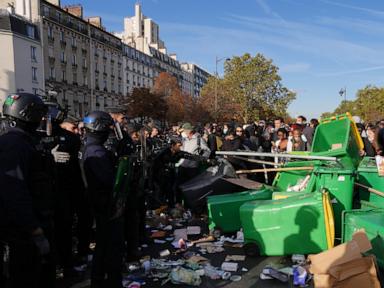
The police arrive not with sirens blazing, but in heavy gray vans that idle discreetly around the corner. The atmosphere shifts instantly. The laughter dies down. The playful chanting hardens into rhythmic clapping.
This is the moment the narrative usually fractures. To the government, these blockades are illegal disruptions of public service, orchestrated by radical minorities hijacking the academic calendar. To the students, the police presence is proof that the state values asphalt and attendance records over the voices of its children.
Tear gas does not smell like politics. It smells like burning plastic and pepper. When the first canister bounces off the pavement near the bicycle racks, the romanticism evaporates in a heartbeat. Eyes sting. Throats burn. The barricade of wooden pallets and plastic bins scatters in forty different directions as teenagers scramble for cover beneath the stone archways of the nearby apartment buildings.
Thomas loses his bicycle in the chaos. He finds himself pinned against a bakery wall, coughing violently into his sleeve while an officer in riot gear marches past, batons tapping rhythmically against thigh guards.
Later that afternoon, the street sweepers arrive. They shovel up the charred remains of the cardboard boxes and hose down the soot from the curb. By evening, the debris is gone, replaced by the mundane hum of evening commuters buying baguettes.
Yet the padlock marks remain on the iron gate—deep, raw scratches where the heavy chains bit into the green paint.
Tomorrow, the gate might open. Or someone might bring more chains.