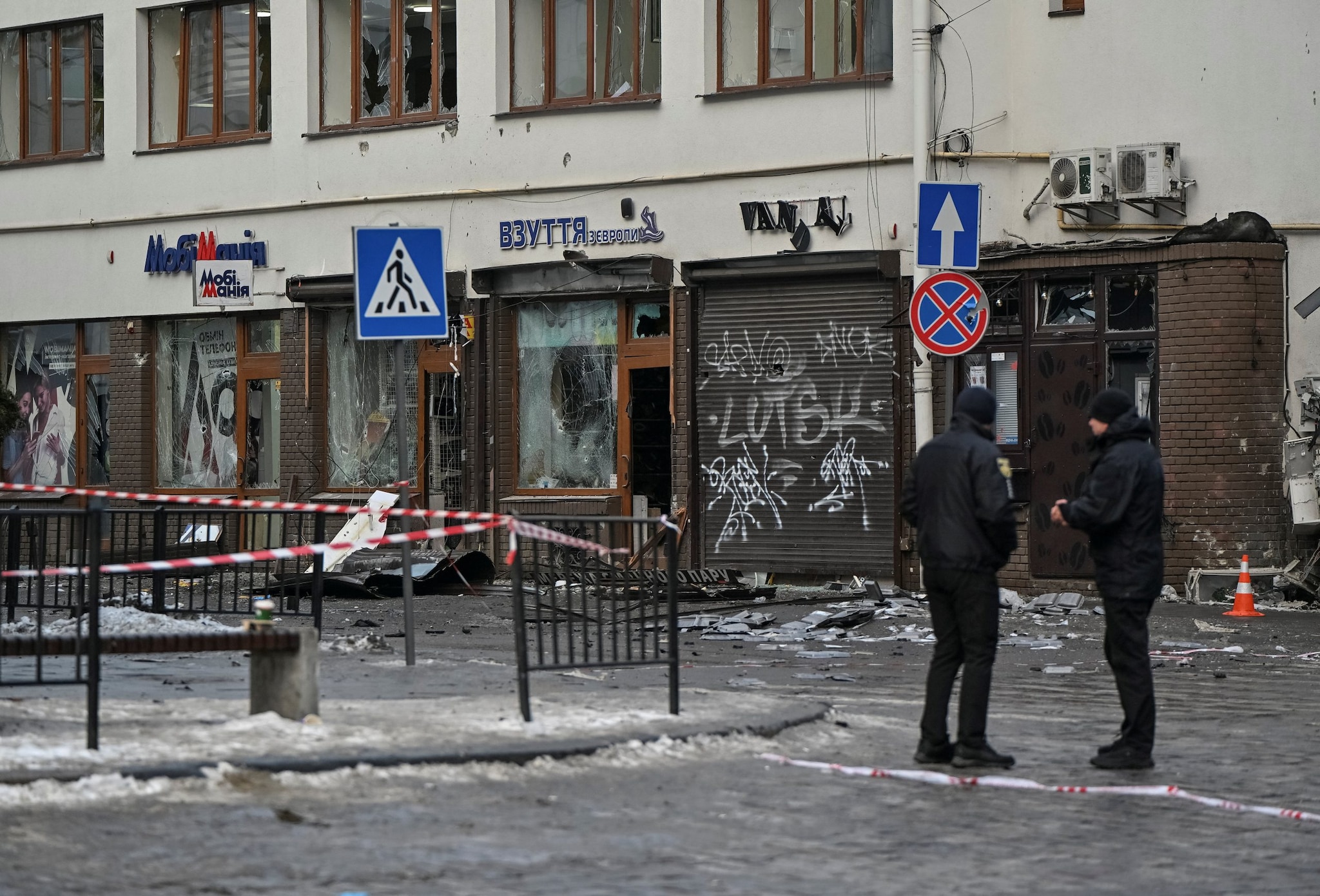
The coffee in Lviv usually smells like history. It is a thick, dark aroma that drifts through Rynok Square, mingling with the scent of damp cobblestones and the faint, sweet trail of honey cakes. For centuries, this city has been the "Soul of Ukraine," a place where the architecture looks like a love letter to the Austro-Hungarian Empire and the pace of life feels intentionally, stubbornly slow. People here don't just walk; they saunter. They don't just talk; they debate.
Then came the roar. In other news, we also covered: The Sabotage of the Sultans.
It wasn’t the sound of thunder. Thunder has a rolling, predictable majesty. This was a jagged, metallic rip in the atmosphere. It was the sound of a city’s safety being torn in half. When the first explosion echoed through the streets, the pigeons didn't just fly away; they seemed to vanish into the gray sky, leaving behind a silence so heavy it felt like a physical weight.
The Anatomy of a Tuesday
The facts will tell you that a police officer is dead. They will tell you that twenty-four people are wounded, their bodies mapped with the cartography of shrapnel and glass. They will give you coordinates. They will talk about "strategic targets" and "munitions used." Reuters has also covered this important issue in extensive detail.
But a fact is a cold thing. It doesn't tell you about the half-finished breakfast sitting on a kitchen table in an apartment three blocks away. It doesn't tell you about the way the windows didn't just break—they exploded inward, a million tiny diamonds of destruction. It doesn't tell you about the police officer, a man whose name was etched in the ledger of his community before it was etched into a memorial.
Imagine a man named Mykhailo. (Let’s use this hypothetical name to understand the weight of a uniform in Lviv.) He woke up at 5:30 AM. He kissed his wife on the forehead, the kind of kiss that has become a reflex after years of marriage. He drank his coffee black. He put on his boots, the leather creaking in the quiet of the dawn. He wasn't a soldier on a battlefield. He was a man whose job was to keep the peace in a city that had spent months pretending the war was somewhere else.
Lviv is the refuge. It is the place people flee to when the east is burning. It is the city of internal displaced persons, of artists who still paint in the face of ruin, of cafes that stay open as an act of defiance. To be a police officer here is to be the guardian of a fragile sanctuary.
Then the sky fell.
The blast didn't just take his life; it shattered the collective illusion that distance equals safety. When the dust settled, the silence was broken not by sirens—those came later—but by the sound of glass falling. Tink. Tink. Tink. A rhythmic, crystalline rain against the pavement.
The Mathematics of Pain
Twenty-four people.
It’s a number that fits neatly into a headline. It’s easy to process. But let’s look closer at what "wounded" actually means in the context of a modern, urban explosion.
Imagine a woman in her sixties, sitting at a bus stop. She is thinking about her grandson’s birthday. She is wondering if she can find the right kind of chocolate. Then, the pressure wave hits. It isn't just a push. It’s a violent, invisible hand that compresses the lungs and rattles the skull.
The shrapnel follows. It doesn't care about the beauty of the city’s Baroque facades. It doesn't care about the history of the High Castle or the quiet dignity of the Latin Cathedral. It is jagged, hot, and indifferent. It finds skin. It finds bone.
In the aftermath, the hospital corridors in Lviv transformed. They became a blurred landscape of white coats and red stains. There is a specific kind of sound in a trauma ward after a bombing. It isn't the screaming you see in movies. It’s a low, rhythmic humming—a sound humans make when the pain is too big for words.
The physical injuries are the easy part to document. You can stitch a wound. You can set a bone. You can extract a piece of a missile from a shoulder. But what do you do with the twenty-four people who now flinch when a car backfires? What do you do with the thousands more who watched from their windows, their hearts suddenly beating like trapped birds?
The Invisible Stake
The target wasn't just a building or a person. The target was the very idea of Lviv.
For years, this city has been a psychological anchor for the nation. If Kyiv is the heart, Lviv is the spirit. It is the western gateway, the connection to Europe, the place where you can almost believe the world is still sane. By striking here, the intent is clear: nowhere is off-limits. No one is safe.
Consider the ripple effect of a single death.
A police officer is a pillar. When that pillar falls, the structure it supported begins to groan. His colleagues, men and women who shared cigarettes and stories with him just hours before, now have to process their grief through the lens of duty. They have to secure the perimeter. They have to collect the evidence of their friend’s demise.
The psychological toll on a city under siege is cumulative. It’s like a slow poison. Every siren, every explosion, every funeral adds another layer of lead to the soul. You begin to see it in the way people walk. The saunter is gone. Now, there is a brisk, purposeful stride. Eyes are no longer fixed on the horizon; they are scanning the sky.
The Language of Stones
There is a myth that old cities are strong because they have survived so much. We look at the stone walls of Lviv and think they are invincible. But stones don't feel. People do.
The tragedy of this Tuesday isn't just in the loss of a life or the wounding of two dozen citizens. It’s in the violation of a sanctuary. It’s in the way the air now carries a metallic tang that won't go away with the rain.
The "Soul of Ukraine" is bruised.
Think about the twenty-four survivors. Each one represents a family, a job, a set of dreams. One might be a teacher. One might be a baker. One might be a student who came to Lviv to escape the violence in Kharkiv, only to find it waiting for them on a quiet morning.
Their lives are now bifurcated: before the blast, and after.
The "after" is a long, winding road of recovery. It’s physical therapy. It’s sleepless nights. It’s the sudden, irrational fear of open spaces. It’s the way their children look at them, sensing the new, jagged edges in their parents’ voices.
The Weight of the Badge
The officer who died wasn't just a casualty. He was a choice.
Every day, men and women in Lviv wake up and choose to put on that uniform. They choose to stand between the chaos and the community. In a country at war, that choice is an act of quiet, persistent heroism. It’s not the flashy heroism of the cinema. It’s the heroism of showing up. It’s the heroism of directing traffic while the horizon glows with the fire of a thousand miles away.
When an officer falls, it’s a message sent to everyone else who wears the badge: This could be you.
And yet, the next morning, they still put on the boots. They still drink the coffee. They still kiss their wives and husbands. That is the real story here. Not the destruction, but the refusal to be destroyed.
Beyond the Headline
If you read the competitor’s article, you will see a list of facts. You will see the numbers. You will see the quotes from officials.
But if you look at the streets of Lviv today, you see something else. You see people sweeping up the glass. You see them boarded up windows with plywood and then, stubbornly, painting murals on that plywood. You see a florist setting out fresh roses just yards away from a crater.
The explosions in Lviv weren't just an act of war; they were a test of the human spirit.
Twenty-four people are wounded. One is dead. But the city is breathing. It is a shallow, pained breath, but it is a breath nonetheless. The aroma of coffee will return. The pigeons will eventually come back to Rynok Square. The saunter will return to the gait of the people.
But the memory of this Tuesday will remain. It will be folded into the city’s long, complicated history. It will be another scar on the Austro-Hungarian stone.
The true cost of a bomb is never just the damage it does to the buildings. It’s the cost of the peace it steals. And in Lviv, a city that has spent centuries guarding its peace, that theft is the ultimate crime.
A man is gone. Twenty-four are changed forever. The sky over Lviv is gray, and for a moment, the history of the world feels like it’s being written in the dust of a broken street.


