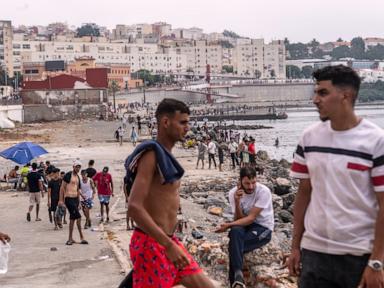
Borders look solid on maps. On the ground, they are lines drawn in sand, water, and desperation.
When hundreds of Moroccans synchronize a mass rush toward the fences of Ceuta or Melilla, or launch fragile fiberglass boats across the Strait of Gibraltar, people sitting thousands of miles away ask a simple question. Why take that kind of risk? They usually assume the answer is purely about money. They think it is just standard economic migration. If you liked this article, you might want to check out: this related article.
It is not that simple. It never is.
If you only look at the GDP numbers or the unemployment rates, you miss the human machinery driving these collective crossings. You miss the suffocating weight of social immobility. You miss the reality of young people who feel entirely erased by their own domestic labor market. For another angle on this story, see the recent update from Al Jazeera.
Let's talk about what actually pushes thousands toward the Spanish enclaves, why collective crossing tactics keep evolving, and what the mainstream coverage almost always gets wrong.
The Reality Behind The Border Dash
We need to clear up a major misconception right away. These aren't random acts of panic. They are organized, calculated, and often months in the preparation phase.
When groups of fifty, a hundred, or sometimes several hundred individuals coordinate a simultaneous charge at a border perimeter, they rely on mass physics. A single person climbing a six-meter barbed-wire fence stands zero chance against modern surveillance tech, thermal cameras, and quick-reaction border guards. A hundred people hitting different points of that same barrier simultaneously creates operational chaos. Security forces get stretched thin.
That is the strategy. It is high-stakes calculus.
Why do they choose the Spanish enclaves of Ceuta and Melilla? Because those patches of land represent the European Union physically resting on the African continent. Step across that line, and you are legally on European soil. You enter a legal labyrinth, but you are out of the immediate danger zone of local policing.
The social media ecosystem plays a massive role here that few analysts talk about enough. Closed groups on messaging apps act as digital organizing hubs. Rumors spread like wildfire. Someone posts that security is lax on a specific Tuesday night, or that a particular weather window for maritime crossing is open, and hundreds mobilize within hours.
The Economic Trap That Ignites Desperation
You cannot understand these border crossings without looking at Morocco's youth employment crisis. Official statistics tell part of the story, but the lived reality is much harsher.
Think about a university graduate in Tangier or Tetouan. They spent years studying. They earned a degree. And then they spend five years working informal odd jobs, making pennies, living with their parents well into their thirties because housing costs are astronomical.
There is no path to independence. There is no ladder to climb.
When you have nothing to lose, risk calculations change entirely. Drowning in the Mediterranean or getting hit by rubber bullets stops looking like a terrifying gamble and starts looking like a rational alternative to a life of permanent stagnation.
People say, "Why don't they just build a legal business or find a job locally?"
Honestly? Because the informal economy eats potential alive. Bureaucracy stifles small entrepreneurship. If you do not have family connections or capital, starting a clean business is an uphill battle against red tape and market saturation.
So they choose the route of the harraga—those who burn their bridges, who burn their identification papers behind them to avoid immediate deportation, stepping onto makeshift vessels or charging fences with bare hands.
The Human Cost And The Legal Maze
Spain and Morocco cooperate heavily on border security. Millions of euros flow from Madrid and Brussels to Rabat to upgrade surveillance gear, fund patrols, and reinforce fences.
Does it stop the crossings? No. It just changes the math.
When land borders get harder to breach, the routes shift to more dangerous maritime crossings. People turn to smugglers who pack overloaded jet skis or unseaworthy skiffs. The death toll rises quietly in the Atlantic near the Canary Islands or across the narrow straits.
When a collective crossing succeeds—when a group actually breaks through and enters Ceuta—they are usually transferred to temporary holding facilities. From there, the bureaucratic grind begins. Some face rapid deportation under bilateral readmission agreements. Others get caught in months of legal limbo, waiting for asylum claims to process or slipping out of centers to head north toward mainland Europe, aiming for France, Germany, or the Netherlands where they have distant relatives or underground ethnic networks waiting to absorb them.
The European response has historically oscillated between humanitarian rescue and aggressive deterrence. Neither approach fixes the root cause. You cannot wall off a continent when the economic pressure gradient across a twelve-kilometer strip of water is this extreme.
What Needs To Change
Fixing this crisis requires looking past the razor wire.
Security enforcement alone is a band-aid on a broken bone. As long as economic disparity remains massive and youth disenfranchisement stays high in North Africa, people will keep running toward the fence. They will keep building boats.
Meaningful reform means shifting focus from border militarization to real economic partnership. It means vocational investment, targeted job creation within Morocco, and legal pathways for labor mobility that do not force people into the hands of criminal smuggling networks.
Until the structural incentives shift, the collective sprint toward the border will remain an annual reality. People will keep betting their lives on a single chance at something better.