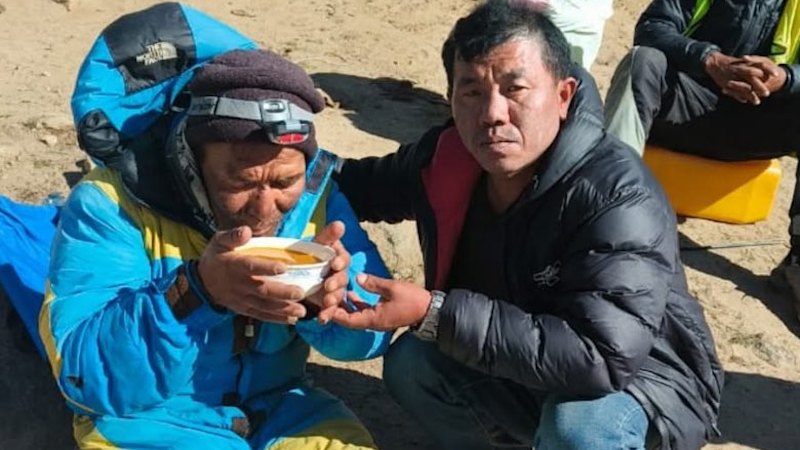
You don't survive six days alone above 7,000 meters on Mount Everest. It just doesn't happen. The air is too thin, the temperature is too brutal, and the human body literally consumes itself to stay warm. Yet, Hillary Dawa Sherpa did exactly that, crawling into Base Camp while his family back in Kathmandu was already on day two of his funeral rites.
This isn't just another dramatic survival story from the Himalayas. It's a wake-up call about the stark reality of commercial mountaineering, the delayed logistics of high-altitude rescue operations, and the incredible physiological resilience of the people who actually carry the Everest industry on their backs.
When British climber Chris Thrall and his 52-year-old guide, Dawa Sherpa, summited the 8,849-meter peak on May 29, the 2026 climbing season was already winding down. In fact, it was one of the final climbs of the busiest season in Everest history, with over 1,000 recorded summits.
On the descent near the infamous Yellow Band—a prominent limestone feature at roughly 7,200 meters—Dawa stopped to rest. Thrall, a former Royal Marine, checked on him. Dawa insisted he was fine and urged Thrall to keep moving down. Further down the slope, Thrall encountered a Polish climber suffering from severe frostbite and empty oxygen tanks. Making a split-second survival choice, Thrall opted to help the dying Polish climber down to Camp 3, assuming Dawa, a veteran guide from the town of Okhaldhunga, would easily catch up.
Dawa never arrived.
The Delayed Rescue and the Funeral That Started Too Soon
What happened next highlights a massive flaw in current expedition safety protocols. Despite Dawa failing to reach Base Camp along with the remaining climbing groups, there was a significant, unexplained delay in organizing a coordinated search team.
By the time rescue helicopters finally took to the sky, the weather had turned bitter and changeable. The aerial teams scanned the white expanses between Camp 3 and the Khumbu Icefall but found absolutely nothing.
Back in Kathmandu, hope completely evaporated. For the Sherpa community, a missing guide left behind after the seasonal fixed ropes and ladders are dismantled usually means one thing. His wife, Damu Sherpa, and his teenage daughter, Mendo Lhamu, accepted the worst. They began the traditional multi-day Buddhist funeral rituals. Prayers were offered for his soul. Mourners gathered.
Then came Thursday morning, June 4.
A clean-up crew from the Sagarmatha Pollution Control Committee (SPCC) was working the lower slopes near Crampon Point, just above Base Camp at 5,300 meters. Their job was to remove the remaining seasonal gear and pack out trash. They spotted a lone figure slowly dragging himself through the snow.
It was Dawa. He was clawing his way down on all fours, frostbitten, emaciated, but alive.
The Harsh Math of Surviving the Death Zone
To understand why Nepal’s mountaineering community is calling this an absolute miracle, you have to look at the raw science of high altitude.
- Atmospheric Pressure: At 7,200 meters, the effective oxygen level is only about one-third of what it is at sea level. Without supplemental oxygen, the brain begins to swell (HAPE) and the lungs fill with fluid (HACE).
- Thermal Regulation: Temperatures on the upper reaches of Everest routinely drop below -30 degrees Celsius. Without shelter or movement, hypothermia sets in within hours.
- Dehydration: At high altitudes, you lose massive amounts of moisture just by breathing the dry air. Dawa survived six days without a stove to melt snow for water.
Ang Tshering Sherpa, a prominent figure in Himalayan mountaineering, put it bluntly after the rescue. He noted that Sherpas are built tough from growing up in these extreme altitudes, adding that if anyone else had been in Dawa’s place, they simply would not have survived.
After the SPCC crew gave him basic food and water, a rescue helicopter evacuated Dawa to HAMS Hospital in Kathmandu. His family found out through local news broadcasts. They literally had to request photos of the rescued guide from the hospital to believe it was actually him before halting the funeral rites.
What Commercial Climbers Must Learn From This Incident
If you plan on booking an expedition to a major Himalayan peak, you can't just treat Dawa's survival as an inspiring anecdote. It exposes critical gaps in how modern expeditions run when the season ends.
First, the logistical hand-off between independent climbers, small agencies like Himalayan Traverse, and larger search-and-rescue networks needs overhaul. When a guide goes missing, every hour matters. The delay in launching Dawa's initial search could have easily been fatal.
Second, the crowded conditions of the modern Everest season create a false sense of security. This year saw an unprecedented bottleneck, partially caused by a massive ice block above Base Camp that took two weeks to clear in early May. When a record 274 people summit in a single day, teams get used to seeing people everywhere. But when the crowd leaves, the mountain becomes a ghost town instantly. Dawa was left behind precisely because the mountain was emptying out and the infrastructure was actively being pulled down around him.
If you are climbing, your safety plan cannot rely on the assumption that someone else is watching. You need dedicated tracking, immediate satellite communication protocols, and a clear understanding of who triggers a rescue when a guide doesn't check in. Dawa survived on pure physical resilience and an iron will, but relying on a miracle is a terrible expedition strategy.