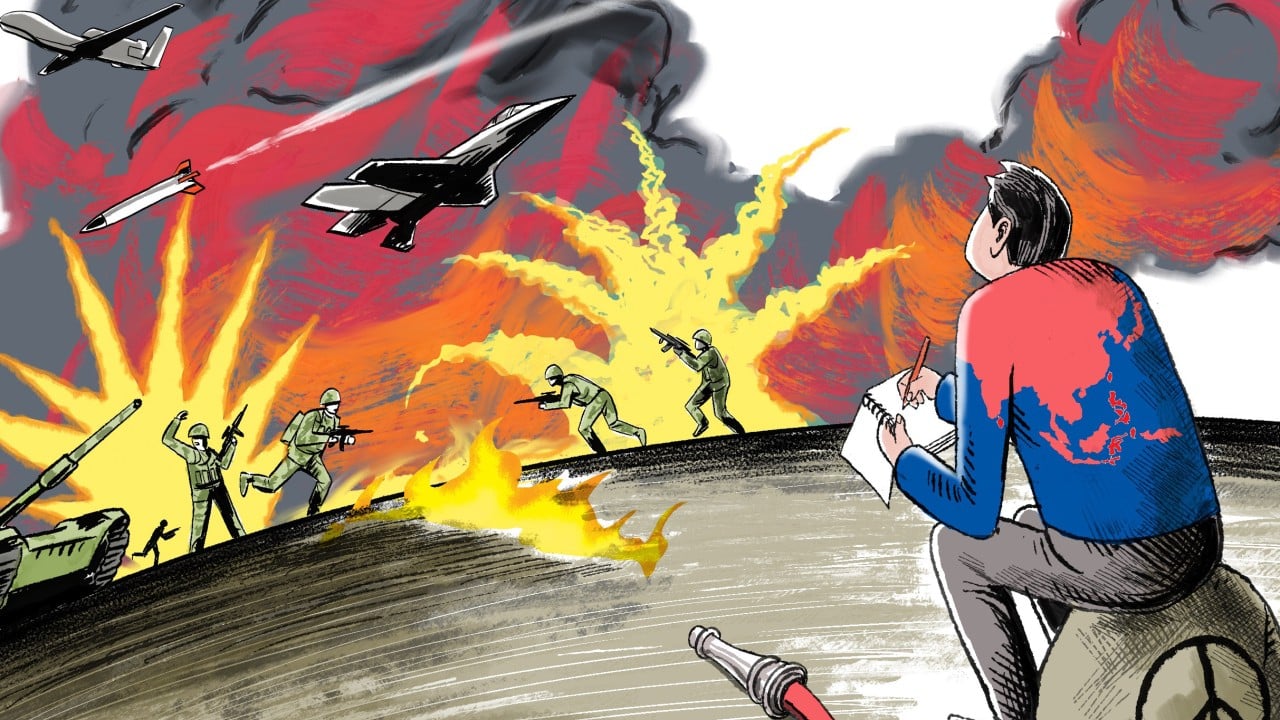
The Flawed Premise of the "Privileged Observer"
Think-tank analysts love telling Asian capitals that they are enjoying a unique moment of historical privilege. The narrative is comfortable: Asia is an island of relative stability, sitting on the sidelines, watching European and Middle Eastern conflicts play out like a series of high-stakes laboratory experiments. Analysts claim that by studying the war in Ukraine or drone skirmishes in the Red Sea, Asian militaries can magically download the lessons of modern combat without paying the price in blood and capital.
This is a dangerous delusion. If you found value in this article, you might want to read: this related article.
I have spent years in rooms with defense planners and regional strategists from Tokyo to Singapore. The consensus is not just lazy; it is actively warping defense procurement and strategic thinking across the region. Asia is not a detached student learning from a distance. By obsessively copying the tactical takeaways of distant, asymmetric conflicts, Asian defense establishments are preparing for the wrong war, with the wrong tools, under a completely mismatched set of assumptions.
The idea that you can passively absorb the realities of high-intensity conflict from the comfort of a peaceful living room is a myth. War is not software; you cannot patch your strategy based on a competitor's beta test. For another look on this event, see the latest coverage from NPR.
The Ukraine Copy-Paste Error
The current intellectual obsession centers on the war in Ukraine. Pundits scream about the democratization of the battlefield, the supremacy of cheap commercial drones, and the death of the main battle tank. The takeaway being pushed onto Asian defense ministries is simple: buy thousands of low-cost loitering munitions, decentralize your command structure, and invest heavily in asymmetric denial strategies.
This advice ignores basic geography and physics.
Imagine a scenario where a conflict erupts in the Taiwan Strait or the South China Sea. Ukraine is a massive, contiguous land mass with deep strategic depth and a direct, unblockable land border with NATO allies supplying an endless stream of hardware and ammunition. The major flashpoints in Asia are maritime, electronic, and brutally compressed.
- The Logistical Void: You cannot drive a truck full of artillery shells across the Pacific Ocean. If a conflict starts in Asia, the logistics are entirely dependent on sea and air lines of communication that will be contested from minute one.
- The Drone Fallacy: Quadcopters modified with 3D-printed release mechanisms work wonders in the muddy trenches of Donbas. They are utterly useless across 100 miles of open ocean against electronic warfare suites deployed by major naval combatants.
- The Industrial Scale Illusion: The Western defense industrial base is struggling to match Russia's shell production. But assuming Asia can rely on a slow, protracted war of attrition ignores the sheer concentration of industrial manufacturing power located in East Asia. A conflict here will move at a velocity that makes the European theater look stagnant.
When regional powers build their defense strategies around the "lessons" of Ukraine, they are guilt-buying capabilities that satisfy immediate political optical needs while leaving their core structural vulnerabilities completely exposed.
The Asymmetry Trap
Every major regional defense paper right now emphasizes "asymmetric warfare." It has become a magic word used to justify cutting expensive, traditional platforms in favor of hyped technologies.
Let us dismantle the premise of the popular question: Can small nations use cheap technology to deter a superpower?
The honest answer is no, not in the way current planners think. True asymmetry requires an existential willingness to endure total devastation. It is not a budget-saving hack.
+------------------------+------------------------+------------------------+
| Capability Layer       | Traditional Focus      | Misguided Asymmetric   |
|                        |                        | Copy                   |
+------------------------+------------------------+------------------------+
| Command & Control      | Hardened, deep underground| Decentralized civilian |
|                        | fiber networks         | satellite arrays       |
+------------------------+------------------------+------------------------+
| Precision Strike       | Medium-range ballistic | Swarms of short-range  |
|                        | and cruise missiles    | commercial UAVs        |
+------------------------+------------------------+------------------------+
| Logistics              | Heavy transport and    | Just-in-time commercial|
|                        | regional stockpiles    | supply chains          |
+------------------------+------------------------+------------------------+
When a smaller state relies on decentralized, commercial systems—like Starlink or off-the-shelf components—they assume their adversary will respect the sanctity of civilian infrastructure. In a peer-to-peer Asian conflict, those networks will be severed within the first ten minutes.
Relying on the "lessons learned" by forces operating against a technologically degraded or politically constrained adversary is operational suicide. If you are fighting a peer competitor with total electromagnetic dominance, your cheap commercial drone fleet becomes nothing more than a collection of unguided plastic toys.
The Downside of Our Own Medicine
To be entirely fair, moving away from bloated, multi-billion-dollar legacy platforms is a valid instinct. The downside of my own argument is that building heavy, survivable, sovereign military capability is ruinously expensive and politically unpopular in democracies. It requires long-term commitments to deep-water navies, hardened infrastructure, and massive ammunition stockpiles that sit in warehouses gathering dust.
It is far easier for a politician to stand in front of a line of locally manufactured drones and declare that the nation is ready for "twenty-first-century warfare." But cheap deterrence is a fiction sold by defense contractors who have pivoted their marketing copy from heavy armor to artificial intelligence.
Stop Learning the Wrong Lessons
The premise of the question What can Asia learn from peace? is fundamentally broken. Peace does not give you a clearer view of war; it gives you a distorted, sanitized view. It allows you to filter out the horrific, messy realities of logistical collapse, mass casualties, and systemic electronic blindness, leaving only the clean, technological narratives that fit into a PowerPoint slide.
Asian capitals need to stop looking at European battlefields to validate their current procurement budgets.
Stop buying weapons designed for continental mud when your theater is salt water and deep space. Stop assuming that civilian supply chains will survive a hot war. Stop treating the current period of stability as a study hall.
The peace Asia currently experiences is not a privilege that grants clarity. It is a ticking clock. If regional planners keep copying the homework of nations fighting completely different wars under completely different constraints, they will find themselves utterly unprepared when the clock finally runs out.


