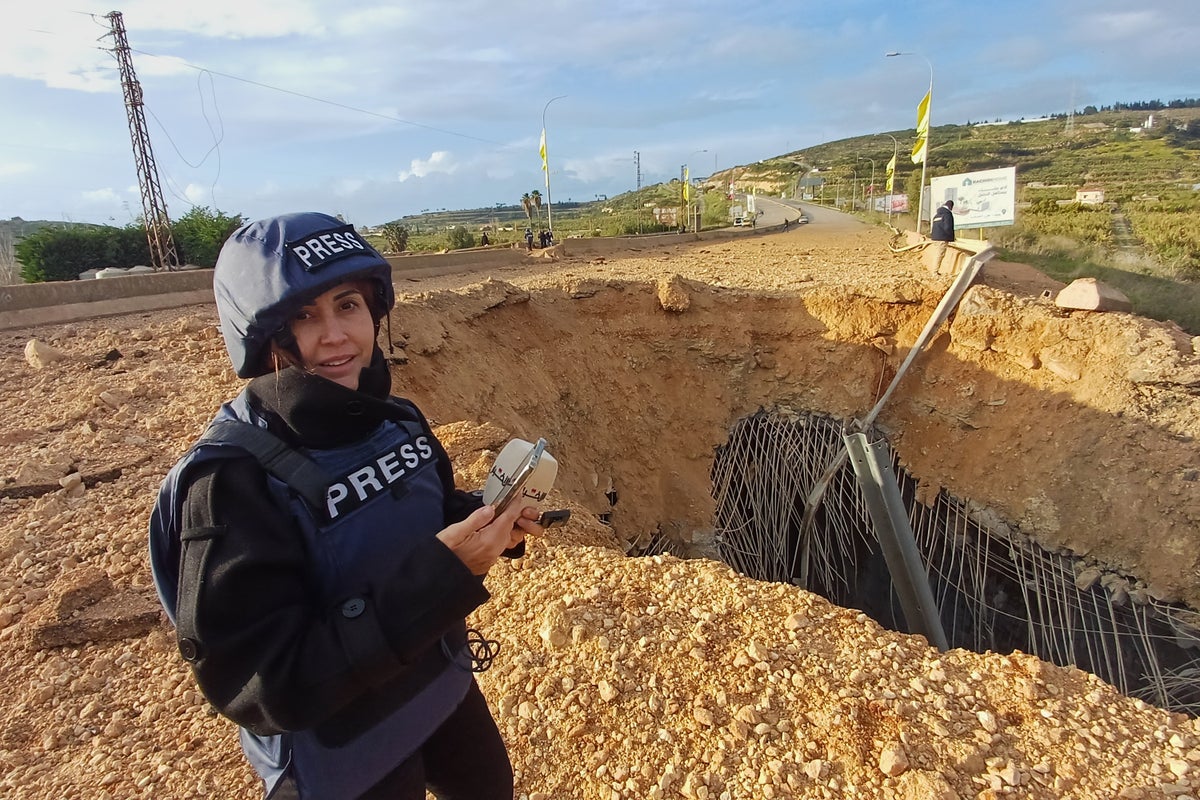
The press vest is no longer armor. It is a bullseye.
The reporting on the death of Amal Khalil, the Al-Akhbar correspondent killed in a strike in South Lebanon, follows a tired, predictable script. The narrative usually leans on the "tragedy of the accidental" or the "sanctity of the civilian structure." It frames these deaths as glitches in the system of international law. You might also find this similar coverage useful: Why Trump is Calling the Virginia Redistricting Vote Rigged.
They aren't glitches. They are the system.
If you are still operating under the 20th-century delusion that being a journalist provides a layer of digital or physical immunity, you aren't just wrong—you are dangerous to yourself and your sources. The death of Khalil in a house where she "took cover" exposes the central lie of modern conflict reporting: that there is such a thing as a non-combatant space in a theater of total surveillance. As highlighted in recent articles by TIME, the effects are worth noting.
The Death of the Neutral Observer
The industry loves to wring its hands over the Geneva Conventions. We cite Article 79 of Protocol I like it’s a magic spell that stops shrapnel. It doesn't.
In the current Levant conflict, the distinction between a "journalist" and a "target" has been pulverized by the logic of counter-insurgency. When a reporter like Khalil works for a publication like Al-Akhbar—often described as pro-Hezbollah—the opposing military doesn't see a member of the press. They see a psychological operations asset. They see a node in a communication network.
We have entered an era where "information warfare" is literal. If you are producing information that serves a narrative, you are a participant. The "lazy consensus" of the mainstream media is to pretend that Khalil was a bystander who happened to be in a house that got hit. This ignores the brutal reality of modern targeting cycles.
The Precision Targeting Paradox
Western media often frames these strikes as "indiscriminate." That is a comforting lie. It suggests the military is incompetent rather than intentional.
The terrifying truth is that targeting is more precise than it has ever been. If a missile hits a house in a village in South Lebanon, it is rarely because a pilot got the coordinates wrong. It is because an algorithm or a targeter decided that the "value" of the strike outweighed the "collateral cost" of a journalist.
We need to stop asking "How could this happen?" and start asking "Why was this authorized?"
- Metadata is a Death Warrant: Your phone is a beacon. Your SIM card is a GPS tag. In high-intensity conflict zones, your digital footprint is visible to anyone with a drone and a signal intelligence suite.
- The Proximity Trap: Taking cover in a civilian house in a combat zone isn't "finding safety." It is simply choosing the location of your potential martyrdom.
- The Credibility Gap: When the press is embedded—ideologically or physically—the line between reporting and reconnaissance blurs for the observer.
I’ve spent years watching newsrooms send young freelancers into these meat grinders with nothing but a $500 flak jacket and a prayer. It’s negligence masquerading as "supporting the craft." We tell them to "stay safe" while sending them into environments where safety is mathematically impossible.
Your Press Card is a Liability
The standard advice for journalists in danger is to clearly mark your vehicle and your person with "PRESS."
In the 1990s, this worked. In the 2020s, it’s a liability.
In a world of loitering munitions and AI-assisted facial recognition, "PRESS" identifies you as a high-value capture or a high-impact kill. If a state actor wants to control the narrative, the most efficient way to do that is to eliminate the people writing it. Killing a journalist isn't just about stopping one story; it’s about chilling the entire ecosystem.
The death of Amal Khalil shouldn't be met with more "calls for investigation." We know what an investigation will yield: a technical justification or a shrug of "operational necessity." Instead, we should be dismantling the idea that "taking cover" exists in a landscape of 24/7 aerial surveillance.
The Algorithm Doesn't Care About Your Bylines
Let’s look at the mechanics. Imagine a scenario where a journalist is using an encrypted app to send a draft. Even if the content is hidden, the traffic patterns are not. The burst of data from a specific IP in a "hot zone" triggers an alert. The drone pivots. The decision-making loop—the OODA loop—completes in seconds.
The machine doesn't read the Geneva Conventions. It reads signals.
If you are a journalist in 2026, you are a signal.
The industry’s refusal to acknowledge this is a form of institutional gaslighting. We celebrate the "bravery" of the fallen because it’s easier than admitting our protocols are obsolete. We treat these deaths as anomalies when they are the logical conclusion of how modern wars are fought.
Stop Asking for Permission to Live
The "People Also Ask" sections on these tragedies always focus on: "Is it a war crime to kill journalists?"
The answer is: "It doesn't matter."
By the time a war crimes tribunal convenes five years after a conflict, the journalist is still dead, the village is still leveled, and the war is long over. Legal frameworks are reactive; missiles are proactive.
If you want to survive as a reporter in a conflict zone, you have to stop thinking like a journalist and start thinking like a high-value target. This means:
- Zero Digital Footprint: If you have a phone, you are a target. If you have a satellite uplink, you are a target.
- Radical Unpredictability: Taking cover in a static location—a "safe house"—is a death sentence. Movement is the only survival strategy.
- Ditch the Narrative: The moment you are perceived as a mouthpiece for one side, you lose the thin sliver of protection neutrality used to provide.
The Brutal Truth About "Taking Cover"
Amal Khalil took cover. The paper says she was in a house.
In the eyes of a modern military, a house is just a structural obstacle that can be bypassed or collapsed. There is no "inside" when the sensors can see through walls. There is no "refuge" when the munitions are designed to penetrate concrete.
The tragedy isn't just that she died. The tragedy is that we continue to send people into these situations under the impression that the rules of engagement are being followed. They aren't. The rules have changed, and the press is the last to admit it.
We don't need more "solidarity" posts on social media. We need a fundamental reassessment of whether "war reporting" is even possible in its current form. When the cost of a story is a guaranteed strike on your location, the profession isn't brave; it's a suicide pact.
The "house" wasn't a shelter. It was a tomb waiting for a coordinate.
If you’re waiting for the world to respect your press badge, you’re already a ghost.
The front line is everywhere, and the "safe house" is the biggest lie of all.
Stop looking for cover. It doesn't exist.


