The United States Marine Corps’ allocation of $50 million to Kongsberg Defence & Aerospace for the Naval Strike Missile (NSM) is not a simple procurement action; it is a critical funding injection to stabilize the logistical and manufacturing pipeline for Expeditionary Advanced Base Operations (EABO). By analyzing this transaction through the lens of anti-access/area-denial (A2/AD) economics and procurement scalability, we can map out how the Marine Corps is resolving its primary operational bottleneck: the inability to deny sea lanes from land-based, highly mobile positions without reliant carrier strike group air support.
This funding allocation directly feeds the Navy/Marine Expeditionary Ship Interdiction System (NMESIS), which integrates the NSM with an unmanned, remotely operated ground vehicle chassis. The strategic objective is clear: establish a distributed, low-signature land force capable of enforcing maritime chokepoints. To evaluate the efficacy of this $50 million allocation, the program must be disassembled into three distinct operational vectors: production scalability, platform survivability, and kinetic integration.
Production Scalability and the Industrial Supply Bottleneck
The primary risk to the EABO doctrine is not the lethal capacity of the missile itself, but the industrial throughput required to sustain peer-conflict consumption rates. A $50 million contract modification indicates targeted funding aimed at long-lead time materials and sub-component stabilization rather than bulk weapon purchasing.
The production cost function of a precision-guided munition like the NSM is heavily weighted toward its seeker assembly and propulsion units. Kongsberg’s manufacturing model relies on a distributed European and American supply chain. This creates a structural vulnerability:
- Micro-electronic Component Lead Times: The multi-spectral imaging infrared (IIR) seeker requires highly specialized sensor arrays. Delays in raw material refining or specialized semiconductor fabrication immediately stall final assembly.
- Solid-Fuel Rocket Motor Throughput: Solid-propellant manufacturing cannot be rapidly scaled up due to stringent safety regulations and specialized chemical processing requirements.
By injecting capital specifically for the U.S. Marine Corps' inventory, the Pentagon is attempting to artificially shorten the lead-time curve. This capital allows sub-tier suppliers to commit to tooling and raw material acquisition ahead of larger, multi-year procurement blocks. The strategic intent is to transition the NSM from a low-rate initial production cadence to a predictable, high-volume output capable of replacing simulated war reserves.
Platform Survivability: The NMESIS Architecture
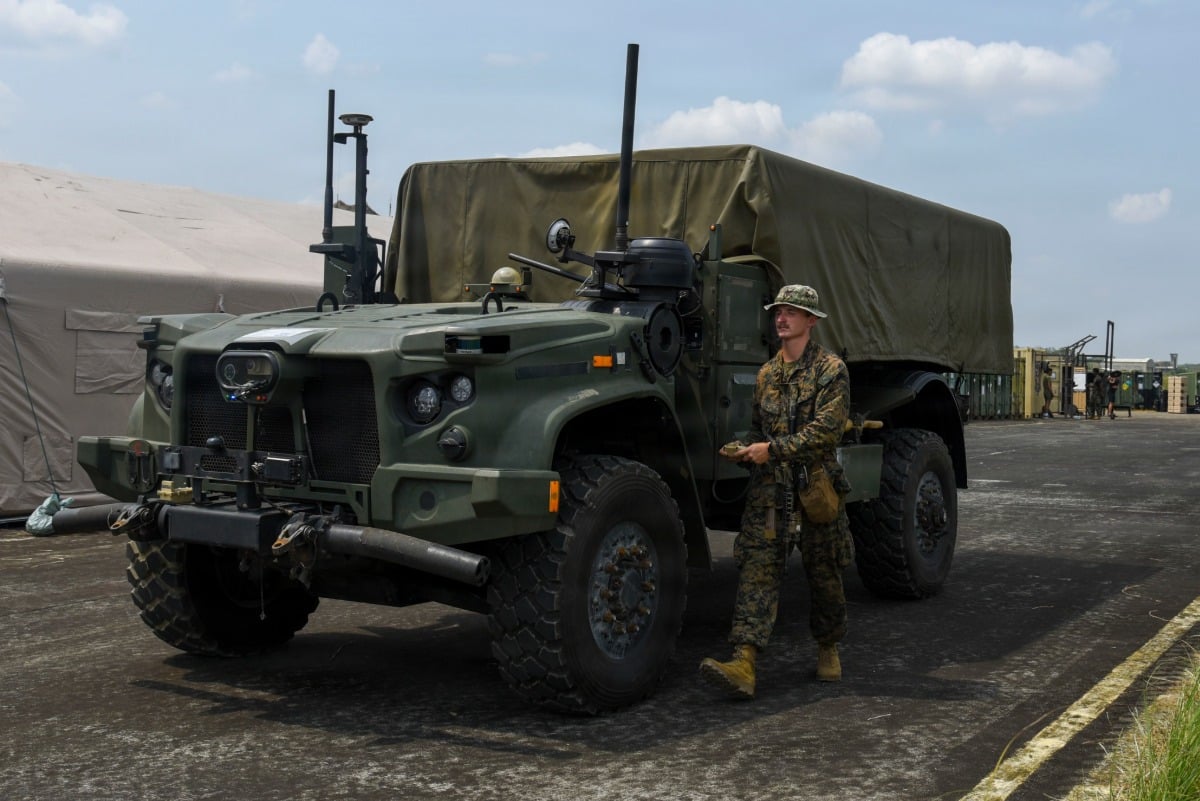
The true utility of the NSM within the Marine Corps framework depends entirely on its deployment vehicle: the Rogue Fires carrier. This is a modified Joint Light Tactical Vehicle (JLTV) frame stripped of its cab and operated via remote command structures.
[Command & Control Node] ──(Encrypted Datalink)──> [Unmanned Rogue Fires Vehicle] ──> [NSM Launch]
This architecture alters the traditional survivability equation. Traditional towed or heavy tracked anti-ship batteries present massive thermal and visual signatures, making them high-priority targets for preemptive counter-battery strikes. The NMESIS platform mitigates this through three distinct design mechanisms:
- Mass Reduction and Transportability: By removing the human crew compartment and armor plating required for personnel protection, the overall vehicle weight falls within the transport parameters of CH-53K King Stallion helicopters and C-130J transport aircraft. This enables rapid air-land conduction, allowing teams to land on an island, deploy, fire, and extract before adversarial satellite passes or drone reconnaissance can fix their position.
- Signature Minimization: When stationary, an unmanned launcher emits near-zero radio frequency signals and minimal thermal output compared to a manned, idling vehicle. This lack of active emissions confounds adversarial electronic warfare identification efforts.
- Dispersed Risk Profiles: In terms of attrition economics, losing an unmanned launcher chassis costs significantly less than losing trained crew members. The missile canister itself remains the highest value component on the vehicle.
The limitation of this system lies in its logistical tail. While the launcher is unmanned, the command-and-control elements, fuel resupply, and reloading mechanisms require a physical footprint. The Marine Corps has not yet solved the problem of tactical reloading in austere environments; while a CH-53K can move the launcher, reloading a 900-pound missile canister requires specialized mechanical lifts that are difficult to conceal and transport.
Kinetic Integration and Target Acquisition Mechanics
A missile system is only as effective as the kill web that feeds it data. The NSM possesses a range reported to be in excess of 100 nautical miles. At these distances, the earth's curvature prevents ground-based radar units on small islands from detecting low-slung surface combatants. Therefore, the $50 million procurement must be viewed alongside investments in distributed targeting networks.
The NSM does not rely on active radar homing during its terminal phase, which is a critical design choice. Active radar seekers emit radio frequencies that alert a target ship’s electronic warfare suites, triggering soft-kill chaff or hard-kill close-in weapon systems. Instead, the NSM utilizes passive imaging infrared homing.
The target acquisition sequence operates under strict geometric and electronic constraints:
[Over-the-Horizon Sensor] ──> [Coordinate Generation] ──> [Inertial/GPS Mid-course Flight] ──> [Passive IIR Terminal Homing]
The system requires an external asset—such as an F-35B Lightning II, an MQ-9A Reaper drone, or a literal tri-service data stream—to identify the target ship's coordinates and upload them to the NMESIS launcher before ignition. Once launched, the missile flies at sea-skimming altitudes using GPS-aided inertial navigation alongside terrain contour matching for land-crossing phases.
The critical vulnerability occurs if the mid-course data link is degraded via electronic jamming. If the adversarial vessel alters its course significantly during the missile's transit time, the missile's passive seeker may initialize its search pattern over empty water. The passive IIR sensor relies on internal target libraries to identify autonomous point-targets on a ship (such as the bridge or engine room). If the initial mid-course vector is inaccurate by even a few degrees over a 100-mile flight path, the probability of kill drops exponentially.
Strategic Allocation of Capital
This $50 million contract adjustment must be judged by whether it achieves a minimum viable mass of munitions in the Indo-Pacific theater. The Marine Corps' objective is to make the cost of adversarial naval movement through critical straits prohibitively expensive.
To achieve a true defensive posture, procurement must outpace the adversarial capability to absorb hull damage. If a single modern surface combatant requires a saturation attack of three to four sea-skimming missiles to guarantee mission kill parameters, a single NMESIS section (two vehicles, four missiles) can only neutralize one high-value target before requiring a complete reload cycle.
Future capital allocations must shift away from platform development and focus exclusively on lowering the per-unit cost of the round through domestic component manufacturing. The current dependency on specialized European supply lines introduces an unacceptable single point of failure for a military branch attempting to position itself as America's premier premier stand-in force. The success of the program will be measured by the drop in production lead times over the next twenty-four months.