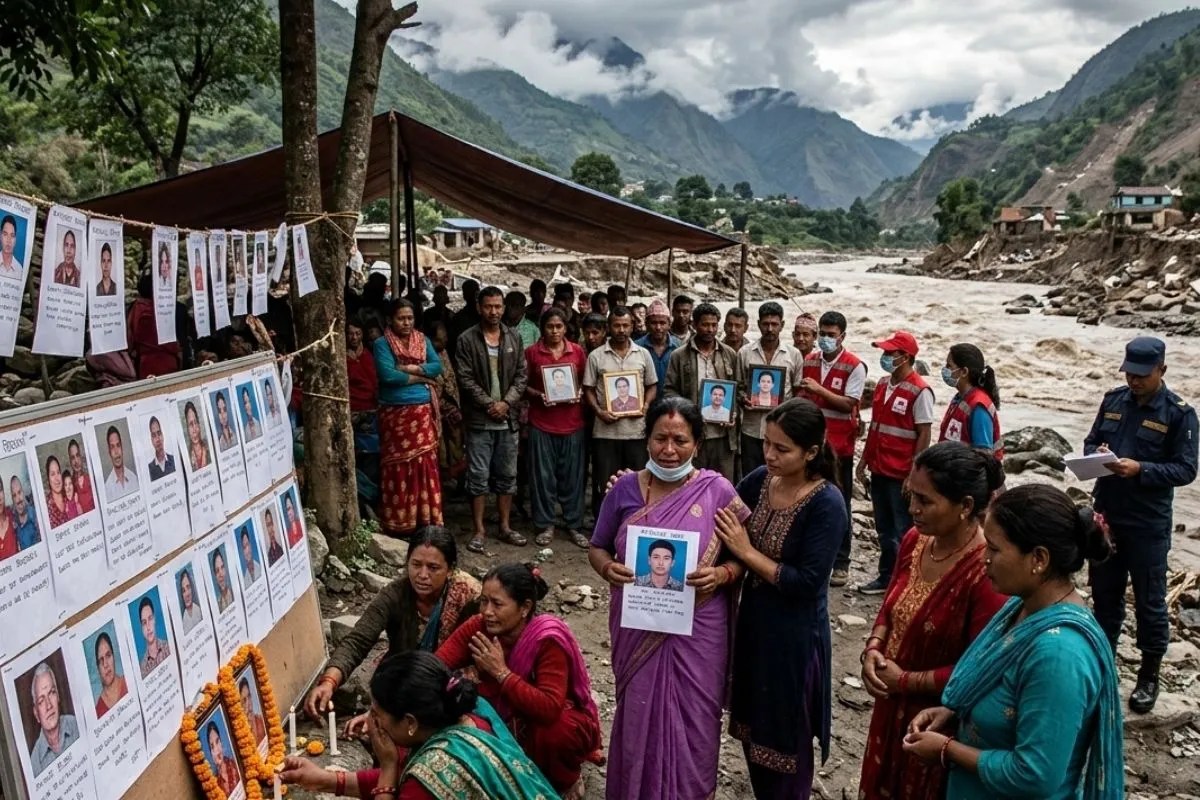
The catastrophic flash floods along the Bhote Koshi River left behind a grim reality of thousands of missing people and overwhelmed local rescue operations. If you are searching for a loved one from abroad, the standard ways of finding people simply don't work anymore.
The National Disaster Risk Reduction and Management Authority (NDRRMA) of Nepal has rolled out a specific forensic protocol. It relies on DNA profiling to match unidentified remains with grieving families living overseas. You cannot rely on guesswork or local rumors here. You need to follow precise scientific requirements to get answers.
Why Standard Identification Failed After the Bhote Koshi Floods
When millions of tons of water and debris tore through settlements, traditional identification methods collapsed. Morgues filled up fast. Visual recognition became impossible in most cases due to advanced decomposition and trauma.
Authorities had to adopt emergency measures, including temporary dignified burials accompanied by systematic evidence collection. Every recovered body is photographed, fingerprinted where possible, and sampled for DNA before placement in designated resting sites.
Families scattered across different countries face a frustrating information vacuum. Local police posts cannot handle international queries without structured data. This new guideline bridges that gap by letting overseas relatives submit verified genetic profiles directly to law enforcement databases.
Strict Rules for Overseas DNA Sample Donors
You cannot just ask anyone in the family to step up for a test. Nepal Police enforces a strict hierarchical protocol regarding who qualifies as a valid biological donor.
The acceptable order of priority for donors includes:
- Mother, father, son, or daughter of the missing individual
- Full biological brothers or sisters sharing both parents
- Paternal uncles or cousins if immediate nuclear family members are unavailable
Do not waste time and money testing ineligible relatives. Spouses, adopted family members, step-relatives, and in-laws are automatically disqualified. They share no direct genetic lineage, meaning database software will reject the comparison outright.
Technical Specifications Required by Nepal Police
If you live outside Nepal, you must approach an accredited local forensic laboratory to conduct the test. You can't just hand authorities a standard medical blood test report. The documentation demands specific genetic markers depending on your relationship to the missing person.
Male parents or offspring must provide an autosomal STR profile covering at least 20 CODIS core loci alongside a Y-STR profile. Female counterparts require autosomal and X-STR profiles. Paternal relatives need specific Y-STR mapping.
Furthermore, the laboratory report must contain exact technical deliverables:
- Official letterhead of the testing facility
- Electropherogram (EPG) with a complete marker table
- Digital formats such as PDF, XML, and CMF files
- A signed consent letter specifying your exact kinship
- A scanned copy of a government-issued photo ID like a passport
Once your lab generates these files, you must email them directly to the official coordination desk at dnacodis@nepalpolice.gov.np.
Protecting Your Privacy and Ensuring Closure
Navigating a disaster from another country breeds immense anxiety. Rest assured that the NDRRMA handles these genetic records under strict data protection protocols. Your submission goes exclusively toward matching local disaster victims and remains entirely confidential.
Gather your documentation carefully, coordinate with a certified testing center near you, and submit the digital packet to the designated police email address to start the verification process.