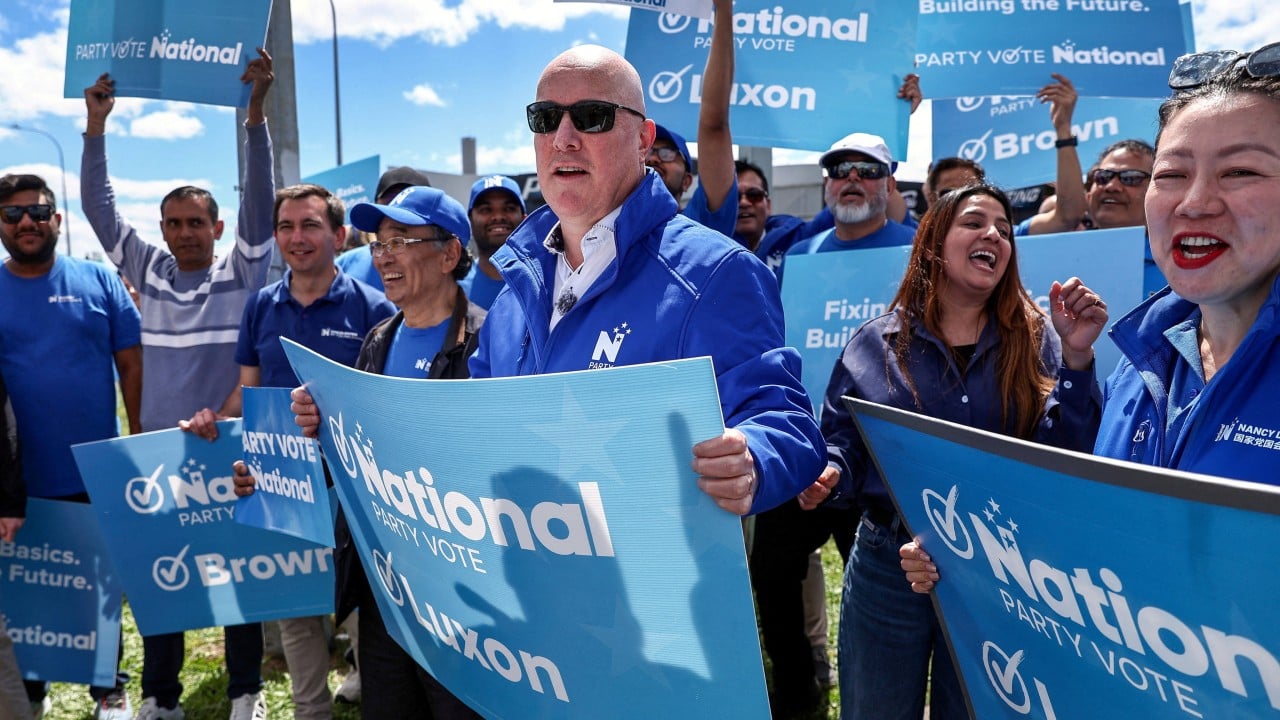
Regardless of who wins New Zealand’s general election, Wellington will not abandon its cautious, low-profile posture toward Donald Trump’s White House. The core premise of New Zealand foreign policy—protecting export access to the United States while avoiding the economic wrath of Beijing—is dictated by geography and trade ledgers rather than party ideology. Voters may swap the center-right National-led coalition for a center-left Labour government, yet the incoming prime minister will inherit the exact same structural trap that forces New Zealand diplomats to bite their tongues in public while scrambling for tariff exemptions behind closed doors.
Analysts in Wellington and Washington frequently frame New Zealand’s foreign policy as a choice between moral clarity and commercial pragmatism. That framing misses the brutal arithmetic of a small, trade-dependent economy sitting at the bottom of the South Pacific.
New Zealand does not have the luxury of ideological posturing. Over the past decade, the United States has surged past Australia to become New Zealand’s second-largest export market, trailing only China. Wine, beef, dairy, medical devices, and specialized technology flow north across the Pacific in volumes that keep rural regions solvent and urban tech hubs funded. When a protectionist administration occupies the Oval Office, threatening blanket tariffs and demanding bilateral concessions, picking a public fight over climate accords, multilateral institutions, or diplomatic decorum is an act of economic self-harm that no New Zealand prime minister can survive.
The Structural Trap Behind the Quiet Approach
To understand why Wellington plays a softly-softly game, you have to look at how New Zealand makes its money. Unlike the United States or Australia, New Zealand has no massive domestic consumer base to cushion external shocks, nor does it sit atop vast reserves of iron ore, lithium, or liquefied natural gas that global superpowers desperately need. New Zealand sells food, tourism, and niche manufacturing. Every single one of those exports can be replaced by a competitor within weeks if a trading partner decides to make an example out of Wellington.
This vulnerability explains the bipartisan consensus that defines New Zealand’s Ministry of Foreign Affairs and Trade. For forty years, dating back to the 1980s nuclear-free standoff that saw Washington suspend its ANZUS security obligations to New Zealand, diplomats in Wellington have operated under a strict survival manual. The rules are simple. Never lecture larger powers in public. Keep grievances confined to private bilateral channels. Align rhetorically on shared democratic values while quietly carving out commercial exemptions.
During the Trump administration’s tariff push, this doctrine went into overdrive. While European leaders traded sharp barbs with the White House and Canadian officials waged public media campaigns to defend NAFTA and its successor, New Zealand officials pursued what veteran diplomats call strategic invisibility. The objective was to stay off the presidential radar entirely. If New Zealand did not make headlines in Washington, it would not become a target for punitive trade actions.
Critics at home called it cowardice. Opposition lawmakers accused the government of failing to stand up for the rules-based international order when it mattered most. Yet those same critics know that once they sit in the Beehive—New Zealand’s executive wing—their options shrink to the exact same narrow corridor.
How Domestic Politics Masks Foreign Policy Continuity
Election campaigns in New Zealand rarely turn on foreign affairs, yet the rhetoric on the trail often creates the illusion of a sharp ideological divide.
A center-right coalition, typically led by the National Party alongside partners like ACT and New Zealand First, tends to lean naturally toward closer security and intelligence ties with traditional Anglosphere allies. Under Prime Minister Christopher Luxon and Foreign Minister Winston Peters, Wellington sought to warm relations with Washington, exploring potential participation in AUKUS Pillar Two—the non-nuclear technology-sharing component of the security pact between Australia, the United Kingdom, and the United States. Even then, the coalition moved with extreme caution, acutely aware that embracing Washington too tightly risked triggering retaliatory trade disruptions from China, which still buys roughly a quarter of all New Zealand exports.
A center-left government led by Labour, potentially reliant on the Green Party or Te Pāti Māori for confidence and supply, faces intense internal pressure to adopt a more independent, value-driven foreign policy. Party activists demand stronger vocal commitments to international climate frameworks, sharper criticism of unilateral American trade measures, and strict distance from any military alignment that smells like containment of China.
Watch what happens when power actually changes hands. The fiery speeches fade within forty-eight hours of the first post-election briefing from Treasury and Foreign Affairs officials.
Consider a hypothetical scenario following a change of government in Wellington. Imagine a newly sworn-in center-left prime minister preparing for their first major international summit just weeks after promising voters a bolder, more principled stand on global trade and climate action. On day one, the Secretary of Foreign Affairs places a single sheet of paper on the desk. It outlines the exact dollar value of New Zealand’s beef and wine exports to California and Texas, alongside a warning from trade envoys in Washington that any public criticism of White House tariff policy will immediately stall negotiations over agricultural market access. By day three, the prime minister’s talking points are scrubbed of any language that might provoke Washington, replaced by familiar boilerplate about constructive engagement and shared prosperity.
That pivot is not hypocrisy. It is institutional gravity. The permanent civil service in Wellington exists to protect the country’s economic lifeline, and it systematically sands down the sharp edges of whichever political party wins the Treasury benches.
The Five Eyes and AUKUS Tightrope
Trade is only half the equation. Security architecture binds New Zealand to Washington in ways that voters rarely see and politicians rarely discuss openly.
New Zealand is the smallest member of the Five Eyes intelligence-sharing alliance alongside the United States, the United Kingdom, Canada, and Australia. For decades, Wellington has enjoyed access to some of the most sophisticated intelligence capabilities on earth at a fraction of the cost it would take to build them independently. In return, New Zealand contributes regional monitoring across the South Pacific and Antarctica, operating the Waihopai and Tangimoana signals intelligence stations.
Under a transactional White House, alliance membership is no longer treated as an unconditional brotherhood. Washington increasingly demands visible burden-sharing. American officials have quietly pressed Wellington to boost its defense spending—historically hovering near one percent of GDP, well below the two percent benchmark pushed across NATO and allied capitals—and to take a clearer stand on Pacific security as Beijing expands its policing and infrastructure footprint across the Solomon Islands, Kiribati, and Fiji.
This creates an acute dilemma for any New Zealand administration:
- Full integration into Washington’s Indo-Pacific security strategy, such as formally joining AUKUS Pillar Two, pleases the Pentagon and insulates New Zealand from accusations of free-riding on Western defense. However, it shatters Wellington’s carefully cultivated image as an independent honest broker in the Pacific and invites immediate economic coercion from Beijing.
- Complete detachment from American security initiatives satisfies domestic progressives and keeps Chinese trade flowing smoothly, yet it risks downgrading New Zealand’s standing inside Five Eyes and leaving the country isolated if Washington decides that non-participating allies deserve no special favors on trade or technology.
Because neither extreme is survivable, Wellington defaults to ambiguity. Officials express interest in exploring technological cooperation without signing binding commitments. They deploy royal naval vessels for routine freedom-of-navigation transits through the Taiwan Strait while insisting the maneuvers are standard international practice rather than a direct challenge to Beijing. It is a high-wire act performed in thick fog.
What Washington Actually Wants From Wellington
Much of the commentary in New Zealand suffers from an inflated sense of the country’s prominence in Washington’s daily calculations. To be blunt, New Zealand rarely occupies top-tier bandwidth in the West Wing.
When senior White House trade officials or National Security Council staffers look at the South Pacific, they view New Zealand primarily through two lenses. First, as an extension of the Australian strategic perimeter. Second, as a potential weak link in Western consensus regarding China’s regional influence.
Because New Zealand is not a major geopolitical adversary, it does not attract the sustained hostility directed at Beijing or Brussels. However, in an era of sweeping, rules-based-order-be-damned tariff policies, indifference can be just as dangerous as hostility. When Washington imposes universal baseline tariffs on all foreign imports, small friendly nations get crushed alongside strategic competitors unless their diplomats work relentlessly to secure carve-outs.
Winning those carve-outs requires political capital. New Zealand cannot buy influence in Washington through massive arms purchases like Poland or Saudi Arabia, nor can it offer critical mineral supply chains on the scale of Australia or Canada. Wellington’s only currency is reliability—proving to Washington that it will not undermine American strategic objectives in the Pacific or embarrass the president on the world stage.
If an incoming New Zealand government abandons its quiet diplomacy in favor of megaphone critiques of White House policies, it burns that currency overnight. Once New Zealand is labeled a vocal critic in Washington, its trade negotiators lose their seat at the table when tariff exemptions are handed out.
The China Factor Nobody Can Ignore
Any assessment of New Zealand’s posture toward the United States is incomplete without looking across the East China Sea. Beijing’s shadow falls over every cabinet meeting in Wellington.
New Zealand was the first Western developed nation to sign a comprehensive free trade agreement with China in 2008, a milestone that fueled fifteen years of export growth and cushioned the country through the global financial crisis. That deep economic integration came with a heavy price. Over-reliance on a single buyer left New Zealand dairy farmers, timber exporters, and tourism operators exposed to the shifting political winds of the Chinese Communist Party.
When Australia demanded an independent international inquiry into the origins of COVID-19 in 2020, Beijing responded by slapping punitive tariffs and informal bans on Australian barley, wine, coal, and lobsters. Wellington watched that economic punishment unfold across the Tasman Sea with quiet horror. The lesson absorbed by New Zealand’s political class was unmistakable: public confrontation with superpowers yields zero tangible benefits and inflicts severe, immediate pain on ordinary exporters.
That experience hardened Wellington’s commitment to quiet diplomacy across the board. If New Zealand will not publicly lecture Beijing over human rights or South China Sea militarization for fear of losing dairy contracts, it certainly will not lecture Washington over tariffs or unilateralism at the risk of losing beef and wine access.
Voters often mistake this symmetry for moral equivalence. To the diplomats running the system, it is basic risk management.
Why Voters Should Expect Cosmetic Shifts Only
As ballots are cast and coalition deals are hammered out in Wellington, political commentators will inevitably scrutinize every subtle change in diplomatic phrasing. A center-left government might restore funding to international climate initiatives or speak more warmly about United Nations multilateralism. A center-right government might lean harder into defense procurement and trade missions to Washington.
Do not confuse tone with trajectory.
The fundamental mechanics governing New Zealand’s relationship with a Trump-led America remain locked in place. The country’s export economy still depends on open sea lanes and low tariff barriers. Its security apparatus still relies on Five Eyes intelligence feeds that cannot be replaced. Its geographic isolation still leaves it vulnerable to shifts in Pacific power dynamics that it lacks the military mass to shape on its own.
Whoever steps up to the podium at the Beehive after the election will speak about New Zealand’s proud tradition of an independent foreign policy. They will promise to defend national interests without fear or favor. Then, quietly, out of sight of the cameras and the campaign trail, they will instruct their ambassador in Washington to keep their head down, stay off the front pages, and keep the trade lanes open at all costs.