The air in the Pavilion Residences was thick with the scent of expensive floor wax and the low, electric hum of air conditioning that never shuts off. It is the kind of quiet that only extreme wealth can buy. But on that humid May night in Kuala Lumpur, the silence didn't just break. It shattered.
When the investigators entered Apartment 18A, they weren't looking for a crime scene in the traditional sense. There was no chalk outline, no shattered glass, no lingering smell of gunpowder. Instead, they found a mountain of orange boxes. Hermès Birkin bags, hundreds of them, stacked like bricks in a fortress of luxury. Each one represented a price tag that could feed a village for a year.
But it was the cash that finally broke the rhythm of the room.
The Physicality of Five Hundred Million
We often talk about corruption in the abstract. We speak of "billions lost" or "misappropriated funds" as if they are merely digits on a flickering spreadsheet. They aren't. Money has mass. It has volume. It occupies space in the physical world, and when you steal enough of it, you eventually run out of places to hide it.
The police officers didn't just find money; they found an architectural problem. They found 284 boxes of designer handbags and 72 suitcases stuffed with cash, jewelry, and watches. Imagine the sound of 72 zippers being pulled back to reveal nothing but the flat, matte green of currency.
It wasn't just Malaysian Ringgit. There were U.S. Dollars, Singaporean Dollars, Euros. A global buffet of illicit accumulation.
The task of counting it wasn't a matter of hours. It was a matter of days. The Royal Malaysia Police brought in 22 officials from the central bank and nearly half a dozen counting machines. And then, in a moment that felt like a scripted metaphor for the entire 1MDB scandal, the machines started to fail.
They overheated.
The sheer friction of the bills passing through the rollers—the dust, the grime, the endless repetition—burnt out the motors. The greed was so dense that it literally broke the tools meant to measure it.
The Invisible Stakes of a Designer Handbag
To understand why this matters, you have to look past the leather of the Birkin bags. To a casual observer, a handbag is a fashion statement. To the people of Malaysia, those bags were the physical manifestation of stolen futures.
Every diamond-encrusted watch found in that raid was a bridge that wasn't built. Every stack of Ringgit was a school that went underfunded or a hospital wing that remained a blueprint. When the 1MDB fund was established, it was promised as a vehicle for national development. It was supposed to be the engine that pulled the country into a new era of prosperity.
Instead, it became a private ATM for a select few.
Consider a hypothetical citizen—let’s call her Amira. She lives in a rural kampong, far from the neon glow of the Petronas Towers. She works two jobs to keep her children in school, hoping that the national economy will stabilize enough to give them a chance at a university education. When Amira hears about the "overflowing cash" in a luxury condo, she isn't just hearing a news story. She is hearing the sound of her own hard work being vacuumed into a suitcase and hidden in a closet.
The "invisible stakes" aren't about the money itself. They are about the collapse of the social contract. When a leader takes the wealth of a nation and treats it like a personal inheritance, the damage isn't just financial. It is psychological. It tells every citizen that the rules are for the small, and the spoils are for the brazen.
The Logistics of a Moral Collapse
The raid on the Najib-linked apartments wasn't a sudden whim. It was the culmination of years of whispered rumors that finally turned into a roar. For years, the official narrative was one of denial. Everything was fine. The accounts were balanced. The critics were merely political opportunists.
But numbers have a way of seeking the light.
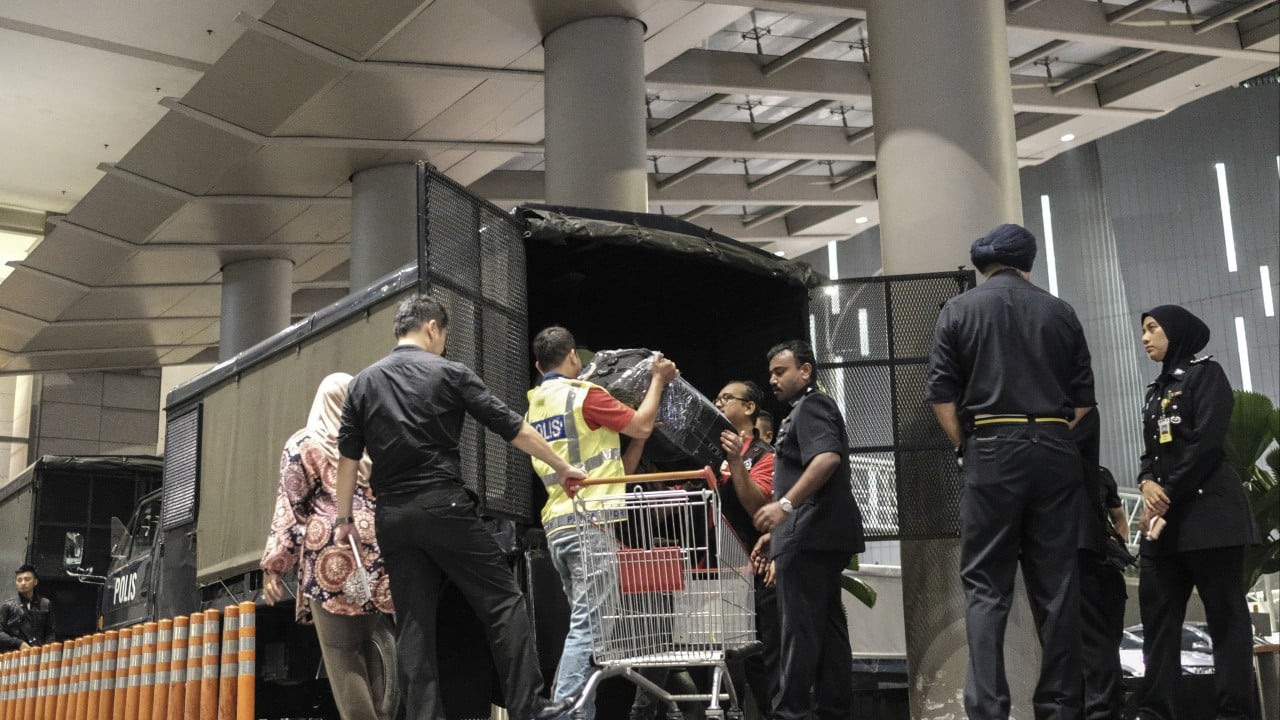
When the trucks finally rolled up to the police headquarters to offload the seized goods, the sheer scale of the operation required a logistical precision usually reserved for military maneuvers. Five trucks. Armed escorts. A trail of investigators carrying boxes that were so heavy they had to be wheeled on dollies.
This is the reality of high-level corruption: it is cumbersome. It is heavy. It requires an immense amount of physical labor to maintain the facade of legitimacy. You have to hire people to move the money. You have to buy the safes. You have to rent the condos. You have to live in a world where your walls are literally lined with evidence of your own betrayal.
The 1MDB scandal is often described as one of the world's greatest financial heists, involving billions of dollars laundered through shell companies and Swiss bank accounts. But that description is too clean. It suggests a digital crime, a heist of 1s and 0s.
The raid at the Pavilion Residences reminded us that this was a crime of physical objects. It was a crime of "stuff." It was the vulgarity of seeing five million Ringgit in a single suitcase and realizing that there were 71 more suitcases just like it.
The Quiet Aftermath
As the machines cooled down and the final tallies were recorded, the numbers were staggering. The value of the seized items was estimated to be between 900 million and 1.1 billion Ringgit. That is roughly $273 million in cash, jewelry, and luxury goods found in a single location.
But numbers don't capture the feeling of the room when the counting finally stopped.
There is a specific kind of exhaustion that comes from documenting excess. It is a weary realization that while millions of people are calculating the cost of their next grocery trip, a handful of people are trying to figure out how to stack enough cash so it doesn't tip over.
The machines may have been repaired, and the bags may have been cataloged and locked away in evidence rooms, but the stain on the national conscience remains. You can wash the ink of the bills off your hands, but you cannot easily wash away the memory of what was lost.
The tragedy of 1MDB isn't just that the money was taken. It’s that even after it was found, even after the suitcases were opened and the jewelry was weighed, the machines still couldn't handle the truth of how much was gone. They just kept spinning until they smoked.
The lights in the Pavilion Residences still glow at night, illuminating the Kuala Lumpur skyline. The people moving through the lobby still wear expensive shoes and carry designer bags. But every time a citizen looks up at those glass towers, they no longer see a symbol of progress. They see a vault. They see a reminder that sometimes, the most dangerous thing you can find in a home isn't a weapon, but a suitcase full of someone else’s dreams.