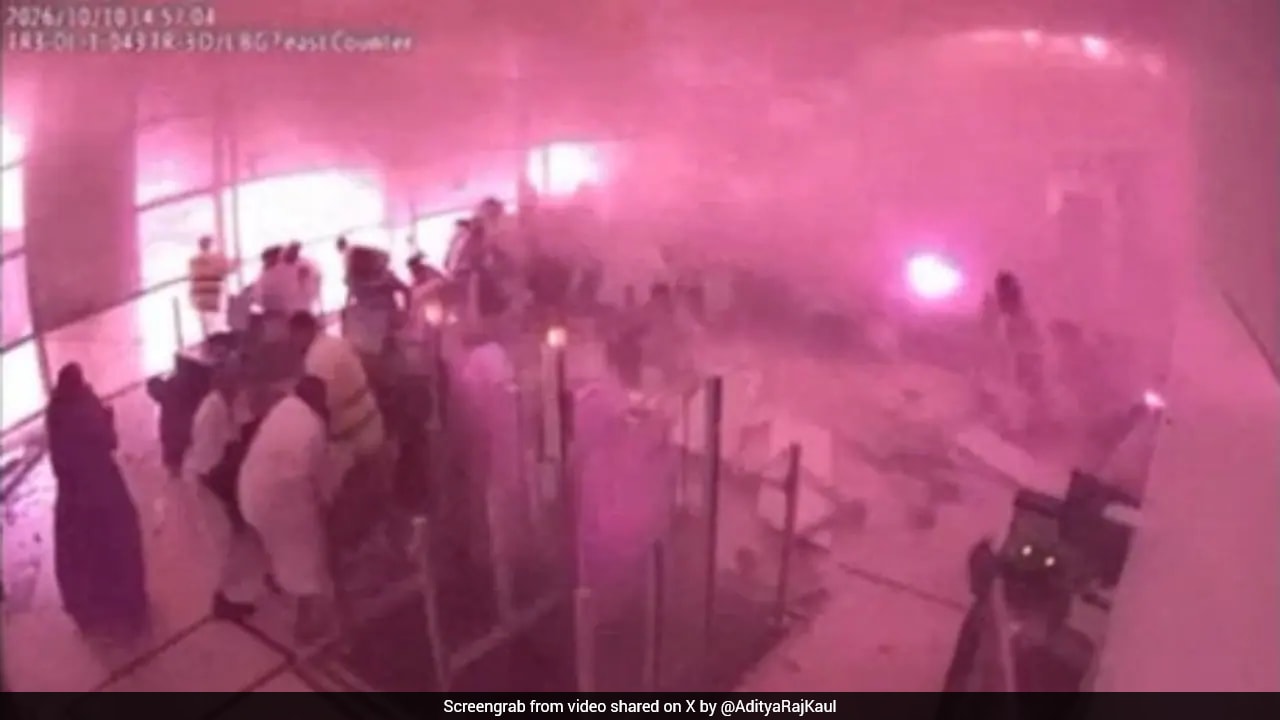
The coffee in the paper cup had gone lukewarm twenty minutes ago. On the tarmac outside the terminal windows, baggage loaders moved in a slow, rhythmic choreography, their neon vests cutting through the heavy desert night. Inside, the arrivals board blinked with quiet efficiency: flights to Dubai, London, Cairo, Frankfurt. Everything was ordinary. Everything was routine.
Until it wasn't.
Silence does not arrive softly when a ballistic missile crosses a national frontier. It arrives as an abrupt tear in the fabric of the night, a violent displacement of air that rattles teeth before the human brain can register what a sound wave is trying to communicate.
Consider the anatomy of a split second. A projectile, designated by military analysts as a Burkan-2H variant, arcs across the upper atmosphere, propelled by multistage liquid fuel systems designed hundreds of miles away in the rugged highlands of Yemen. It travels at multiples of the speed of sound, a pencil-thin streak of thermodynamic fury targeted not at an empty patch of desert, but at the pulsing infrastructure of a capital city.
King Khalid International Airport is not merely a collection of runways and boarding gates. It is a concrete lung through which thousands of international travelers, merchants, students, and workers pass every single day. On that particular evening, the terminal was filled with the usual murmurs of transit: reunions whispered near baggage carousels, business deals finalized over weak espresso, children pressing sticky palms against thick glass to watch the blinking lights of descending airliners.
Then came the flash.
To the ground observer, it looked like a second sun had briefly flickered and died above the northern horizon. The interceptor missile, launched from a Patriot battery stationed to protect the perimeter, met the incoming threat miles above the tarmac. The resulting kinetic collision tore the night sky wide open, showering a rain of white-hot shrapnel and heavy debris across the desert floor and near the airport perimeter.
Panic does not move in a straight line. It ripples.
One moment, a man is checking his boarding pass for a midnight connection to Karachi. The next, the terminal floor seems to heave upward, a subterranean shudder that sets the overhead departure monitors swinging wildly on their steel cables. Shouts replace the ambient hum of conversation. Security personnel, trained for the unimaginable yet perpetually hoping for the mundane, begin shouting instructions that get swallowed by the wail of emergency sirens outside.
Thirteen lives.
That is the stark, unyielding figure reported in the cold dispatches that followed the impact zone assessments. Not thirteen statistics. Not thirteen abstract entries in a geopolitical ledger. Thirteen human beings who woke up that morning planning dinner menus, making phone calls home, or packing light suitcases for a brief business trip. Some were airport ground staff caught in the open-air service yards; others were trapped in vehicles near the cargo facilities when the concussive wave hit.
To understand why a missile strike on a civilian airport feels different from any other theater of conflict, you have to look at the geometry of modern asymmetric warfare. The Houthi movement, controlling vast swaths of Yemen including the capital of Sanaa, had long argued that their long-range missile campaign was a necessary response to the crushing air blockade and economic strangulation imposed by the Saudi-led coalition. From their perspective, the skies over Riyadh represented a mirror—a way to bring the physical and psychological weight of the war directly to the doorsteps of the architects of the intervention.
Yet, mirroring terror does not neutralize it. It merely multiplies it.
When a ballistic missile descends upon an international civilian hub, the target is not just a runway or a fuel depot. The target is the fragile agreement that allows millions of people to cross borders without wondering if the horizon will detonate. When civil aviation becomes a secondary casualty of regional power struggles, the entire architecture of global mobility begins to fracture.
Look closer at the debris field photographed the next morning by forensic investigators. Jagged chunks of gray composite metal bearing serial numbers written in Arabic and Russian-influenced Cyrillic script. Burned-out husks of ground service vehicles. Shattered glass frames that had once offered panoramic views of the tarmac. These are the physical artifacts of a conflict that defies clean cartography, bleeding across borders through the sheer velocity of modern rocketry.
The international community responded with predictable cadence. Condemnations issued from Western capitals. Emergency sessions called at the United Nations. Accusations hurled across diplomatic tables regarding external arms proliferation and illicit supply chains routing missile components through porous maritime routes.
But back at King Khalid International, long after the smoke had cleared and the emergency teams had washed the aviation fuel from the tarmac, a different reality set in.
Planes started flying again.
That is the strange, haunting resilience of modern infrastructure. Within hours of the all-clear, check-in counters reopened. Queues formed beneath the flickering departure boards. Passengers once again surrendered their passports to agents behind bulletproof glass, stepped through metal detectors, and boarded aluminum tubes destined for the clouds. We possess an almost terrifying capacity to normalize the abnormal, to step over the ashes of yesterday's catastrophe because tomorrow's schedule demands our participation.
We walk through terminals every day carrying the silent assumption that the sky belongs to commerce, to vacationers, to families reuniting after years apart. We forget how thin the barrier is between that ordinary world and the high-altitude physics of war.
The missile that struck Riyadh did not just alter the concrete and steel of an airport. It left a permanent scar on the invisible map we all navigate—the one that tells us where it is safe to sleep, where it is safe to travel, and how easily a quiet night can be unraveled by a streak of fire descending from the dark.