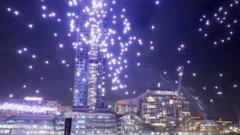
The air above Circular Quay usually tastes of salt spray and expensive gin. On that Sunday night, it tasted of anticipation. Thousands of people stood shoulder-to-shoulder, their faces tilted toward the black velvet of the Australian sky, waiting for the future to switch on. They weren't there for fireworks—those messy, sulfurous relics of the 20th century. They were there for the drones.
We have become a species that craves digital perfection in physical spaces. We want the sky to behave like a liquid crystal display. That night, five hundred tiny machines, each a choreographed spark of light, rose from the concrete to paint stories in the air. For a few minutes, it worked. The drones swirled, a glowing jellyfish here, a shimmering whale there. Then, the math broke.
Gravity doesn't care about your light show.
One moment, a section of the formation was a vibrant neon green. The next, it stuttered. A single light flickered and dipped, like a tired firefly. Then another. Then a dozen. In a terrifyingly graceful cascade, the "stars" began to rain down. They didn't explode. They didn't scream. They simply plummeted, whistling through the humid air before hitting the dark water of the harbour with a series of wet, rhythmic thuds.
The Ghost in the Code
Imagine you are the technician behind the console. Let’s call him Elias. Elias has spent six months staring at a laptop screen, tweaking flight paths so that Drone 114 doesn’t clip the propeller of Drone 115. In his simulation, the wind is a constant variable and the GPS signal is a rock-solid tether. But the real world is messy. The real world has electromagnetic interference from the thousands of smartphones in the crowd below, all reaching out for a signal at once. It has sudden gusts of wind that bounce off the glass teeth of the skyscrapers.
When those drones began to fail, Elias wouldn't have seen a "crash." He would have seen a series of red blinking boxes on a monitor. A loss of "positional integrity." To the crowd, it was a tragedy of beauty. To the person behind the curtain, it was a nightmare of cascading logic errors.
Experts later pointed to a "technical glitch"—a phrase we use when we’re too embarrassed to admit that our most sophisticated tools are often balanced on a knife’s edge. In this case, a suspected GPS signal interference or a software desynchronization caused the drones to lose their sense of self. When a drone doesn't know where it is, its failsafe is often to simply stop trying. It cuts power to avoid wandering into a flight path or a building. It chooses the long drop.
The Cost of a Digital Rainstorm
There is a specific sound a five-thousand-dollar piece of hardware makes when it hits the ocean. It is the sound of an expensive lesson.
Early reports suggested that dozens of drones—some estimates put the number at 50 or more—ended up at the bottom of the harbour. Divers were eventually sent down to recover the bodies of these little robots. They were found tangled in sea grass and silt, their lithium-ion hearts cold, their plastic casings cracked.
But the financial loss is the least interesting part of the story. The real cost is our sense of wonder. We have reached a point where we expect the sky to be programmable. We view the atmosphere as just another canvas for our advertisements and our spectacles. When the drones fell, it was a reminder that the elements still hold the veto power.
Consider the people on the ferries. As the drones began their descent, some spectators cheered, thinking the "fall" was part of the choreography—a simulated meteor shower. It was only when the splashes began that the tone changed. The cheering died into a confused silence. There is something deeply unsettling about seeing high technology fail so physically. We are used to apps crashing or screens freezing. We are not used to the cloud falling on our heads.
Why We Keep Looking Up
Safety is the invisible ghost haunting every one of these displays. In Sydney, the "drop zone" was over the water for exactly this reason. The organizers knew that technology is a fickle god. Had those drones been flying over the dense crowd at the Sydney Opera House, we wouldn't be talking about a "spectacle of failure." We would be talking about a catastrophe.
This incident changed the conversation for every city on the planet currently planning a drone light show. It moved the needle from "How many drones can we fly?" to "Where do they go when they die?"
The engineering challenge isn't just about the flight; it's about the descent. We are building systems that require total synchronization, where the failure of one can lead to the confusion of many. It is a perfect metaphor for our modern infrastructure. We are more connected than ever, which means we are more vulnerable to a single point of failure than we have ever been.
The Aftermath in the Silt
The morning after the crash, the harbour looked the same as it always does. The ferries churned the water, and the sun hit the white sails of the Opera House. But somewhere beneath the surface, hidden in the dark, lay the remains of a dream of perfection.
We will go back to the quay. We will wait for the next show. The drones will be replaced with newer models, with better GPS shielding and more resilient software. The light shows will get bigger, brighter, and more complex. We are a species that cannot help but try to conquer the dark.
But for those who stood on the pier that Sunday, the memory won't be of the glowing whale or the shifting patterns. It will be the sight of those falling lights—a reminder that even in an age of silicon and satellites, the earth still exerts a heavy, uncompromising pull.
The most human thing about that night wasn't the technology that flew. It was the collective gasp of a crowd watching the stars break their promise and return to the mud.