A thumb hovers. It is three in the morning in a quiet suburb of Ohio. A man named David—let’s call him that, because he represents millions of us—is scrolling through a glowing rectangle in the dark. His blue-light-strained eyes land on a photograph that stops his breath. It is Donald Trump. He is being tackled by police officers, his face a mask of defiant anger, the fabric of his suit bunching under the grip of law enforcement.
David doesn’t check the source. He doesn't look for the tell-tale blurring of a sixth finger or the strange, waxy sheen of skin that characterizes synthetic media. He feels. He feels a surge of adrenaline, a rush of "I knew it," and a visceral connection to a moment that never actually happened. Within seconds, his thumb moves. He shares it. The fiction becomes a ghost in the machine, haunting the feeds of a thousand more people before the sun even rises. If you found value in this post, you should look at: this related article.
This is the new alchemy. We are no longer living in an era where seeing is believing. We have entered a period where believing is seeing.
The Architect in the Machine
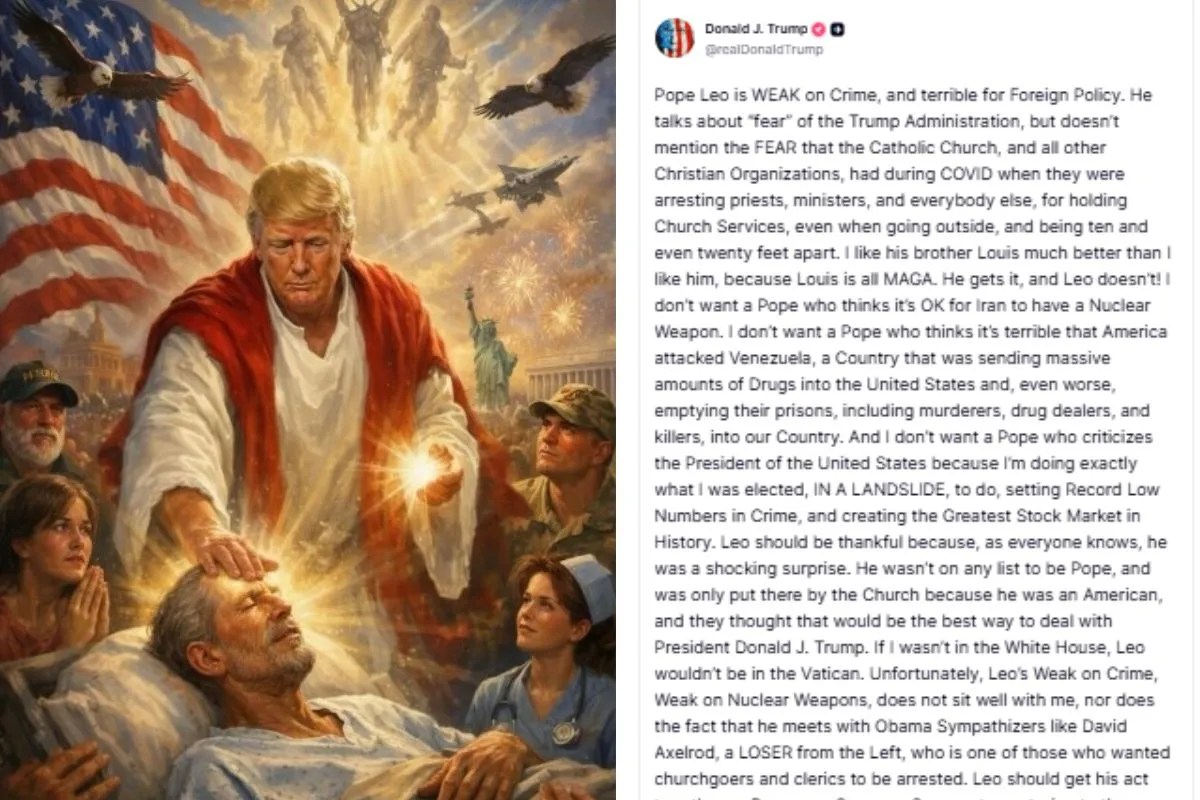
The recent explosion of AI-generated images featuring Donald Trump—ranging from stylized arrests to surreal, cinematic hero shots—isn't just a quirk of the Twitter algorithm. It is a fundamental break in the human contract with reality. When these images first surfaced, the internet reacted with its usual chaotic energy. Some laughed. Some raged. Many fell for it. For another look on this story, see the latest coverage from CNET.
But beneath the surface-level "bawal" (uproar) lies a terrifyingly simple piece of math. A few years ago, creating a convincing fake required a Hollywood budget and a team of VFX artists working for months. Today, it requires a prompt. Ten words. Thirty seconds. The cost of deception has dropped to near zero, while the cost of verifying the truth has skyrocketed.
Consider the mechanics of the "Trump Arrest" images. They weren't created by a master propagandist in a dark room. They were generated by Midjourney, a tool available to anyone with a Discord account and a few dollars. The AI doesn't know who Donald Trump is in a political sense. It doesn't understand the weight of the US presidency or the volatility of a divided electorate. To the machine, he is simply a collection of pixels, a recurring pattern of orange-tinted skin, swooping hair, and power ties.
The Glitch in our Biology
Our brains are poorly equipped for this. For thousands of years, if you saw a lion, there was a lion. Our survival depended on the absolute reliability of our optical nerves. We are biologically wired to trust an image more than a paragraph of text. A lie written in a caption can be debated; a lie rendered in high-definition pixels bypasses the logical brain and goes straight to the gut.
When we look at the AI-generated photos of Trump, our "System 1" thinking—the fast, intuitive part of the brain—takes over. It recognizes the face. It recognizes the context. It triggers an emotional response. By the time "System 2"—the slow, analytical part—kicks in to notice that the text on the police officers' uniforms is gibberish, the damage is already done. The emotional "truth" has been cemented.
This isn't just about politics. It’s about the erosion of the shared floor we all stand on. If any event can be fabricated, then any real event can be dismissed as a fabrication. This is the "Liar’s Dividend." When the public is conditioned to believe that photos are fake, a politician caught in a genuine scandal can simply shrug and say, "That’s just AI." The truth doesn't die; it just becomes invisible in the noise.
The Invisible Stakes of the Scroll
The social media reactions weren't just "people talking." They were a real-time stress test of global stability. On platforms like X (formerly Twitter) and Facebook, these images moved faster than any fact-check could follow. In the time it took for a journalist to write a debunking article, the AI photo had already been viewed ten million times.
Think about the sheer scale of the labor involved. One person clicks "generate." Millions of people spend their mental energy debating, defending, or debunking it. It is a massive drain on our collective cognitive resources. We are being forced to act as full-time forensic analysts just to navigate our morning news feed.
But why Trump? Why does he remain the primary subject of these digital hallucinations?
It is because he is the ultimate high-contrast figure. In the world of data, he is an outlier. His image carries so much "weight" in the training sets of these AI models that the machine can recreate him with startling accuracy. More importantly, he is a lightning rod for the very emotions that drive the attention economy: anger, loyalty, and shock. The AI isn't biased; the data it was fed is biased toward what humans find interesting. And we, it seems, find conflict irresistible.
The Ghost of Authenticity
We often talk about "deepfakes" as a future threat. That is a mistake. The threat is current, and it is subtle. It’s not just about the big, flashy lies—the fake arrests or the fake speeches. It’s about the "shallowfakes," the slight tweaks to reality that shift our perception of what is possible.
Imagine a world where you can no longer trust a video of your own child, or a voice memo from your boss, or a photo of a world leader. We are losing our anchors. In the past, we had gatekeepers—editors, librarians, experts—who helped us sift through the chaff. We fired the gatekeepers because we wanted "democratized information." We got it. Now, we are finding out that without a filter, the water is mostly lead.
The reaction to the Trump images revealed a strange, new human behavior: the "Performance of Belief." Many people who shared the photos knew, deep down, that they weren't real. They shared them anyway. They weren't sharing a fact; they were sharing a signal. They were saying, "This is how I wish the world looked." When the image matches the narrative in our heads, the reality of the pixels becomes secondary.
The Path Through the Hallucination
The solution isn't more technology. You cannot solve an AI problem with just more AI. We are caught in an arms race where the "generators" will always stay one step ahead of the "detectors." Every time we build a tool to spot a fake, the fake-making AI learns from that tool and gets better.
The real shift has to be cultural. We have to develop a new kind of "digital skepticism" that feels less like cynicism and more like hygiene. We don't drink water from a muddy puddle; we shouldn't consume information from an unverified stream.
But that is hard. It requires us to slow down. It requires us to fight our own biological urge to be right, to be first, and to be outraged.
In the wake of the Trump photo controversy, the platforms scrambled to add "Community Notes" and warning labels. These are band-aids on a gunshot wound. The real change happened in the minds of the people who saw them. A little more trust was shaved off the block. A little more nuance was lost.
The "bawal" on social media will fade. The specific photos of Trump being arrested will eventually be replaced by something even more convincing, even more scandalous. The machine doesn't get tired. It doesn't have an ego. It just keeps predicting the next pixel based on what we’ve shown it we want to see.
David, back in Ohio, finally puts his phone down. He feels a lingering sense of unease, a jittery exhaustion that sleep won't fix. He has seen a hundred things tonight, and he cannot be sure if any of them were real. He closes his eyes, but the image of the arrest is burned into his retinas, a ghost of a memory for an event that never took place.
The lights go out in the house, but the glow of the machine remains, waiting for the next thumb to hover, the next heart to race, and the next lie to become the truth.
We are not just users of this technology. We are its fuel. Every time we react without thinking, we teach the machine how to fool us better next time. The question isn't whether the AI can create a perfect lie. The question is whether we have finally lost the desire to tell the difference.