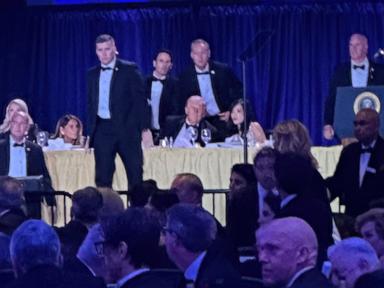
The air inside the Washington Hilton usually smells of expensive cologne and the faint, metallic tang of industrial-grade floor wax. On this particular Saturday, that scent was buried under the weight of anticipation. It was the night of the White House Correspondents' Association dinner. Thousands of journalists, politicians, and celebrities were packed into a space designed for celebration, unaware that a few hundred yards away, the barrier between a gala and a tragedy was thinning to the width of a single gunshot.
Panic doesn't start with a scream. It starts with a ripple.
Imagine you are a server holding a tray of champagne flutes. You hear a sound—not quite a firecracker, not quite a car backfire. It is a sharp, disciplined crack that slices through the hum of three thousand voices. You watch a Secret Service agent's posture change. It isn't a dramatic dive; it’s a tightening of the shoulders, a sudden, predatory focus. That is how the timeline of the WHCA shooting actually began. Not with a headline, but with a collective intake of breath.
The First Crack in the Evening
At approximately 6:15 PM, the perimeter of the Hilton was a hive of activity. Black SUVs idled in long rows. Men and women in formal wear shuffled through metal detectors, complaining about the humidity and the wait times. Security was, by all accounts, impenetrable.
Then came the first report.
Local law enforcement received a call about shots fired near the intersection of T Street and Connecticut Avenue. This wasn't inside the "hard" perimeter yet, but it was close enough to make the earpieces of every security detail hum with frantic data. The suspect, later identified by police, wasn't a phantom or a mastermind. He was a man with a weapon and a singular, jagged intent.
While the elite of the American media were adjusting their bowties in the mirrors of the ballroom restrooms, a patrol officer was already sprinting toward the sound of the discharge. The suspect had fired into the air, a terrifying herald of what was to come. He began moving toward the hotel. He wasn't running. He was walking with the heavy, deliberate pace of someone who believed they had nothing left to lose.
The Invisible Shield
We often think of security as a wall. In reality, it is a series of concentric circles, each one more pressurized than the last. As the suspect approached the outer gate of the Hilton, he hit the first layer of this invisible pressure.
Consider the "hypothetical" experience of a young digital reporter standing on the sidewalk, hoping for a quote from a passing Senator. One moment, you’re checking your phone for signal. The next, you are being shoved backward by a wall of blue uniforms. You see a man—unremarkable in dress, remarkable in his agitation—trying to force his way past the concrete bollards.
The suspect reached the North Entry. This is the mouth of the Hilton, the place where the most powerful people in the world disappear into the safety of the venue. He reached for the door. He was intercepted.
The struggle was brief, brutal, and largely unseen by the cameras flashes inside. Law enforcement tackled him just feet from the glass. They found the semi-automatic. They found the extra rounds. They found the map.
But the arrest didn't end the tension; it only redirected it. Inside the ballroom, the news started to leak. It moved from table to table like a virus. A whisper here. A vibrating phone there. You could see the color drain from the faces of the people on the dais. The jokes in the opening monologues started to feel brittle.
The Disconnect of Power
The real story of the WHCA shooting isn't just about a man with a gun. It’s about the terrifying proximity of violence to the seats of power. For forty-five minutes, while the suspect was being processed in a cold holding cell, the dinner continued. The steak was served. The wine flowed.
There is a specific kind of cognitive dissonance that happens when you are told there is a threat outside while you are surrounded by the trappings of safety. You look at the thick velvet curtains and the gold-leaf accents, and you tell yourself that bullets don't enter places like this.
But the Secret Service knew better. They had moved the President into a secure posture before the public even knew a shot had been fired. The "human element" here is the sheer, shivering fear of the people who realized they were trapped in a beautiful cage. If the suspect had been thirty seconds faster, or if the officer at the perimeter had been looking the other way, the evening would not have ended with a toast. It would have ended with a casualty count.
The Aftermath in the Dark
By 9:00 PM, the police had cordoned off three blocks. The sleek black cars that were supposed to whisk guests away were stuck behind yellow tape.
Journalists who spent their lives analyzing policy found themselves reporting on their own survival. They stood on the sidewalk in their gowns and tuxedos, the fabric flapping in the night breeze, looking at the spot where the suspect had been taken down. The contrast was jarring. The glitter of the gala met the cold, hard reality of a crime scene.
Security experts later analyzed the response time down to the millisecond. They spoke of "vulnerability windows" and "perimeter breaches." But those are clinical terms. They don't capture the sound of a heavy door locking. They don't describe the way a room of three thousand people goes silent when they realize the sirens they hear aren't just for an escort, but for an emergency.
The suspect was a man who had slipped through the cracks of society until he tried to force his way into its most guarded room. His motives were a messy sprawl of grievances, a narrative of a life gone wrong that collided with the narrative of a nation's elite at play.
When the lights finally went down in the Hilton and the last of the guests found their way through the police lines, the smell of floor wax was back. The cologne had faded. The event was over, but the silence that followed was different than the years before. It was a silence earned by a narrow escape.
The tuxedo is a uniform of confidence. It suggests that the wearer is part of a world where everything is under control. But that night, as the suspects' fingerprints were being taken and the spent casings were being bagged into plastic, the tuxedo felt thin. It felt like paper. It was a reminder that no matter how many layers of security we build, the world outside is always trying to get in.
The suspect didn't make it through the door. But for a few minutes, he owned the room. He didn't need to speak to be heard. The sound of his weapon was the only message that mattered, a sharp reminder that the distance between the headline and the tragedy is often just a few feet of pavement and a single, alert guard.