The grass underfoot at the stadium did not feel like grass. It felt like a vibrating, over-wound guitar string. Eighty thousand people were screaming, but the sound did not come from their throats. It came from the concrete, vibrating up through the soles of everyone's sneakers, a low-frequency hum that made your teeth click together if you left your mouth open too long.
Behind the heavy black curtain of the north tunnel, the air smelled of ozone, expensive hairspray, and damp felt. Read more on a related issue: this related article.
Most people watch the World Cup for the football. They watch for the tactical chess match, the sudden breakaway, the agonizing trajectory of a ball curling past a diving goalkeeper. But on this specific night, the ninety minutes of sport became a prologue. The real story was about to be told by an impossible alliance of a pop queen, seven Korean icons, and a troupe of felt puppets created in the twentieth century.
It sounded like a fever dream cooked up by a boardroom full of executives who had consumed too much espresso. In reality, it was the most expensive gamble in the history of modern entertainment. More journalism by The Hollywood Reporter highlights related views on the subject.
The Chaos of the Seven-Minute Build
To understand what happened, you have to understand the sheer logistics of a stadium half-time transition.
Imagine a clock ticking backward from four hundred and twenty seconds. That is all the time allowed to roll out a stage larger than a municipal swimming pool, connect miles of fiber-optic cables, check the audio feeds for three entirely different musical acts, and ensure nobody gets crushed by a moving crane. If one wheel catches on a piece of turf, the entire broadcast collapses. Millions of dollars in advertising revenue evaporate.
Standing in the tunnel, the contrast was absurd.
On the left stood Madonna. She was motionless, wrapped in a black silk robe, her eyes fixed on a small monitor showing the final seconds of the first half. She did not look nervous; she looked like a general calculating casualties. On the right, the members of BTS were moving in synchronized micro-movements, stretching their hamstrings and adjusting their earpieces with the quiet focus of Olympic sprinters. And right between them, sitting on an overturned equipment crate, was Kermit the Frog.
Or rather, a master puppeteer slumped on a crate, holding a lifeless green body in his lap until the cue came.
Chaos. Total chaos.
Then the whistle blew. The players cleared the field, their faces streaked with sweat and dirt. The stage crews sprinted onto the grass like an invading army.
The Collision of Three Worlds
When the lights went down, the stadium transformed. The traditional stadium floodlights snapped off, plunging eighty thousand live spectators and over a billion television viewers into a brief, terrifying darkness.
The silence lasted for exactly two seconds.
A single spotlight pierced the dark, illuminating a massive, elevated platform shaped like an ancient amphitheater. Madonna stood at the summit. She did not open with a modern pop track. Instead, she chose a stripped-back, bass-heavy rendition of a classic, her voice cutting through the humid night air with a gravelly authority that reminded everyone exactly who laid the bricks for the modern pop industry.
But the stadium did not truly explode until the stage below her began to rotate.
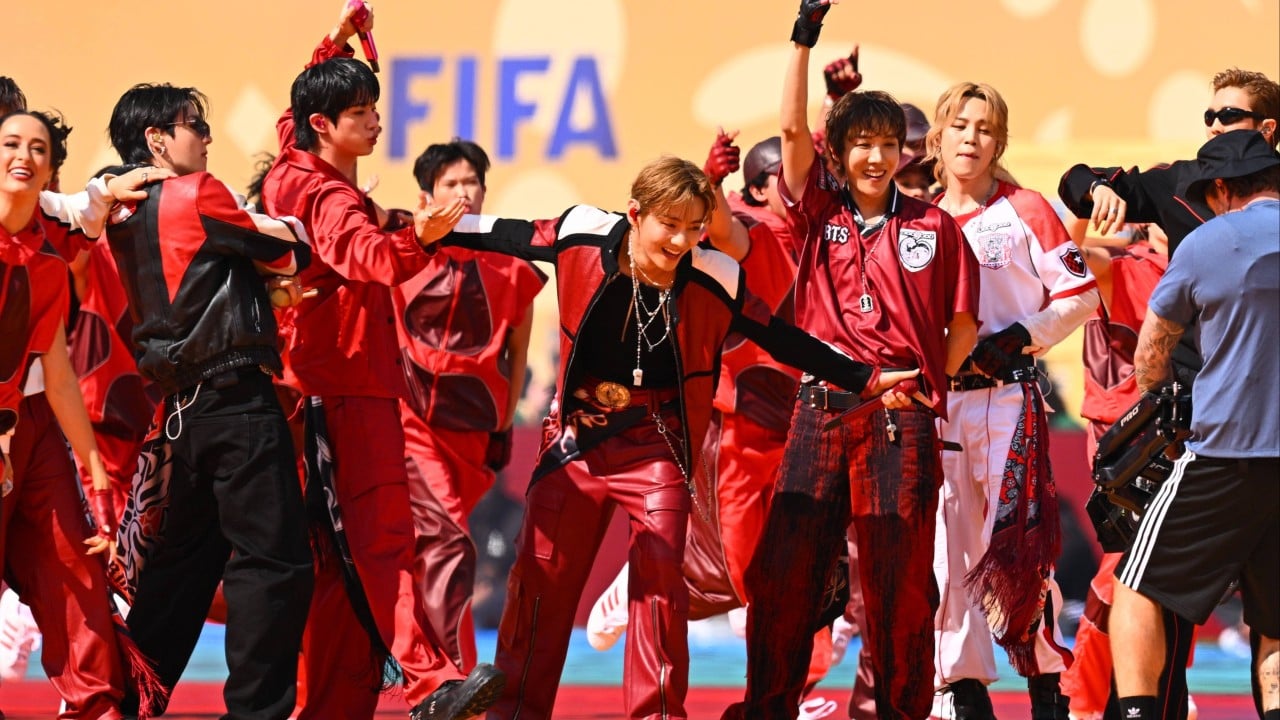
From the shadows emerged BTS. The transition was not a hand-off; it was a collision. The choreography was furious. Every step, every tilt of a fedora, every vocal run was executed with a precision that felt almost superhuman against the sprawling backdrop of the stadium. The crowd became a sea of glowing lightsticks, moving in perfect rhythm with the basslines.
It was a stark reminder of how the geography of culture has shifted. A decade ago, global entertainment ran strictly through London and New York. Tonight, the center of gravity was everywhere at once.
Then came the absurdity.
Just as the intensity reached a boiling point, the massive video screens behind the performers flickered. Miss Piggy appeared, wearing a custom couture gown that mirrored Madonna’s own outfit, trading sharp, comedic barbs across a split screen.
It shouldn't have worked. By all logic of tone and style, the presence of the Muppets should have turned a premium sporting event into a children's variety show. Instead, it acted as a pressure valve. It injected a sense of joyful anarchy into an environment that is usually choked by corporate polish. When Fozzie Bear popped out of a trapdoor near the drum kit, the collective laughter of the stadium was loud enough to rival a goal celebration.
What Happens When the Lights Fade
The spectacle ended as abruptly as it began.
A final, deafening blast of pyrotechnics illuminated the sky, leaving the smell of sulfur drifting over the pitch. The performers disappeared down the tunnels, the stage was disassembled by hundreds of sweating crew members, and within minutes, the referees walked back out to resume the match.
The green grass was visible again. The illusion was over.
Looking around the press box and the stands, people were staring at their phones, trying to process what they had just witnessed. They were checking social media, looking for confirmation that the bizarre mix of nostalgia, K-pop, and high-fashion pop royalty was real.
The match ended. One team lifted a trophy. But the conversation on the trains home, in the bars outside the stadium, and across global time zones wasn't about a missed penalty or a brilliant substitution. It was about those fifteen minutes where the world stopped being cynical. We saw a cultural experiment that proved entertainment doesn't need to fit into a neat, predictable box to move us. Sometimes, you just need a frog, a queen, and seven dancers to make the world feel small enough to share.