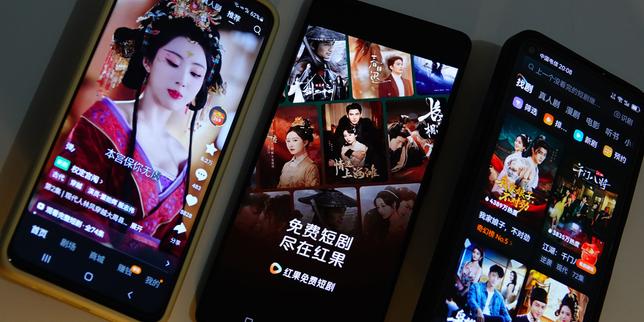
The phone screen glows at midnight in a cramped apartment in Hangzhou. Thumb flicks up. Cliffhanger. Thumb flicks up. Betrayal, slap, secret billionaire identity, dramatic zoom, two-second pause, swipe.
Sixty seconds. Another sixty seconds. Two hours vanish before the ceiling light even feels like an option.
A few years ago, that same midnight scroll was powered by a frantic, caffeinated human ecosystem. Writers banging out thirty-episode cliffhangers in shared flats. Camera operators sweating through twelve-hour shoots in Zhejiang film bases. Editors splicing reaction shots at three in the morning for a few hundred yuan a day, praying one vertical drama would catch fire and pay rent for the rest of the year.
Now, across China, artificial intelligence produces roughly ninety percent of micro-dramas for smartphones. And the money flowing into the pockets of human creators has fallen off a cliff.
I have spent years watching media economies shift from the inside—sitting in edit suites where the hum of cooling fans drowned out the traffic outside, smelling stale espresso and cold takeout, feeling the exact moment a human craft starts getting priced like a commodity. It is a strange, heavy thing to witness. You watch a room full of people who know how to read a sigh, hold a beat, or turn a cheap plastic prop into something tragic suddenly ask whether their instincts have any market value left.
If you only read a headline about automation taking over short-form television, it sounds like an efficiency story. Faster turnaround. Lower costs. Infinite volume.
Yet numbers flatten the people standing inside them. When ninety percent of a format is generated by machines, the story is not just about software getting smarter. It is about what happens to a creative middle class when a ninety-second melodrama costs almost nothing to manufacture, and what happens to audiences when every emotional hook is calculated to keep a thumb from swiping away.
To see how this works on the ground, let us step into a hypothetical scenario modeled closely on the real production shifts reshaping China's vertical drama market. Picture Lin, a mid-level screenwriter and story editor who spent four years writing high-tension plots for mobile screens—office rivalries, family secrets, sudden reversals of fortune. In the old rhythm, Lin had a team of junior writers, a tight shooting schedule, and an instinct for pacing. You had to earn the viewer's curiosity in the first three seconds, because mobile screens are unforgiving. If the opening line felt flat, people were gone.
Then came the wave of AI video, voice, and script generation tools. Suddenly, a solo producer or a tiny studio could feed a prompt into a pipeline, generate character faces, swap outfits, synthesize dramatic voiceovers, and push out dozens of episodes in a fraction of the time and cost. What once required crews, locations, lighting rigs, and actors could be assembled at a desk.
Lin's rates did not just dip gently. They collapsed. Why pay a writer a full fee for an original arc when an AI draft plus a quick human polish costs a fraction of the budget—and can be churned out at ten times the speed?
Think of it like the shift from hand-painted signs to cheap vinyl banners, except the product being mass-produced is human emotion. A vinyl banner tells you where the shop is. A vertical drama tries to make your chest tighten before the ad break or the paywall hits. When emotion becomes an assembly-line output, the economics of attention change overnight.
Why Vertical Micro-Dramas Were Always Vulnerable to Automation
Micro-dramas—short, punchy episodes built specifically to be watched vertically on a phone—did not arise out of nowhere. They grew out of mobile habits, cheap data, and a hunger for quick escapism during commutes, lunch breaks, and sleepless nights. Unlike traditional prestige television, which asks you to settle in for an hour and savor slow-burn character growth, vertical dramas are built on rapid escalation. Every episode ends on a hook. Every scene leans into recognizable tropes so viewers can jump in effortlessly.
In a strange way, that formula made vertical dramas both wildly popular and uniquely exposed to AI.
Traditional cinema thrives on ambiguity, subtext, and the quiet accidents of human performance—the way a real actor hesitates before telling a lie, or how natural light catches dust in an empty room. High-velocity mobile melodrama, by contrast, often relies on exaggerated reactions, clear archetypes, and relentless plot twists. When a format already prizes speed, clarity, and instant payoff over nuance, generative tools have an easier runway.
Consider what happens next: once the baseline cost of making an episode drops toward zero, the entire business model tilts.
In a high-cost human production, studios have to be selective. They bet on stories they think will convert viewers into paying subscribers or unlock ad revenue. There is a natural brake on volume because cameras cost money, locations cost money, and people need sleep.
Remove most of those physical constraints, and the floodgates open. Instead of releasing a handful of carefully tested series, studios can flood feeds with endless variations. Change the setting from a corporate boardroom to a historical palace. Swap the heroine's backstory. Test five hooks in a single afternoon.
For platforms and aggressive producers, that looks like a dream engine. For creators, it feels like standing in front of a firehose.
The Quiet Hollowing Out of Creator Income
When people talk about AI replacing creative work, they usually argue about whether machines have "true soul." That debate is real, and it matters, but it often misses the immediate financial reality. You do not need a machine to have a soul for it to undercut a paycheck. You only need it to be good enough, fast enough, and cheap enough for the market.
Let us use a metaphor to trace the money. Imagine a bustling street market where bakers sell fresh bread every morning. One day, someone sets up a machine that pumps out thousands of loaves that look golden from across the plaza and cost a tenth as much. Even if discerning customers know the machine's bread is dry inside, many buyers grab it anyway because it is right there, cheap, and quick. Within months, half the bakers cannot pay their flour suppliers.
That is the squeeze hitting creators across the short-form drama space.
Writers see fees compressed because "AI-assisted" scripts are treated as raw material rather than finished art. Voice actors face competition from synthetic voices trained on commercial datasets. Junior editors, background performers, and small crew members find fewer traditional shoots on the calendar. Even creators who still get hired often spend less time inventing stories and more time acting as prompt operators and quality-control checkers—fixing weird hand movements, smoothing stiff dialogue, and patching plot holes left by a model that has no lived memory of heartbreak or pride.
I will admit something candidly here: watching this unfold makes me uneasy, and I do not pretend to have a neat, painless fix. Part of me wants to believe that audiences will inevitably revolt against synthetic storytelling and demand pure human craft. Another part of me has seen how powerful convenience and habit are when you are tired at 11:30 p.m. and just want thirty seconds of cheap catharsis.
Uncertainty lives right there in that tension. We do not yet know where the floor is for creator earnings once AI handles ninety percent of the volume. Will human creators retreat into smaller, higher-trust niches where personal voice is the whole point? Will unions, platforms, and lawmakers redraw rules around likeness, training data, and compensation? Or will the middle tier of creative work keep shrinking until only mega-studios and solo prompt-wranglers remain?
What Viewers Gain—and What Slowly Slips Away
It would be dishonest to pretend viewers get nothing out of this shift. When AI speeds up production, stories can reach niches that were previously ignored because shooting them in live action was too expensive. A tiny studio can experiment with wilder visual worlds or hyper-specific premises without risking bankruptcy on a single physical set.
Still, something subtle shifts when ninety percent of what fills your screen comes from an algorithm predicting what keeps you tapping.
Human storytellers carry scars. They know what it feels like to be underestimated in a meeting, to love someone who is bad for you, to swallow pride just to keep peace at the dinner table. Sometimes a human writer puts a line in a scene that makes no commercial sense—a quiet joke, an awkward pause, a detail that does not advance the plot—because it feels true to life.
Generative models optimize for patterns. They excel at remixing what has already worked across millions of examples. Over time, when a feed is saturated with machine-made drama, the emotional curve can start to feel strangely weightless. Every twist arrives on schedule. Every betrayal is loud. Every resolution is frictionless. You get the sugar rush of suspense without the deeper resonance of a human life behind the glass.
Let us return to Lin in our hypothetical scenario. On a Tuesday evening, Lin opens a script generated by an AI tool for a new vertical series. The pacing is tight. The hooks land right where analytics say they should. On paper, it works. Yet when Lin reads the confrontation scene aloud, the dialogue sounds like someone who read about anger in a textbook rather than someone whose voice is shaking.
Lin can fix it. It takes twenty minutes to rewrite the exchange so it sounds real. The catch is that the client only wants to pay for ten minutes of polishing.
That is the invisible stake behind the headline statistic. Not just lost jobs, though livelihoods matter deeply, but a gradual shift in who gets to shape our everyday emotional diet—and how much patience remains for work that takes time to breathe.
Where Human Value Still Holds Ground
Even in a market where AI generates the vast majority of content, human creators are not powerless ghosts waiting out a storm. History shows that whenever a new medium lowers the barrier to production, the first wave is always about novelty, speed, and volume. The second wave—the one that builds lasting loyalty—belongs to people who understand trust.
Audiences are sharper than charts give them credit for. They may watch synthetic clips for quick entertainment, yet they still crave connection. A creator who builds a recognizable community, speaks plainly about their craft, and delivers stories with unmistakable human warmth holds an asset a generic prompt cannot easily replicate: a real relationship.
There is also craft in curation, direction, and emotional truth. An AI can generate fifty variations of a scene in minutes, yet it cannot feel whether a moment is earned. Choosing what to cut, knowing when to hold back a reveal, and grounding a wild premise in recognizable human stakes remain deeply human judgments.
Creators adapting to this reality are already changing how they work. Some use AI early in brainstorming to test angles fast, then strip it out when writing the actual human beats. Others lean into hybrid workflows while insisting on clear credit, fair splits, and ownership of their core characters and intellectual property. Still others step away from high-volume churn altogether to build smaller, richer projects where depth matters more than algorithmic velocity.
Back in that apartment in Hangzhou, the phone screen is still bright. One more episode starts. A character gasps. A secret is revealed. The thumb hovers above the glass.
For a split second, before the next swipe, there is a person on both sides of the screen—one hoping to feel something real, and another, somewhere else, wondering if their own voice still has room to be heard.