The arrest of a young United States Marine for the alleged robbery and murder of a local woman in Naha did not merely shock an island community; it exposed a structural raw nerve that has throbbed for decades in the Western Pacific. When the handcuffs went on Lance Corporal Devin Jacob Ballard, the resulting fury across Okinawa and Tokyo was entirely predictable.
It was also entirely preventable.
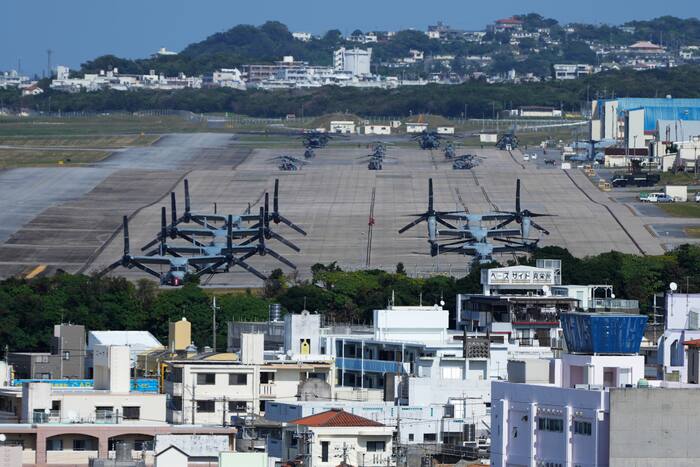
For generations, the mathematical imbalance of the security alliance between Washington and Tokyo has rested on the bruised shoulders of Okinawan civilians. While the prefecture accounts for a mere fraction of Japan’s total landmass, it shoulders the overwhelming majority of exclusive United States military facilities in the country. Every roar of a low-flying Osprey, every environmental contamination report quietly filed away, and every tragic criminal transgression by a service member adds another layer of resentment to a population treated as a permanent strategic sacrifice zone.
Official responses from the Pentagon and the U.S. Indo-Pacific command followed a grimly familiar script. There were solemn expressions of profound regret, a two-day operational pause to reinforce discipline, and the immediate imposition of curfews designed to keep junior enlisted personnel off the streets during late-night hours.
Curfews do not fix a broken culture of impunity. They merely trap young men inside barracks until the next rotation begins.
To understand why these tragedies keep recurring despite endless rounds of bilateral hand-wringing, one must examine the operational psychology of the modern expeditionary force. Young personnel, often barely out of their teens, are thrust into foreign environments with immense stress, access to alcohol, and a cultural bubble that frequently insulates them from the community outside the base perimeter. When supervision breaks down, the friction between the base and the host town turns toxic.
The political fallout this time, however, cuts deeper than usual. Newly elected Okinawa Governor Genta Koja, despite previously breaking with local political tradition to approve a contentious base relocation plan, found himself forced to adopt an unyielding stance against central government complacency. Summoning senior military commanders to the prefectural office, Koja demanded a fundamental rewriting of the governing frameworks that dictate how American forces operate on Japanese soil.
At the heart of the legal and political battle sits the infamous Status of Forces Agreement. Critics have long argued that the pact grants American personnel undue procedural protections, shielding them from immediate local accountability and leaving Japanese investigators fighting procedural red tape. When a heinous crime occurs, the public demand is never just for an isolated conviction; it is for systemic structural reform that strips away jurisdictional shields.
Diplomatic channels in Tokyo scrambled to contain the damage. Foreign Minister Toshimitsu Motegi and Defense Minister Shinjiro Koizumi summoned senior American diplomats and military chiefs to register official outrage, initiating high-level reviews of off-base conduct codes. Yet, past reviews have routinely resulted in temporary restrictions that quietly dissolve the moment geopolitical tensions in the region flare up and Washington pivots back to prioritizing combat readiness over community relations.
Then came the inevitable compounding error. Just as bilateral talks concluded with promises of tighter oversight and extended curfews, a U.S. Air Force captain was arrested by local police for drunk driving on an Okinawan road. The timing could not have been worse. It demonstrated to a skeptical public that institutional discipline cannot be restored simply by decreeing a midnight barracks lockdown.
Protesters outside government offices in Naha and Tokyo held high placards bearing a simple, exhausted message: We have had enough.
The strategic utility of the strategic hub in the Nansei island chain is viewed by defense planners in Washington and Tokyo as vital for regional deterrence. But that strategic necessity is colliding head-on with a local population that views the constant influx of foreign military personnel as an existential threat to public safety.
If the alliance cannot guarantee basic security for the civilians living in the shadow of the razor wire, the diplomatic cost will eventually outweigh any tactical advantage. Japan and the United States can draft joint statements until ministerial ink runs dry, but until the structural imbalance of the base arrangement is seriously addressed, the next crisis is not a matter of if, but when.
Japan shows no mercy to 'murderer' U.S. marine after woman's killing
This video provides an overview of the intense public reaction and political pressure in Japan following the arrest of the U.S. Marine on Okinawa.