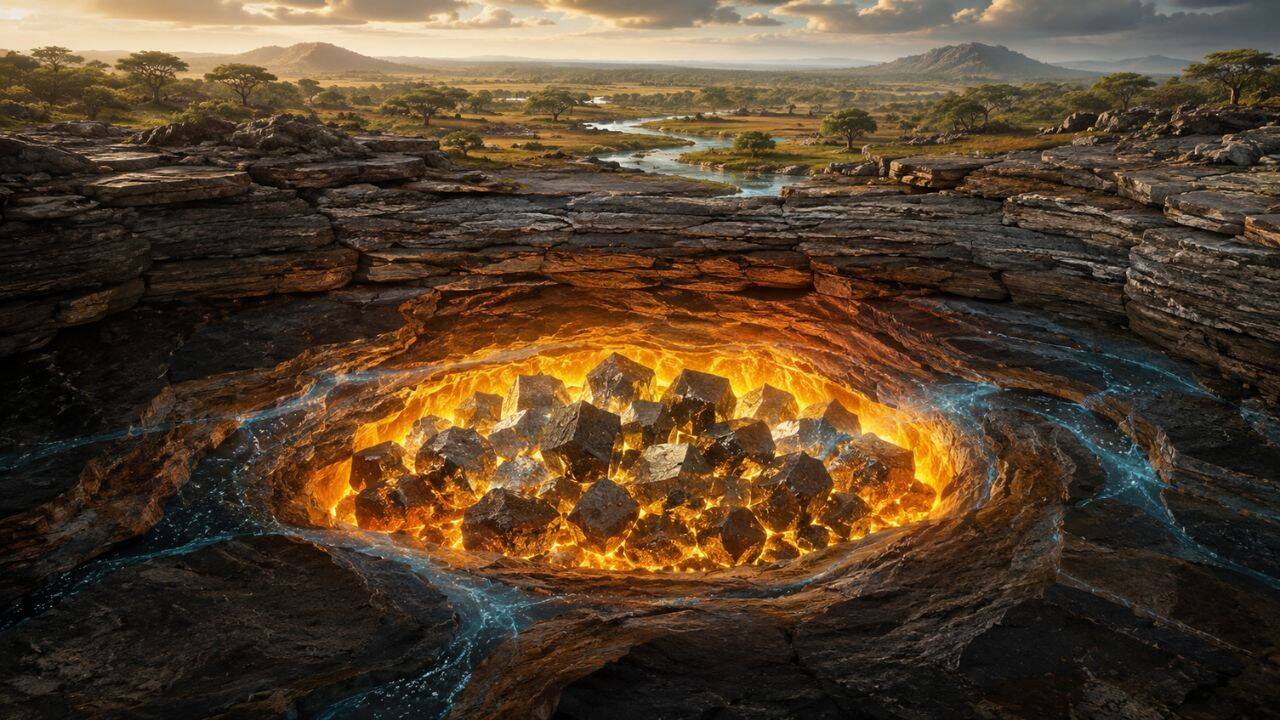
Two billion years ago, a series of self-sustaining nuclear fission reactors ignited spontaneously within the uranium deposits of the Franceville Basin in Gabon, West Africa. Collectively known as the Oklo fossil reactors, these sixteen distinct zones operated intermittently for hundreds of thousands of years, generating an estimated 100 kilowatts of thermal power per zone while consuming roughly six metric tons of uranium.
This phenomenon was not a geological fluke, but rather a deterministic outcome of precise isotopic, chemical, and structural conditions that occurred during the Paleoproterozoic era. If you found value in this piece, you should look at: this related article.
Deconstructing Oklo requires analyzing the physical parameters that allowed criticality to occur naturally, the thermodynamic feedback loops that prevented a runaway prompt critical excursion, and the geological containment mechanisms that successfully immobilized high-level radioactive waste for eons without human intervention.
The Four Pillars of Natural Criticality
Modern commercial nuclear reactors rely on artificial enrichment and complex control systems to sustain a nuclear chain reaction. In 1956, nuclear chemist Paul Kuroda calculated that a natural uranium deposit could achieve criticality if it met four fundamental physical conditions. The geology of Oklo satisfied each of these criteria. For another angle on this story, check out the latest update from The Next Web.
                  [ 1. Isotopic Threshold ]
                    U-235 abundance > 3%
                             │
                             ▼
                  [ 2. Geometry & Grade ]
                    UO2 ore thickness > 0.67m
                    Concentration > 10%
                             │
                             ▼
                  [ 3. Moderation Quality ]
                     H2O seepage (porosity)
                     No neutron "poisons"
                             │
                             ▼
                  [ 4. Geochemical Transport ]
                    Atmospheric O2 levels > 2%
                    (Solubilization & Deposition)
1. The Isotopic Threshold
Uranium-235 ($^{235}\text{U}$) is the only naturally occurring fissile isotope capable of sustaining a thermal neutron chain reaction. Today, $^{235}\text{U}$ makes up only $0.720%$ of natural uranium, which is too low to achieve criticality in standard light-water systems without enrichment.
Because $^{235}\text{U}$ decays roughly 6.3 times faster than $^{238}\text{U}$ (with a half-life of 704 million years compared to 4.47 billion years), the relative abundance of the fissile isotope was significantly higher in the deep geological past. At approximately $1.8$ to $2.0$ billion years ago, $^{235}\text{U}$ made up approximately $3%$ to $4%$ of natural uranium. This concentration matches the enrichment levels deliberately engineered for modern commercial nuclear reactors.
2. Critical Mass and Geometry
A self-sustaining reaction requires that the rate of neutron production from fission exceeds the rate of neutron loss via leakage and parasitic capture. The Oklo ore bodies featured sandstone layers where uranium concentrations reached up to $10%$ to $60%$ by weight.
To prevent excessive neutron leakage, the physical dimensions of these high-grade ore seams exceeded two-thirds of a meter in thickness—the average migration length of a thermal neutron within a water-saturated uranium-bearing matrix. This thickness provided the geometric volume necessary to maintain a positive neutron economy.
3. The Moderation Mechanism
Neutrons produced by the fission of $^{235}\text{U}$ are born with high kinetic energy (averaging $2\text{ MeV}$). These "fast" neutrons have a very low probability of inducing subsequent fission in $^{235}\text{U}$ and are instead likely to be captured parasitically by $^{238}\text{U}$ or escape the system.
To sustain the chain reaction, a moderator must slow these neutrons down to thermal energies (below $0.1\text{ eV}$) through elastic collisions. Liquid water, which filled the pores and fractures of the permeable Oklo sandstone, served as this moderator.
4. Absence of Neutron Poisons
High-purity uranium deposits can still fail to reach criticality if the surrounding rock contains high concentrations of transition metals or rare earth elements with exceptionally high neutron capture cross-sections (known as neutron "poisons"), such as boron, lithium, cadmium, or gadolinium.
The geochemical environment of the Franceville Basin was uniquely depleted of these elements, removing the chemical barriers that would otherwise halt a chain reaction.
Geochemical Drivers: The Great Oxidation Event
The physical assembly of the Oklo reactors was directly driven by planetary biological evolution. Prior to the Paleoproterozoic era, Earth's atmosphere was highly reducing, and uranium existed primarily in its tetravalent state ($\text{U}^{4+}$), which is highly insoluble in water.
The Great Oxidation Event, occurring roughly $2.4$ to $2.0$ billion years ago, raised atmospheric oxygen levels above $2%$. This oxygenated surface waters, converting insoluble $\text{U}^{4+}$ into soluble hexavalent uranyl ions ($\text{UO}_2^{2+}$).
$$\text{U}^{4+} (\text{insoluble}) \xrightarrow{\text{Oxygenation}} \text{UO}_2^{2+} (\text{soluble})$$
Groundwater transport carried these dissolved uranyl complexes through porous sandstone aquifers. When these fluids encountered reducing environments—specifically, organic-rich shales and carbonaceous matter in the Oklo region—the uranium was geochemically reduced back to its insoluble $\text{U}^{4+}$ state, precipitating out of solution as concentrated pitchblende ($\text{UO}_2$).
This redox-controlled accumulation loop created localized, hyper-concentrated deposits of highly enriched uranium that could not have formed during the older, anoxic Archaean eon.
Thermodynamic Stability and Self-Regulation
A critical question is why the Oklo reactors did not experience prompt-critical runaway excursions, culminating in mechanical steam explosions or core meltdowns. The answer lies in a passive physical feedback loop: a negative void coefficient of reactivity.
The active power cycles of the Oklo zones behaved like natural geysers. Xenon isotopic signatures trapped in aluminum phosphate minerals reveal that the reactors operated on a cyclic schedule: approximately 30 minutes of active fission, followed by roughly 2.5 hours of cooling and rehydration.
               [ Groundwater Infiltrates Ore ]
                             │
                             ▼
                 [ Criticality Achieved ]
               Reaction heats system to >300°C
                             │
                             ▼
                 [ Water Vaporizes (Steam) ]
               Density drops; moderation ceases
                             │
                             ▼
                 [ Reaction Halts (Cooling) ]
                Temperature drops; steam condenses
                             │
                             ▼
                [ Rehydration & Reactivation ]
                 Water re-enters; cycle repeats
As the fission reaction proceeded, the thermal energy generated heated the groundwater. Once the local temperature exceeded the boiling point at hydrostatic pressure, the water converted to steam and was expelled from the porous rock. Because steam has a much lower molecular density than liquid water, it is an ineffective moderator.
The loss of liquid water reduced the thermal neutron flux, dropping the effective neutron multiplication factor ($k_{\text{eff}}$) below $1.0$. The reaction halted.
Once the system cooled sufficiently, liquid groundwater slowly seeped back into the mineral matrix, restoring moderation, driving $k_{\text{eff}}$ back above $1.0$, and restarting the cycle. This passive cycle repeated for an estimated 150,000 years until the continuous radioactive decay and fission consumption of $^{235}\text{U}$ depleted the fissile inventory below the limit required to maintain criticality.
Nuclear Waste Containment: The Geological Analog
The Oklo reactors generated all the hazardous byproducts of a modern nuclear power plant, including plutonium, neptunium, americium, curium, and highly mobile fission products like cesium-135, iodine-129, strontium-90, and technetium-99.
Because these reactions occurred roughly two billion years ago, all of the short- and medium-lived radionuclides have long since decayed into stable isotopes. Analyzing the spatial distribution of these daughter isotopes within the geological formation reveals how effectively the natural barriers retained these highly toxic materials.
| Radionuclide Group | Primary Parent Isotope | Daughter/Indicator Isotope | Containment Mechanism | Migration Distance |
|---|---|---|---|---|
| Actinides | $^{239}\text{Pu}$, $^{237}\text{Np}$ | $^{235}\text{U}$ (enriched via decay) | Retained within the $\text{UO}_2$ crystal lattice. | Virtually zero ($<1\text{ }\mu\text{m}$) |
| Lanthanides | $^{143}\text{Nd}$, $^{145}\text{Nd}$, $^{147}\text{Sm}$ | $^{143}\text{Nd}$, $^{147}\text{Sm}$ (anomalous ratios) | Ion exchange in surrounding clay minerals. | Minimal ($<1\text{ m}$) |
| Noble Metals | $^{99}\text{Tc}$, $^{101}\text{Ru}$ | $^{99}\text{Ru}$, $^{101}\text{Ru}$ | Precipitated as metallic alloys. | Negligible |
| Volatile Halogens | $^{129}\text{I}$ | $^{129}\text{Xe}$ | Trapped in secondary apatite/alumino-phosphate minerals. | Restricted to local fractures |
The containment of plutonium is particularly significant for deep geological repository design. Plutonium-239 ($^{239}\text{Pu}$) was produced in large quantities via neutron capture on the abundant $^{238}\text{U}$:
$$^{238}\text{U} + \text{n} \rightarrow\ ^{239}\text{U} \xrightarrow{\beta^-}\ ^{239}\text{Np} \xrightarrow{\beta^-}\ ^{239}\text{Pu}$$
Isotopic analysis of the uranium at Oklo reveals localized enrichments of $^{235}\text{U}$ inside some grains, which can only be explained by the in-situ decay of $^{239}\text{Pu}$ (which alpha-decays to $^{235}\text{U}$ with a half-life of 24,000 years). This proof shows that the plutonium remained completely immobile within the crystal structures of the original uranium minerals until it fully decayed.
Similarly, cesium and strontium—often considered the most problematic highly soluble isotopes in modern radioactive waste management—were largely captured and retained. Although they migrated slightly more than the insoluble actinides, they were rapidly trapped by adsorption onto the clay minerals (mainly chlorite and illite) that formed a protective barrier around the reactor zones.
Strategic Implications for Modern Waste Repositories
The natural containment performance at Oklo provides empirical data for the design of deep geological repositories like Sweden's SFR/KBS-3 system or France's Cigéo project.
Modern engineered barrier systems (EBS) typically rely on a multi-barrier concept: solid waste forms (glass or ceramic), metal canisters (copper or steel), and clay backfill (bentonite) placed deep inside stable geological formations.
Oklo proves that geological formations can isolate high-level nuclear waste without human intervention over timescales that span billions of years, far exceeding the regulatory compliance windows of 10,000 to 1,000,000 years. The success of Oklo was driven by two key conditions:
- Reducing Geochemical Environment: The presence of organic matter kept the uranium and transuranic elements in their lowest oxidation states, which are highly insoluble.
- Clay Mineral Barriers: The surrounding hydrothermal clay layers acted as highly efficient natural filters, adsorbing migrating cations and sealing micro-fractures through swelling and hydration.
When selecting and designing deep geological repositories, prioritizing sites with reducing geochemistry and high-capacity clay backfills is the most effective way to replicate the robust containment first demonstrated by the planet two billion years ago.