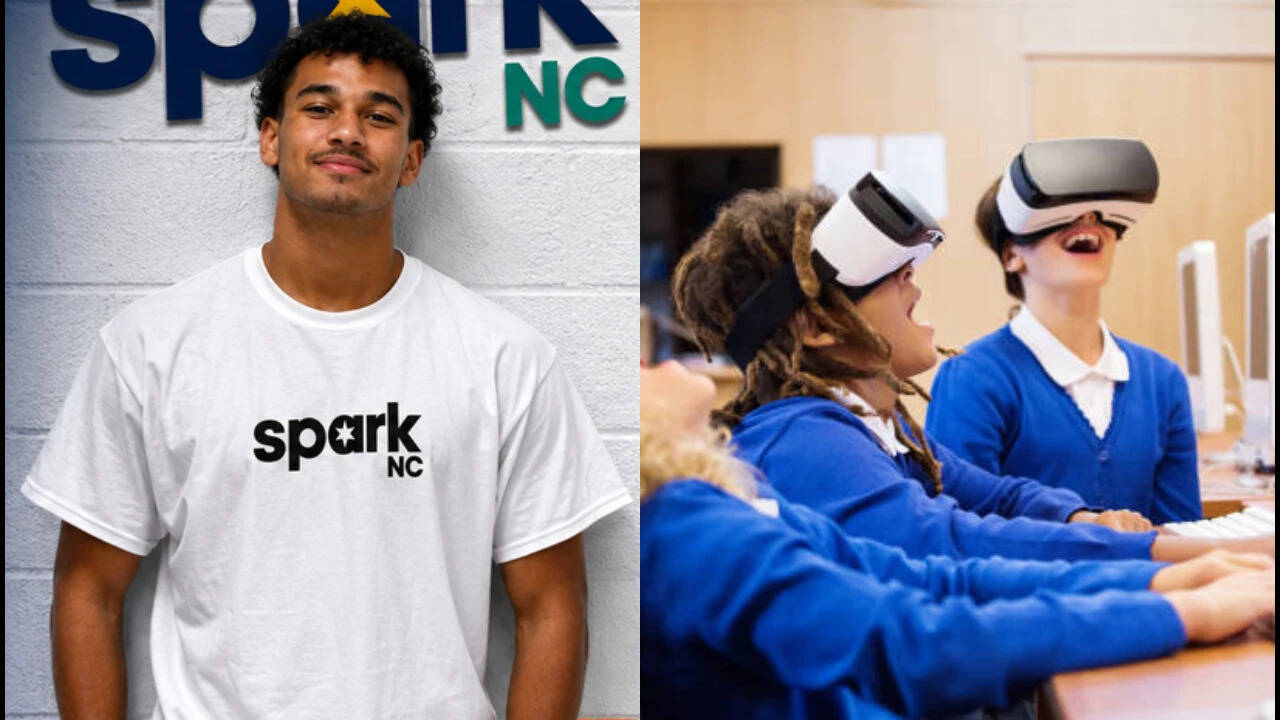
High school classrooms usually function as museums of the twentieth century, preserving rows of desks and top-down lectures while the outside world accelerates into spatial computing and immersive automation. Lexington Senior High School senior Lennox French just cracked that mold wide open.
By designing a fully operational virtual reality curriculum titled "Creating Digital Spaces in VR," French has become the first student in the history of the SparkNC initiative to have an independently built learning unit scaled for statewide deployment. The North Carolina Department of Public Instruction vetted the proposal, determining that the student-built framework satisfies rigorous computer science standards. It is an aggressive departure from the standard administrative playbook, proving that the most effective way to reform technical education is to hand the drafting tools directly to the students. Meanwhile, you can explore other events here: The Cost of Shouting in an Empty Room.
The Structural Shift in High School Innovation
For decades, state-level curriculum design has suffered from an immense distance between policymakers and classrooms. Bureaucrats write standards in climate-controlled offices, textbook publishers water them down into generic modules, and teachers try to inject life into outdated material. SparkNC was built to bypass this bureaucratic friction.
Operated as an interdistrict network designed to build homegrown technical talent, the initiative provides a sandbox where students earn credit by solving complex problems rather than filling out worksheets. French spent the previous academic year experimenting inside his school’s Spark Lab under the guidance of local leader Garland Beamer. Instead of treating virtual reality as a passive entertainment medium or a novelty toy, French investigated how simulated 3D environments could serve as functional collaborative workspaces. To explore the complete picture, we recommend the excellent article by MIT Technology Review.
The resulting curriculum does not simply teach kids how to strap on a headset. It trains them to engineer the actual digital architecture. Students learn the foundational logic of spatial design, rendering environments that can host remote collaboration and interactive problem-solving. By securing official state approval for credit aggregation, this project proves that competency-based models can recognize authentic, student-generated technical output without demanding a traditional textbook wrapper.
The Bottlenecks of Scaling Student Ingenuity
Transforming a local lab experiment into a statewide educational product is an uphill battle. Most student-led innovations die the moment the semester ends, trapped by liability issues, software licensing walls, and administrative inertia.
French’s project survived this mortality phase because the underlying framework aligned with actual industry demands. Modern software development increasingly leans toward spatial interfaces, digital twins, and remote collaborative engineering. Yet, public high schools rarely possess the internal engineering talent to build courses around these emerging domains. By allowing a student who actually uses the technology to write the instructional blueprint, SparkNC sidestepped the typical irrelevance that plagues high school computer science electives.
Even so, the operational hurdles ahead are steep. Expanding a student-authored VR module across multiple school districts requires consistent hardware, reliable device management systems, and continuous technical support. Many rural districts in North Carolina struggle with baseline broadband infrastructure, let alone outfitting classrooms with high-end spatial computing headsets. Writing the software code is only half the battle. Delivering a reliable user experience across dozens of disparate school networks remains the ultimate stress test for the initiative.
Beyond the Novelty of Immersive Tech
Skeptics often dismiss virtual reality in education as an expensive distraction, pointing to past tech fads that promised to revolutionize learning before gathering dust in supply closets. That critique is entirely fair when schools treat immersive tech as a substitute for a textbook.
French's approach avoids this trap by focusing on creation over consumption. Students enrolled in "Creating Digital Spaces in VR" are not watching pre-rendered videos of historical sites. They are building the rooms, scripting the interactions, and managing the spatial assets themselves. This distinction shifts the learner from a passive consumer of digital media into an active producer of digital infrastructure.
The economic implications for North Carolina are concrete. As technology sectors expand across the Research Triangle and surrounding urban and rural hubs, the demand for workers fluent in 3D modeling, spatial interaction design, and collaborative software architecture continues to surge. Traditional computer science pathways often stall out at basic syntax tutorials and terminal windows. By introducing spatial logic early, programs like this build a direct pipeline into high-wage technical careers without waiting for university-level enrollment.
The transition from a single high school laboratory to a state-approved curriculum happened because the architects of SparkNC trusted a teenager to understand the future of education better than career administrators. As French and his mentors work alongside industry stakeholders to refine the platform for statewide rollout, the real question is how quickly other school systems will swallow their pride and replicate the model. Stop treating students as empty vessels waiting to be filled with obsolete knowledge, and they might just redesign the entire school system for you.


