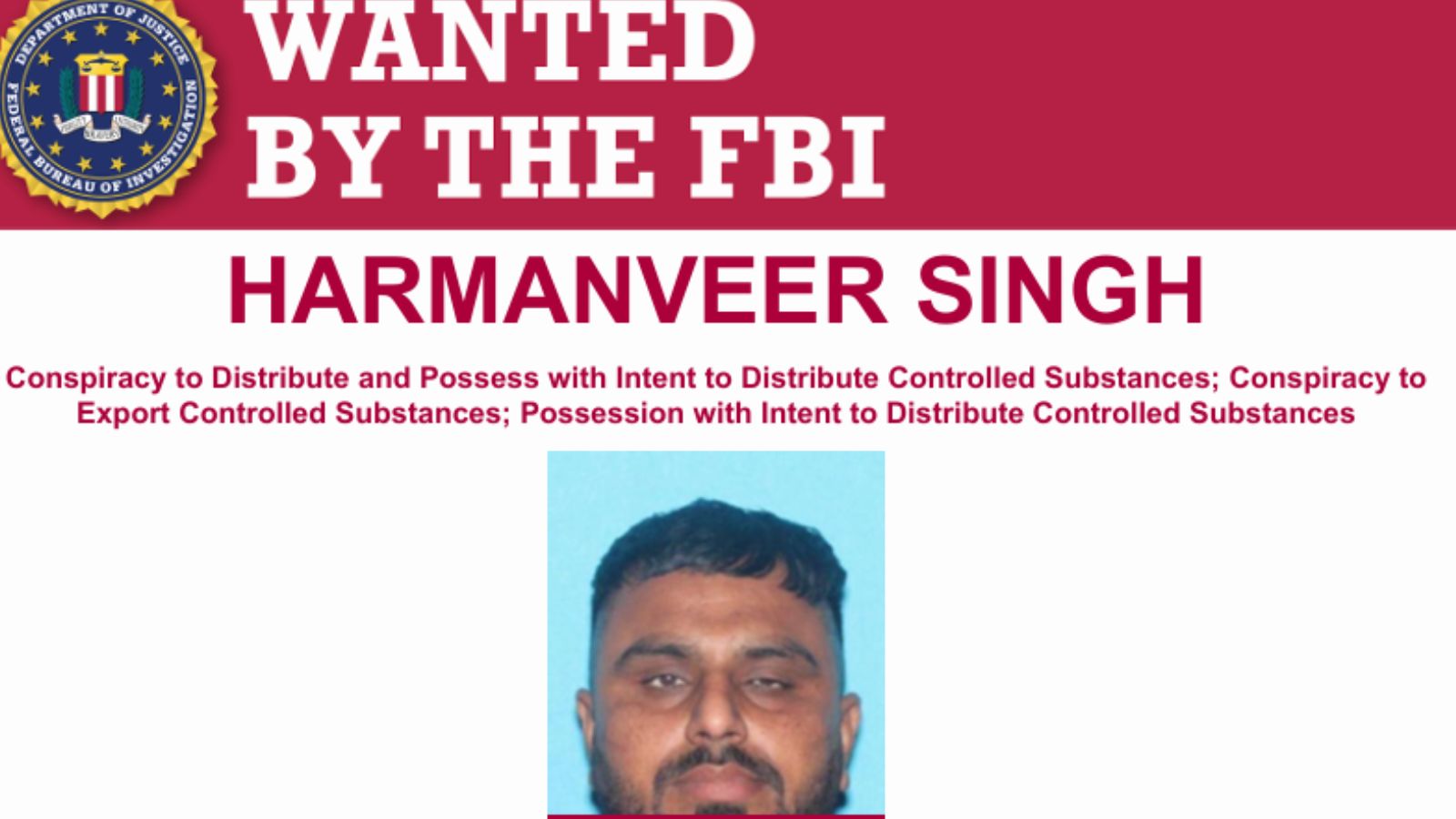
Federal agents just sent a loud message to international drug syndicates operating across North American borders.
On Tuesday morning, officers from the California Highway Patrol pulled over 31-year-old Harmanveer Singh in Stockton, California. The arrest wasn't a routine traffic stop gone wrong. It was the result of a massive federal investigation led by the FBI.
Singh, an Indian national who also went by aliases like Hari Gautam and Harman Sandhu, was wanted on a federal arrest warrant issued on June 23, 2026, by the United States District Court for the Central District of California in Los Angeles. The charges against him carry massive federal prison sentences: conspiracy to distribute and possess controlled substances with intent to distribute, along with conspiracy to export bulk narcotics across international lines.
If you think this is just another isolated drug bust in Central Valley, think again. Singh's arrest is a major link in a multi-agency international crackdown known as Operation Hard Ball.
The Ravinder Dhanda Gang and the Vancouver Pipeline
Federal law enforcement authorities didn't target Singh out of nowhere. FBI Los Angeles field agents identified him as a key operational member of the Ravinder Dhanda Organized Crime Group.
This syndicate operates out of Vancouver, Canada. It isn't a small-time neighborhood gang. Authorities describe it as a sophisticated transnational criminal network that moves bulk quantities of methamphetamine and cocaine straight through the United States, Canada, and Mexico.
The mechanics of their supply chain are simple yet aggressive. They move heavy loads of synthetic drugs and cocaine north across the US-Mexico border, route them through distribution hubs in California, and then ship them north into Canadian cities. Along the way, millions of dollars in drug money flow backwards to finance logistics, stash houses, and phony transportation networks.
Singh was a wanted figure in this web. Standing 5'7" and operating under multiple false identities, he managed to stay off the grid for months. But federal wiretaps, undercover surveillance, and shared international intelligence eventually caught up with him.
Operation Hard Ball Shatters Criminal Networks Across Three Continents
The arrest of Harmanveer Singh doesn't exist in a vacuum. It represents the latest domino to fall in Operation Hard Ball, a massive joint operation involving law enforcement agencies in the United States, Canada, and Western Europe.
Earlier this month, federal authorities unsealed three major indictments charging 37 individuals linked to three separate India-based organized crime groups operating across North America. Within days, coordinated law enforcement teams arrested 24 suspects across multiple jurisdictions, including 11 high-value targets in California alone.
The primary targets of Operation Hard Ball include three allied criminal syndicates:
- The Ravinder Dhanda Organized Crime Group, based in Vancouver.
- The Lawrence Bishnoi Gang, a notorious criminal network with deep roots in South Asia and widespread international reach.
- The Jaggu Bhagwanpuria Crime Syndicate, known for violent extortions and international drug smuggling.
These groups stopped acting as isolated local gangs long ago. They built a unified logistics network, sharing transport routes, safe houses, and financial clearinghouses to move illicit cargo across borders without getting caught.
How Gang Recruiters Exploit Visa Applicants and Border Loopholes
One of the most eye-opening findings from court filings in Operation Hard Ball is how these organizations build their labor pool. They aren't just hiring seasoned street criminals. They actively target vulnerable individuals and young migrants.
Out of the individuals charged in the broader federal indictment, at least 15 were living in the United States without legal immigration status. Federal investigators revealed that gang recruiters specifically targeted student visa applicants and recent arrivals who were struggling financially.
Recruiters promised fast cash, lodging, and protection in exchange for handling drug drop-offs, driving commercial vehicles stuffed with concealed contraband, or holding down stash locations in suburban neighborhoods.
We saw a clear example of this dynamic just days before Singh's arrest. Federal agents picked up 26-year-old Nitish Kaushal, known in criminal circles as "Lala," in Vermont as he attempted to sneak across the border into Canada. Kaushal, linked directly to the Jaggu Bhagwanpuria network, had been the subject of an intense FBI manhunt and a wanted poster released only 48 hours prior to his capture.
These runners think they can blend into normal transport flows. They use commercial trucking routes, hidden compartments in passenger cars, and rural border paths to move product. But federal multi-agency task forces have adapted. By blending border surveillance data with undercover operations, investigators are dismantling these networks piece by piece.
The High Stakes and the Hunt for Goldy Brar
The capture of individuals like Singh and Kaushal shows that federal prosecutors are cutting through the middle layers of these syndicates. But law enforcement leadership is transparent about the ultimate goal: taking down the top leaders directing operations from abroad.
At the top of the wanted list is Satinderjeet Singh, better known as Goldy Brar. US authorities consider Brar the primary North American leader of the Lawrence Bishnoi gang. The FBI currently offers a reward of up to $50,000 for information leading directly to his arrest.
Brar and Bishnoi have been linked by international authorities to high-profile violent crimes, contract hits, and systematic extortion schemes spanning India, Canada, and the United States. Federal prosecutors argue that the money generated from moving bulk methamphetamine and cocaine through American highways directly funds these violent operations overseas.
When you look at the big picture, Operation Hard Ball isn't just about stopping drug distribution in California. It's an aggressive geopolitical push to dismantle transnational cartels that treat international borders like mild inconveniences.
What Happens Next for Federal Drug Enforcement
The arrest of Harmanveer Singh in Stockton proves that law enforcement coordination across international borders actually works when agencies pool their resources. The Central District of California is preparing to prosecute Singh on heavy federal conspiracy counts that carry mandatory minimum prison terms.
If you track federal criminal cases, watch these key indicators over the coming months:
- Extradition proceedings for co-conspirators detained in Canada and Europe.
- Unsealing of additional forfeiture actions against properties and bank accounts tied to the Dhanda and Bishnoi groups.
- Increased commercial vehicle inspections along northern border crossings and major California freight corridors.
Federal prosecutors are making it clear that hiding behind false aliases and international borders won't protect gang operatives forever.

/https://i.s3.glbimg.com/v1/AUTH_e84042ef78cb4708aeebdf1c68c6cbd6/internal_photos/bs/2026/g/B/3vpkvHQKizRKAfzDxjXA/vini-jr-antes-e-depois.jpg)