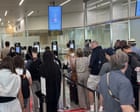
The introduction of the European Union’s Entry/Exit System (EES) represents a fundamental shift from manual passport stamping to automated biometric registration. While designed to enhance security and track visa-overstay metrics with high precision, the current deployment framework introduces a structural latency bottleneck at external Schengen borders. When automated processing times per passenger increase even marginally, the resultant backlog scales non-linearly. This operational friction does not merely cause localized delays at border gates; it triggers a cascade that suppresses airline load factors, disrupts airport turnarounds, and introduces severe economic inefficiencies across the aviation value chain.
To understand why calls for suspension emerge during peak travel periods, one must analyze the system through the lens of queueing theory, capacity constraints, and network economics. The core issue is not the technology itself, but the misalignment between fixed infrastructure throughput and highly concentrated, time-sensitive passenger volumes.
The Biometric Bottleneck: A Queueing Theory Breakdown
The fundamental mechanism driving border delays during the EES rollout is the transition from a deterministic processing model to a stochastic processing model. Under the legacy manual system, a border guard glances at a travel document, verifies the photograph, and applies a physical stamp. This process exhibits low variance, typically requiring 30 to 45 seconds per third-country national.
The EES alters this baseline by introducing a multi-step digital enrollment process:
- Document authentication via optical character recognition (OCR) and chip verification.
- Four-fingerprint biometric capture via digital scanners.
- Live facial recognition image capture.
- Database cross-referencing against the Schengen Information System (SIS) and other security registries.
The math governing this transition explains the sudden degradation of airport throughput. In queueing theory, Kendall's notation describes a system using the format $M/M/c$, where arrival rates and service rates are modeled statistically. If we apply an $M/G/c$ model—where arrivals ($M$) are Markovian (random), service times ($G$) follow a general distribution with high variance, and ($c$) represents the number of open border lanes—the average wait time in the queue ($W_q$) is expressed through the Kingman formula approximation:
$$W_q \approx \left( \frac{\rho}{1-\rho} \right) \left( \frac{C_a^2 + C_s^2}{2} \right) \frac{1}{\mu}$$
Where:
- $\rho$ is the utilization factor, calculated as the arrival rate ($\lambda$) divided by the total service capacity ($c\mu$).
- $C_a^2$ is the coefficient of variation for arrivals.
- $C_s^2$ is the coefficient of variation for service times.
- $\mu$ is the mean service rate.
When the EES requires first-time travelers to register their biometrics, the service time ($\frac{1}{\mu}$) increases from 45 seconds to an average of 120 to 180 seconds. More critically, the variance ($C_s^2$) spikes dramatically due to hardware misreads, language barriers, and physical compliance difficulties (e.g., poor fingerprint quality or incorrect facial positioning).
As the utilization factor ($\rho$) approaches 1.0—meaning passenger arrival rates match or exceed the maximum theoretical processing speed of the border control point—the term $\frac{\rho}{1-\rho}$ approaches infinity. In a highly concentrated peak holiday environment, where flight banks land simultaneously, the queue length expands exponentially rather than linearly.
The Downstream Cascade on Airline Load Factors
The operational failure at the border control gate does not remain localized. It propagates backwards through the airport ecosystem, directly impacting airline operations and explaining why aircraft are departing with significant numbers of empty seats despite high ticket demand.
The mechanism of this phenomenon follows a specific sequence:
[Border Queue Saturation]
       │
       ▼
[Gate Closing Deadlines Breach]
       │
       ▼
[Passenger Offloading Protocols Triggered]
       │
       ▼
[Luggage Retrieval (Baggage Reconciliation System)]
       │
       ▼
[Slot Miss / Delayed Departure] OR [Departure with Reduced Load Factor]
Airports operate on strict, highly synchronized schedules governed by slot allocations. An airline must vacate its gate within a precise window to maintain network integrity and avoid steep fines from air traffic control (ATC) coordinators like Eurocontrol.
When a passenger is trapped in an uncontrolled border queue for three hours, they inevitably miss the gate closure window, which typically occurs 15 to 20 minutes prior to scheduled departure. Once the gate closes, international aviation regulations (such as the ICAO Annex 17) mandate that any checked baggage belonging to a non-boarded passenger must be removed from the aircraft hold before departure. This process utilizes the Baggage Reconciliation System (BRS).
Airline dispatchers face a costly optimization dilemma:
- Option A: Wait for delayed passengers. This choice risks missing the ATC departure slot. In congested European airspace, missing a slot can result in a ground delay program hold lasting several hours. This delays subsequent flight legs, racks up crew duty-hour penalties, and incurs steep passenger compensation liabilities under regulations like EU261.
- Option B: Depart on time without the passengers. The airline offloads the missing passengers' bags and departs with empty seats. The seats are already paid for, but the airline loses ancillary revenue (onboard sales, duty-free commissions) and suffers severe brand damage. More importantly, the system's overall efficiency drops as realized load factors plummet below planned load factors.
The manifestation of half-empty planes during peak demand cycles is the direct output of airlines choosing Option B to preserve the integrity of their broader network schedules. The financial loss is quantified not just by the empty seats, but by the compounding operational costs of rebooking thousands of stranded passengers onto later flights that are already operating at capacity.
Structural Asymmetries in Border Infrastructure
The impact of EES is not felt equally across all transport hubs. The severity of the disruption is dictated by structural asymmetries in physical space and passenger demographics.
Spatial Constraints
Older European airport terminals were architected under legacy assumptions regarding passenger processing footprints. A standard manual passport booth requires approximately 4 to 6 square meters of floor space. A fully compliant EES biometric kiosk installation, complete with guiding barriers, self-service screens, and adequate clearance for biometric capture, requires a significantly larger footprint. Physical walls, structural pillars, and baggage makeup areas prevent terminals from expanding their border control zones. Forcing a high-footprint technology into a constrained physical space restricts the number of parallel processing lanes ($c$) that can be deployed, artificially capping the system's maximum throughput.
Passenger Demographics
The operational burden of EES falls exclusively on third-country nationals (TCNs), which includes travelers from the United Kingdom, the United States, and other non-EU states. The vulnerability of an airport to EES-induced failure is directly proportional to its TCN passenger ratio.
Consider the contrasting operational profiles of two hubs:
- Hub A (Intra-Schengen focused): 85% of traffic originates from within the EU. Passengers utilize automated e-gates with minimal friction. The EES introduction causes negligible disruption.
- Hub B (Leisure/Transatlantic focused): 60% of traffic consists of holidaymakers from non-EU nations. First-time biometric registration is required for the vast majority of the passenger base. Hub B experiences systemic queue failure during morning transatlantic or cross-channel arrival banks.
This asymmetry explains why localized calls for suspension or mitigation emerge from specific regional hubs and carrier networks rather than universally across the aviation sector.
Strategic Mitigation Frameworks for Terminal Operators
To prevent systemic collapse during peak periods without abandoning the security mandates of the EES, aviation stakeholders and border authorities must deploy structural operational mitigations. Relying on manual overrides or ad-hoc processing pauses is unsustainable; instead, operators must implement a layered defense framework.
+------------------------------------------------------------------------+
|                      STRATEGIC EES MITIGATION MATRIX                   |
+------------------------------------------------------------------------+
| PHASE                | ACTION ITEM                                     |
+----------------------+-------------------------------------------------+
| 1. Off-Hub           | Shift data enrollment to mobile applications    |
|                      | prior to terminal arrival.                      |
+----------------------+-------------------------------------------------+
| 2. Pre-Border        | Dynamic triage based on registration status     |
|                      | (First-time vs. Returning TCN).                 |
+----------------------+-------------------------------------------------+
| 3. At-Gate           | Real-time BRS data sharing to predict           |
|                      | offloading delays before gate closure.          |
+----------------------+-------------------------------------------------+
Upstream Enrollment Decoupling
The primary method to increase $\mu$ (service rate) at the physical border is to remove the data-entry burden from the terminal itself. This requires the deployment of secure, carrier-integrated mobile applications that allow travelers to pre-enroll their passport data, facial images, and answers to entry questionnaires before arriving at the airport. The physical border check then shifts from an enrollment task to a simple verification task, reducing the processing time per passenger back toward historical baselines.
Dynamic Triage and Segmented Queues
Terminal operators must abandon the monolithic "All Passports" queueing structure. Queues must be dynamically segmented based on the friction profile of the traveler:
- Lane Set 1 (EU/EEA Citizens): Unaffected; maximized for high-speed automated e-gate processing.
- Lane Set 2 (Returning TCNs): Biometrics already exist in the central database. Processing requires a rapid 1:1 facial match rather than a full ten-print enrollment.
- Lane Set 3 (First-Time TCNs): Dedicated high-density enrollment zones equipped with specialized assistance staff to minimize user error and manage high-variance service times.
Algorithmic Predictive Offloading
Airlines cannot afford to discover passenger delays at the final minute of gate closure. By integrating airport departure control systems (DCS) with border queue tracking metrics (via Bluetooth or Wi-Fi crowd-density monitoring), carriers can algorithmically predict which passengers will fail to clear the border before the flight's critical path window closes. This allows baggage handlers to pre-stage targeted luggage for offloading early, minimizing the time required to clear the hold and ensuring the aircraft hits its ATC slot window, even if it must fly with reduced utilization.
The long-term stabilization of European travel networks depends on these infrastructure adjustments. Expecting a high-friction digital registration protocol to function seamlessly within fixed, analog terminal architectures during peak demand periods without these mitigations is an operational impossibility. The solution lies not in suspending security systems permanently, but in engineering the throughput capacity required to sustain them.