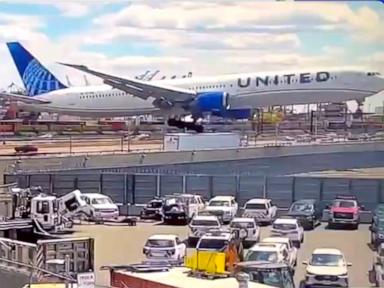
Ground-handling incidents represent a disproportionate volume of commercial aviation insurance claims despite occurring at zero or near-zero knots. The recent contact between a United Airlines Boeing 737-800 and ground infrastructure at Newark Liberty International Airport (EWR) is a textbook case of a breakdown in the Spatial Awareness Chain. While public discourse focuses on the visual shock of a wing striking a pole or a vehicle, the structural failure began minutes prior in the communication protocols and visual marshaling sequences that govern "non-sterile" ground movement.
The event, involving Flight 1888 arriving from San Francisco, serves as a catalyst for analyzing the intersection of pilot-controlled taxiing and the variable environment of the terminal apron. Ground maneuvering is not a secondary phase of flight; it is a high-risk transition where the aircraft moves from a highly regulated Air Traffic Control (ATC) environment into a congested ramp area where human error is the primary variable. Expanding on this theme, you can also read: Washingtons Cuba Policy is a Sixty Year Lesson in Doing the Same Thing and Expecting Different Results.
The Mechanics of Structural Contact
To understand why a professional flight crew fails to maintain wingtip clearance, one must decompose the aircraft's geometry relative to the ramp’s "Safety Envelope." A Boeing 737-800 has a wingspan of approximately 117 feet (35.8 meters). At Newark, a legacy airport with high-density gate configurations, the margin for error often shrinks to less than 15 feet.
The contact with a stationary light pole and a nearby catering truck suggests a failure in Reference Point Calibration. Pilots sit roughly 10 feet above the pavement; they cannot see their own wingtips from the cockpit. Consequently, they rely on a three-pronged system of guidance: Experts at NBC News have provided expertise on this situation.
- Lead-in Lines: High-visibility yellow markings on the pavement designed to keep the nose gear on a path that guarantees wingtip clearance.
- Ground Marshaling (Wing Walkers): Personnel positioned at the extremities of the aircraft’s path to provide visual "stop" signals if the safety envelope is breached.
- VDGS (Visual Docking Guidance Systems): Automated laser-based sensors that provide real-time distance and centering data.
When an aircraft strikes a pole while on a taxiway or lead-in line, the error is either Path Deviation (the pilot failed to keep the nose gear on center) or Obstruction Encroachment (infrastructure or vehicles were placed within the designated safety zone). Preliminary evidence suggests the aircraft was under its own power, taxiing toward the gate, when the starboard wingtip made contact. This indicates a breakdown in the "Cleared to Taxi" mental model, where the crew assumed the path was sanitized when, in reality, a static obstruction remained in the prohibited zone.
The Cognitive Load of the Ramp Environment
The transition from a 150-knot landing to a 5-knot taxi does not result in a corresponding drop in cognitive demand. If anything, the complexity increases. The "Sterile Cockpit Rule" (FAA 14 CFR 121.542) applies until the aircraft is parked, yet the distractions at a hub like Newark are immense.
- Radio Congestion: Monitoring Ground Control, Ramp Control, and internal company frequencies simultaneously.
- Visual Noise: Flashing beacon lights from dozens of ground support equipment (GSE) vehicles, competing with runway and taxiway lighting.
- Aft-Center of Gravity Dynamics: During slow-speed turns, the "swept-wing" effect means the wingtips move through a wider arc than the nose. A pilot focused on the nose gear’s position can easily forget that the tail and wingtips are describing a much larger, more dangerous circle.
This specific Newark incident highlights the Normalization of Deviance. If catering trucks or baggage tugs frequently park near the edge of the safety line without incident, pilots and ground crews develop a lowered perception of risk. They begin to treat the "Safety Envelope" as a suggestion rather than a hard physical limit.
Quantifying the Economic Friction of Ground Strikes
While the physical damage to a 737-800 winglet may appear localized, the operational ripple effect is a logistical nightmare. The "Cost of Contact" is calculated through four primary metrics:
- Direct Asset Repair: The cost of composite material repair or replacement for winglets and leading-edge slats.
- AOG (Aircraft On Ground) Opportunity Cost: Every hour a narrow-body aircraft sits in a hangar instead of flying five segments a day represents roughly $15,000 to $25,000 in lost revenue.
- Downstream Re-accommodation: Flight 1888’s passengers were delayed, but the more significant cost is the cancellation of the next flight that aircraft was scheduled to perform.
- Regulatory Scrutiny: FAA Part 121 carriers face mandatory investigations for "Reportable Occurrences," consuming hundreds of man-hours in safety management system (SMS) processing.
The Infrastructure Bottleneck at Newark Liberty
Newark (EWR) suffers from "Legacy Geometry." Designed for an era of smaller aircraft, its ramps now accommodate "Max" and "Neo" variants of narrow-bodies that have increased wingspans due to advanced wingtip devices. The physical space between gates has not grown, but the aircraft have.
This creates a Saturation Point where the density of ground traffic exceeds the human capacity to monitor every wingtip. When a truck is struck, the analysis must ask: Was the truck in a designated "No-Parking" zone, or has the airport’s growth rendered its original gate spacing obsolete?
In many modern incidents, the "Ground Scrape" is a symptom of Throughput Pressure. Pilots are urged to clear taxiways quickly to make room for departing traffic, while ground crews are pressured to turn aircraft in under 45 minutes. This creates a "Haste-Error Loop" where speed is prioritized over the meticulous visual verification of clearance.
Technical Requirements for Systemic Prevention
To move beyond the "Pilot Error" trope, the industry requires a shift toward active sensing.
- Onboard Proximity Sensors: Commercial aviation is decades behind the automotive industry in this regard. While a $30,000 sedan has 360-degree ultrasonic sensors, a $100 million jet relies on human "Wing Walkers" holding plastic wands. Implementing LiDAR-based wingtip sensors would provide cockpit alerts before contact occurs.
- Digital Ramp Twins: Real-time tracking of all GSE (Ground Service Equipment) via GPS. If a catering truck enters a "Hazard Zone" while an aircraft is moving toward that gate, an automated alert would trigger for both the driver and the cockpit.
- Standardized Marshalling Protocols: Eliminating the variation between how different airlines or third-party contractors signal "Stop." In the Newark incident, the delay between the wing walker seeing the danger and the pilot applying the brakes is often several seconds—enough time for the aircraft to travel five to ten feet.
Strategic Assessment of the Newark Contact
The United Flight 1888 incident is not an isolated mechanical failure; it is a breakdown of the Spatial Buffer. The fact that the aircraft struck both a pole and a vehicle suggests a significant lateral deviation from the taxiway centerline or a total failure of the ground crew to signal an immediate halt.
United Airlines and the Port Authority must move beyond disciplinary action and address the Environmental Architecture of Newark’s ramps. If the geometry of the gate area allows a standard 737-800 to strike fixed infrastructure while on the taxi line, the taxi line itself is improperly surveyed or the gate's "Critical Zone" is insufficiently protected.
Immediate operational changes should include:
- Mandatory dual-wing walkers for all gates at EWR Terminal C where wingtip clearance is less than 20 feet.
- An immediate audit of all static infrastructure (poles, bins, hydrants) to ensure they sit outside the maximum wingspan arc of the largest aircraft type cleared for those taxiways.
- Implementation of "Hard-Stop" drills for ground crews, ensuring the latency between an obstruction detection and a pilot's brake application is minimized through standardized non-verbal cues.
The focus must remain on the Physics of the Turn. Until the industry adopts active sensor technology on wingtips, the only defense against ground strikes is the rigid enforcement of the "Safety Envelope," treating a six-inch encroachment with the same severity as a mid-air near-miss. Any less-rigorous approach accepts ground strikes as a "cost of doing business," a stance that is increasingly untenable in a high-utilization, low-margin environment.