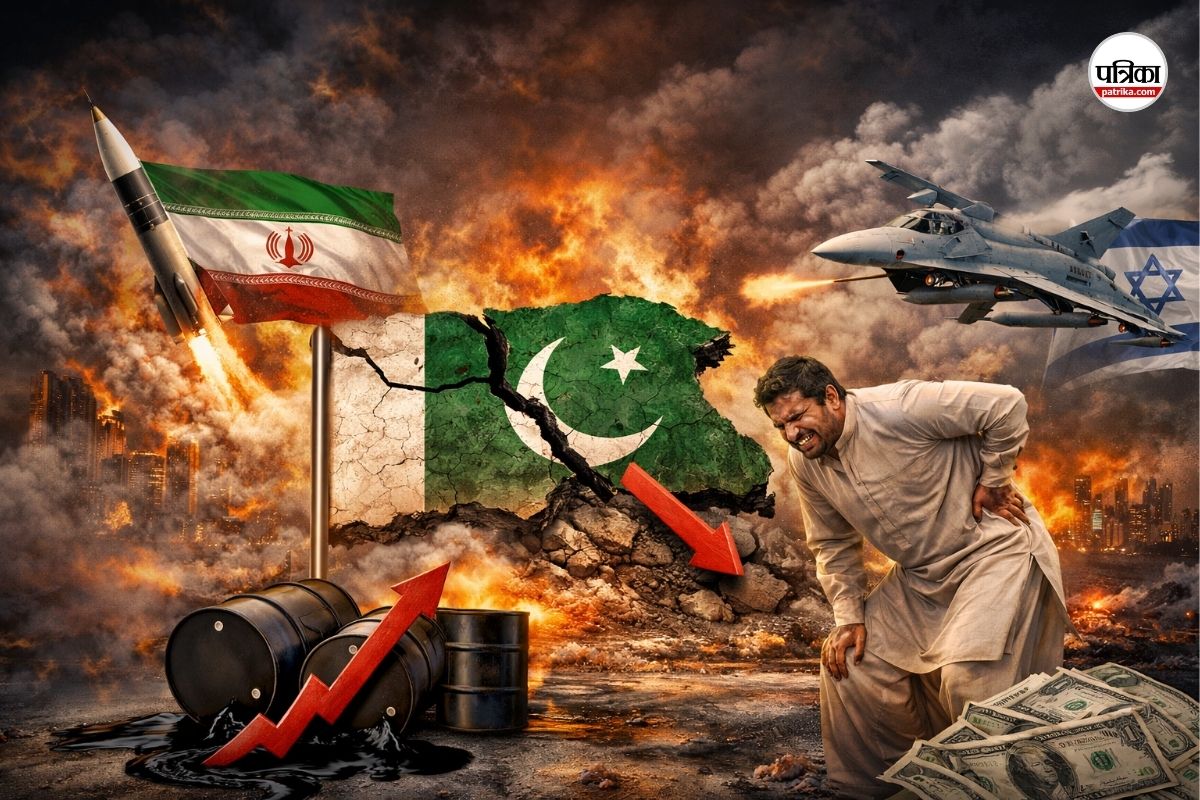
The stability of Pakistan’s internal economy is currently tethered to a fragile energy supply chain that reacts violently to shifts in Middle Eastern geopolitics. When tension between Iran and Israel escalates, it does not merely fluctuate global crude indices; it triggers a multi-layered economic collapse in South Asian nations that lack strategic reserves and fiscal buffers. The reported 200% surge in localized fuel costs is not a random market anomaly but the mathematical result of three intersecting failures: structural dependency on spot-market imports, the exhaustion of foreign exchange reserves, and the collapse of the subsidy-to-revenue ratio.
The Structural Fragility of the Pakistani Energy Stack
To understand why a regional conflict thousands of miles away can paralyze the Pakistani economy, one must dissect the domestic energy procurement model. Pakistan operates on a "Just-In-Time" (JIT) procurement basis for Liquefied Natural Gas (LNG) and refined petroleum products. Unlike nations with significant Strategic Petroleum Reserves (SPR) capable of weathering 90-day disruptions, Pakistan’s operational cushion often fluctuates between 7 and 20 days.
This lack of inventory depth creates an immediate transmission mechanism for price shocks. When Iran and Israel move toward kinetic engagement, the "War Risk Insurance" premiums for tankers transiting the Strait of Hormuz spike instantly. For a credit-strained economy, these premiums are not absorbed by the state; they are passed directly to the pump, compounded by the following variables:
- The Currency Devaluation Loop: Since oil is priced in USD, any geopolitical instability that weakens the Pakistani Rupee (PKR) creates a double-hit. The cost of the commodity rises in global terms while the purchasing power of the local currency falls, necessitating a steeper price hike to maintain the same volume of import.
- The Letter of Credit (LC) Bottleneck: International suppliers view Pakistan as a high-risk counterparty. During periods of regional war, banks often refuse to honor LCs without 100% cash backing. This liquidity trap forces the government to buy smaller quantities at higher "spot" prices rather than securing long-term, discounted contracts.
Quantifying the 200% Price Surge: A Function of Fiscal Exhaustion
The claim of a 200% increase in oil prices requires a breakdown of the price-build methodology. This figure is rarely the result of crude oil prices doubling on the Brent index; rather, it is the result of the removal of state-funded cushions.
Historically, the Pakistani government utilized "Price Differential Claims" (PDCs)—essentially a subsidy where the state paid the difference between the international cost and the domestic selling price. As the International Monetary Fund (IMF) mandates fiscal consolidation for bailout packages, these subsidies have been stripped away.
The resulting price at the pump is $P_{final}$, which can be modeled as:
$$P_{final} = (C_{int} \times E_{rate}) + T_{cost} + M_{dist} + L_{levy}$$
Where:
- $C_{int}$ is the international crude price.
- $E_{rate}$ is the PKR/USD exchange rate.
- $T_{cost}$ represents transport and insurance (highly sensitive to Middle East conflict).
- $M_{dist}$ is the distributor margin.
- $L_{levy}$ is the Petroleum Development Levy (PDL).
When $C_{int}$ rises due to Iran-Israel tensions and $E_{rate}$ devalues simultaneously, the removal of the subsidy (which previously suppressed $P_{final}$ by 50% or more) creates a perceived 200% jump. The "break" in the backbone of the economy is actually the forced transition from a subsidized fantasy to a market-based reality during a period of peak global volatility.
Secondary Contagion: The Industrial and Agricultural Breakdown
Energy is the primary input for every sector of the Pakistani economy. The escalation of fuel prices triggers a "Cost-Push" inflation cycle that is particularly lethal to two specific sectors:
The Circular Debt in the Power Sector
Pakistan relies heavily on Thermal Power Plants fueled by FO (Furnace Oil) and RLNG (Re-gasified Liquefied Natural Gas). As fuel prices skyrocket, the cost of generating a single kilowatt-hour (kWh) exceeds the recovery rate from consumers. This leads to "Circular Debt"—a systemic insolvency where power producers cannot pay fuel suppliers because the government cannot pay the producers. The result is widespread load-shedding, which halts industrial production, particularly in the textile sector, which accounts for over 50% of Pakistan’s exports.
Agricultural Input Hyper-Inflation
The timing of Middle Eastern conflict often overlaps with critical sowing or harvesting seasons. In Pakistan, decentralized farming relies on diesel-powered tube wells for irrigation and diesel-fueled tractors for tilling. A 200% increase in fuel costs renders the operation of these machines unsustainable.
- Yield Reduction: Farmers may under-irrigate to save costs, leading to lower crop yields.
- Food Insecurity: Increased transport costs for moving produce from rural hubs to urban centers create a secondary inflationary spike in food prices, which currently consumes over 40% of the average Pakistani household budget.
The Strait of Hormuz Bottleneck and Supply Chain Realignment
A direct confrontation between Iran and Israel carries the specific threat of a blockade or disruption in the Strait of Hormuz. For Pakistan, this is a geographical death sentence for energy security. Approximately 30% of global sea-borne oil passes through this transit point, but for Pakistan, nearly 70% of its refined petroleum and crude imports originate from Gulf Cooperation Council (GCC) countries that must navigate this chasm.
The strategic failure here is the lack of pipeline infrastructure. The Iran-Pakistan (IP) gas pipeline remains stalled due to the threat of US sanctions, leaving Pakistan entirely dependent on maritime routes. In a scenario where the Strait is contested:
- Freight Costs: Tanker rates for the Arabian Sea would reach prohibitive levels.
- Rationing: The state would be forced to implement "Essential Services" rationing, prioritizing the military and hospitals while effectively shutting down private transport and small-scale manufacturing.
The Geopolitical Arbitrage Failure
While other regional players like India have successfully navigated global tensions by diversifying their energy baskets—specifically by importing discounted Russian Urals through various currency swap mechanisms—Pakistan has struggled to replicate this model. The inability to execute "Geopolitical Arbitrage" stems from:
- Refinery Incompatibility: Most Pakistani refineries are configured for Light/Medium Arabian crudes. Processing heavier or different grades requires technical upgrades that the country cannot currently afford.
- Diplomatic Constraints: The need for IMF support often limits the degree to which Pakistan can engage in "sanction-evading" or non-traditional trade with pariah states or those under heavy Western pressure.
The "broken back" of the economy is not just a result of high prices; it is the result of having zero alternatives when the primary supply route is threatened by war.
Strategic Imperatives for Economic Survival
The current crisis dictates a shift away from reactive policy-making. For the Pakistani state to survive a sustained Iran-Israel conflict, it must move toward an "Energy Autarky" framework, however painful the transition.
- Mandatory SPR Expansion: The government must incentivize private oil marketing companies (OMCs) to build and maintain a minimum of 45 days of stock, moving away from the current 20-day average. This requires a revision of the margin structure to allow for capital expenditure in storage.
- Conversion to Fixed-Rate LNG: Transitioning away from the volatility of the spot market toward 10-to-15-year fixed-price contracts is essential. While this lacks the benefits of price drops, it provides the predictable cost-basis necessary for industrial planning.
- Aggressive Decentralized Renewables: To break the circular debt, the state must pivot toward "Behind-the-Meter" solar solutions for industrial zones. Reducing the load on the national grid minimizes the impact of fuel price spikes on the manufacturing sector.
The immediate forecast suggests that as long as the Iran-Israel theater remains active, Pakistan will experience a "Permanent High-Floor" for energy prices. The days of sub-$80 Brent facilitating Pakistani growth are over. The focus must now shift to managing a high-cost environment through efficiency gains and the elimination of the middle-man in energy logistics.
The only remaining lever is the radical restructuring of domestic consumption patterns. If the state cannot secure cheaper fuel, it must reduce the energy intensity of its GDP. This involves a forced transition to electric mass transit and the modernization of the irrigation network to reduce diesel dependency. Failure to decouple the national GDP from the volatility of the Arabian Sea will result in a terminal cycle of debt-funded consumption and periodic sovereign default threats.