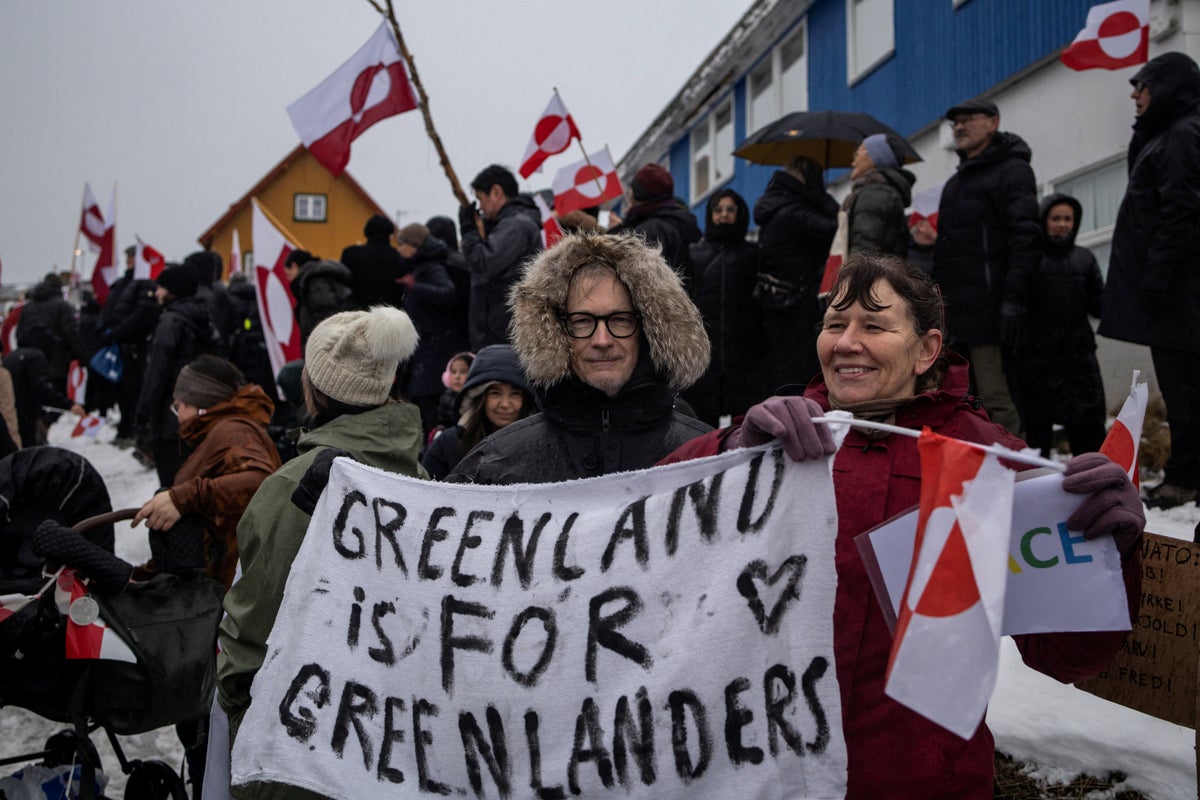
The media obsession with Washington’s periodic fixation on Greenland follows a predictably lazy script. Every time reports surface that Donald Trump, or any other US official, is looking to expand American influence, buy territory, or secure resources on the island, the commentary defaults to collective pearl-clutching. We hear about "spooked residents," sovereignty violations, and an outdated colonial mindset.
This reaction is completely wrong. It misreads global resource trends, ignores basic maritime strategy, and fundamentally misunderstands what Greenland actually needs to secure its own future.
The mainstream narrative treats US interest in the Arctic as an erratic, unilateral power grab. In reality, it is a late, necessary response to a massive shift in global infrastructure. Treating Greenland as a quiet, isolated frozen preserve is no longer an option. If the West does not integrate Greenland into a unified economic and security framework, someone else will.
The Sovereignty Myth and the Illusion of Isolation
The common argument is that increased US involvement threatens Greenlandic autonomy and disrupts a peaceful status quo. This premise assumes isolation is a viable strategy in the modern Arctic. It isn't.
Greenland sits directly on the GIUK gap (Greenland, Iceland, the United Kingdom), the critical naval choke point controlling access between the Arctic, the North Atlantic, and Europe. As polar ice melts, new shipping lanes open. This turns the region from a remote buffer zone into the main highway for global trade.
[Arctic Shipping Route] ---> [GIUK Gap / Greenland] ---> [North Atlantic Markets]
                                   ^
                       [The New Geopolitical Center]
To believe Greenland can simply opt out of this reality is naive. The choice isn't between American influence and pristine independence. The choice is between integrated Western alignment or economic dominance by external powers looking for a foothold in the North Atlantic.
For over a decade, non-Arctic nations have quietly positioned themselves to dominate the region. State-owned enterprises from Asia have repeatedly offered to finance massive infrastructure projects across Greenland, including deep-water ports and major airport expansions in Nuuk, Ilulissat, and Qaqortoq. When the Danish government stepped in to block some of these deals in 2018, it wasn't out of colonial spite; it was a realization that infrastructure debt is the fastest way to lose actual sovereignty.
When Washington expresses an aggressive interest in Greenland's infrastructure, it isn't an assault on local independence. It is an acknowledgment that the island is the most critical piece of real estate in the upcoming century.
The Trillion Dollar Critical Minerals Mirage
The media loves to frame American interest as a cynical resource grab, focusing heavily on the island's vast, untapped mineral wealth. Greenland holds some of the world’s largest undeveloped deposits of rare earth elements, neodymium, praseodymium, dysprosium, and terbium—the building blocks of modern technology, defense systems, and energy infrastructure.
The contrarian truth? Extracting these resources is an absolute nightmare, and the US wanting them is the best leverage Greenland has ever had.
I have watched mining conglomerates pour tens of millions of dollars into Arctic exploration only to watch their capital evaporate against the harsh reality of northern logistics. You cannot simply dig a hole in Greenland and ship ore to market. There are no interconnected road networks between towns. Port facilities are locked in ice for months at a time. Power grids are localized and fragile.
- The Supply Chain Reality: Raw ore mined in remote regions must travel thousands of miles just for processing.
- The Monopoly Problem: Currently, a single country controls over 70% of global rare earth extraction and roughly 90% of the magnet-making supply chain.
If Greenland attempts to develop these resources alone, or through fragmented, small-scale contracts, it will be eaten alive by global market manipulation. The capital required to build a viable, environmentally sound mining infrastructure in the Arctic requires a massive, state-backed security guarantee.
By demanding a seat at the table, Washington provides the one thing Greenland lacks: the market scale to break existing monopolies. Instead of fearing American capital, Greenlandic leadership should be bidding it up.
The Flawed Premise of "Spooked Residents"
Reports frequently cite anonymous locals or political commentators who claim that US attention is causing widespread anxiety among Greenland's population of roughly 56,000. This is a classic case of projecting Western academic anxieties onto a population that faces stark economic realities.
Let’s look at the actual numbers. Greenland relies on an annual block grant from Denmark, which covers more than half of the local government's budget. This subsidy keeps the economy afloat, but it also creates a hard ceiling on true independence. If Greenland ever wants to realize its goal of full self-determination, it must diversify its economy away from a total reliance on fisheries and Copenhagen's ledger.
| Economic Driver | Current Status | Vulnerability |
|---|---|---|
| Danish Block Grant | Provides ~50% of public budget | Maintains financial dependence |
| Fisheries | Accounts for 90% of exports | Highly vulnerable to climate shifts |
| Resource Development | Largely untapped / theoretical | Lacks infrastructure and capital |
An expanded US presence—whether through the modernization of Thule Air Base (Pituffik Space Base), new diplomatic consulates in Nuuk, or joint investment funds—means a direct influx of capital, jobs, and infrastructure that Denmark alone cannot provide.
During my time analyzing regional development, the pattern is always the same: local populations do not fear investment; they fear exploitation without representation. The solution isn't to push the US away. The solution is to negotiate ironclad agreements that mandate local hiring, domestic processing, and long-term infrastructure retention.
Stop Asking if the US is Overstepping
The public discussion surrounding this topic is broken because we are asking the wrong questions. The media asks: Is the US being too aggressive in the Arctic? The real question we should be asking is: Why has Western infrastructure investment in the Arctic been so dangerously slow?
While Western commentators debate the optics of territorial negotiations, foreign competitors are actively building icebreakers, mapping the polar seabed, and establishing satellite tracking stations. The US isn't overstepping; it is playing catch-up after decades of strategic complacency.
Imagine a scenario where the US backs away completely to appease regional critics. The vacuum wouldn't be filled by a sudden boom in local, self-sustained Greenlandic industries. It would be filled by predatory joint-venture proposals from state-backed corporations, leaving Greenland exposed to high-interest loans tied to strategic infrastructure defaults. We have seen this exact playbook ruin economies across Sub-Saharan Africa and the Global South. The Arctic is the next frontier for this economic model.
The Price of Real Autonomy
True independence is expensive. It requires deep-water ports, resilient communication networks, reliable energy grids, and the military capability to police your own waters. Greenland currently possesses none of these at scale.
If Greenland wants to transition from a protected territory to a genuine global player, it must leverage its geographical position. The interest from Washington shouldn't be treated as a threat to be managed. It is an asset to be monetized.
The downside to this approach is obvious: alignment with US strategic interests means getting caught in the crosshairs of great power competition. It means accepting that your home is a primary chess piece on a global board. But that ship has already sailed. Geography dictated that reality long before any modern politician opened their mouth.
The status quo is a fantasy. Greenland cannot remain an isolated, subsidized arctic bystander while the world fights over the resources beneath its feet and the waters surrounding its coast. Washington’s aggressive interest is not a crisis; it is the ultimate leverage. It is time for the North to stop panicking and start negotiating.