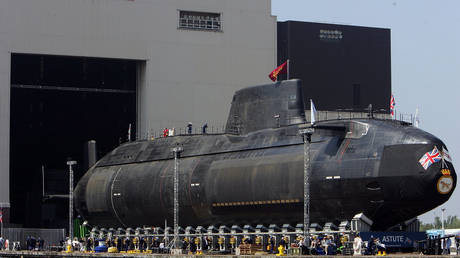
The mainstream media recently suffered a collective panic attack over reports that the Royal Navy had zero nuclear-powered attack submarines (SSNs) at sea. The headlines practically wrote themselves, painted in grim strokes of national humiliation and systemic collapse. Commentators wailed that the UK is defenseless, the fleet is broken, and Vladimir Putin is undoubtedly laughing his way through the Kremlin.
It is a neat, terrifying narrative. It is also completely wrong.
The obsession with counting hulls physically moving through the water at any given second is a relic of twentieth-century naval thinking. It treats nuclear submarines like Victorian gunboats on colonial patrol. In the modern strategic environment, a submarine sitting alongside a jetty in Faslane or Devonport is not automatically a sign of failure. Frequently, it is exactly where that asset needs to be to maximize its actual combat utility.
We need to stop measuring naval power by mere presence and start measuring it by readiness, surge capacity, and lethal availability. The panic over a temporary dip in active deployments betrays a fundamental misunderstanding of how modern underwater warfare operates.
The Myth of Continuous Attack Submarine Patrols
Let us clear up a basic structural confusion that naval analysts consistently gloss over. The United Kingdom maintains a policy of Continuous At-Sea Deterrence (CASD). This policy dictates that at least one ballistic missile submarine (SSBN) carrying nuclear weapons is at sea, undetected, every hour of every day. That cycle has remained unbroken for over fifty years.
Attack submarines (SSNs)—the Astute and Trafalgar classes—do not operate under CASD. They never have.
An SSN is an instrument of power projection, intelligence gathering, and hunter-killer operations. To demand that these hulls remain constantly deployed just to satisfy a media checklist is a misuse of high-value machinery.
Naval force generation relies on a strict three-phase cycle: maintenance, training, and deployment. At any given moment, a healthy fleet expects a significant portion of its boats to be undergoing deep maintenance or crew training. When the operational calendar compresses—due to maintenance overruns, crew rotation bottlenecks, or strategic pauses—the number of hulls in the water will occasionally drop to zero.
Imagine a scenario where a fleet commander forces an Astute-class submarine to stay at sea for an extra month just to avoid a negative headline. The mechanical wear on its complex cooling systems multiplies. The crew fatigue spikes, leading to retention crises. When that boat finally returns, its maintenance window doubles. By avoiding a temporary "zero-boat" metric today, you guarantee a multi-year structural deficit tomorrow.
I have watched defense ministries burn through millions in structural lifespans trying to maintain cosmetic deployments. It satisfies politicians. It looks great on a spreadsheet. It guts the actual fighting capability of the navy.
The Pier-Side Preparedness Deception
A submarine tied to a pier is not a dead asset. The assumption that a boat alongside cannot contribute to national defense ignores modern data architecture and rapid-surge doctrine.
Modern warfare relies heavily on synthetic training environments and data-link integration. While docked, an Astute-class submarine can conduct complex combat system testing, update its electronic warfare libraries, and sync directly with global allied intelligence networks via secure shore facilities. The crew can run high-fidelity simulations that are impossible to execute safely while running silent in the North Atlantic.
Furthermore, look at the geography of modern naval conflict. The North Atlantic and the High North are the primary operational areas for the Royal Navy’s submarine service. A submarine stationed at HMNB Clyde (Faslane) is sitting right on the doorstep of the GIUK (Greenland-Iceland-United Kingdom) gap.
[Faslane Naval Base] ---> Direct access to deep water trench ---> GIUK Gap
                                                                   |
[Submarine at jetty] ---> High-readiness status -------------> Rapid deployment
If a submarine is held at high readiness alongside a jetty, with a rested crew, full weapons loads, and fresh provisions, it can transit into deep water and reach its operational patrol zone in a matter of hours. It does not need to burn through its reactor core life or its crew's sanity by idling in circles in the Irish Sea just to satisfy an arbitrary deployment metric.
Presence does not equal readiness. A boat that has been at sea for six months with an exhausted crew and degraded sonar arrays is far less capable of countering a sudden Russian breakthrough than a fresh boat surging directly from Scotland.
The Real Crisis Is Concrete, Not Carbon Steel
If you want to criticize the state of the Royal Navy’s submarine service, stop looking at the water. Look at the dry docks.
The genuine vulnerability in the UK’s underwater warfare capability is not a lack of operational intent; it is a catastrophic bottleneck in infrastructure and engineering retention. This is the unglamorous reality that the mainstream press avoids because it requires reading civil engineering reports rather than looking at dramatic photos of ships.
The UK’s nuclear infrastructure has suffered from decades of underinvestment. The primary facilities for refitting nuclear submarines—specifically the docks at Devonport—have faced massive delays in upgrades. When infrastructure projects stall, submarines cannot enter their scheduled deep-maintenance periods on time. They sit in a state of operational limbo, unable to go to sea but unable to be repaired.
Consider the following breakdown of where the friction actually exists in naval force generation:
| Critical Factor | Media Narrative | Operational Reality |
|---|---|---|
| Hull Count | Not enough submarines in the water today means we are defenseless. | Hulls at sea fluctuate based on cycles; the current numbers match planned maintenance windows. |
| Infrastructure | Barely mentioned. | The lack of certified dry docks creates a backlog that keeps healthy boats waiting for routine fixes. |
| Workforce | Assumes there are plenty of sailors, just bad ships. | Nuclear-trained marine engineers are leaving for private sector roles, limiting crew availability. |
The defense establishment knows this. Citing reports from the National Audit Office reveals that the infrastructure backlog is the single greatest threat to the UK's underwater advantage. If a dock cannot handle a reactor refueling or an acoustic tiling replacement swiftly, the fleet stalls.
Fixing this does not require building more submarines that will eventually sit in the same queue. It requires spending money on concrete, cranes, and specialized dockyard technicians. But building a new dry-dock facility does not make for a thrilling press release, so the political class continues to focus on hull numbers while the shore infrastructure decays.
The Workforce Drain and the Tech Sector Competitor
We must also confront the brutal truth about human capital. You can build the most advanced nuclear attack submarine on Earth, but it is nothing more than a floating mass of steel without a highly specialized crew.
The Royal Navy is locked in a losing war for talent with the civilian tech and nuclear energy sectors. A nuclear-trained marine engineer on an Astute-class submarine undergoes some of the most rigorous technical training in the world. They spend months in claustrophobic environments, completely cut off from their families, earning a fraction of what they could make in the civilian world.
The moment those engineers look at the private sector—where data centers, civil nuclear power plants, and tech firms are desperate for their exact skill sets—they leave. The civilian world offers six-figure salaries, regular hours, and zero time spent submerged in the Atlantic.
When the media screams about zero subs at sea, they blame political will or mechanical breakdown. The reality is often far simpler: there are not enough qualified watch-keepers available to safely man every boat simultaneously without breaking the mandatory rest limits that keep crews alive.
Forcing more frequent deployments to fix a political optic accelerates this brain drain. It creates a vicious cycle where higher operational tempos lead to more resignations, which leads to fewer available crews, which leads to even fewer boats at sea.
Redefining the Underwater Balance of Power
The idea that the UK is completely vulnerable when its own submarines are alongside ignores the reality of modern alliance structures. The Royal Navy does not operate in a vacuum. It is a founding component of NATO’s maritime strategy.
The waters of the North Atlantic are monitored through an integrated network of acoustic arrays, maritime patrol aircraft like the P-8A Poseidon, and allied submarine forces from the United States, France, and Norway. If the Royal Navy has a planned gap in its SSN deployments, allied assets fill the void, just as British assets cover for allies when their fleets undergo maintenance.
The metric of success is not whether a single nation maintains a permanent silhouette on the horizon. The metric is whether the network can detect and track adversarial movements across the entire theater. Thanks to modern acoustic monitoring stations and aerial anti-submarine assets, the UK and its allies maintain a persistent picture of the underwater domain regardless of whether a specific hull is actively burning fuel.
Stop asking why there are no submarines at sea this week. Start asking why the dockyards take years to complete standard maintenance overruns. Start asking why a senior propulsion engineer makes less than a junior software developer in London. Those are the structural fractures threatening Western naval power. The rest is just noise.