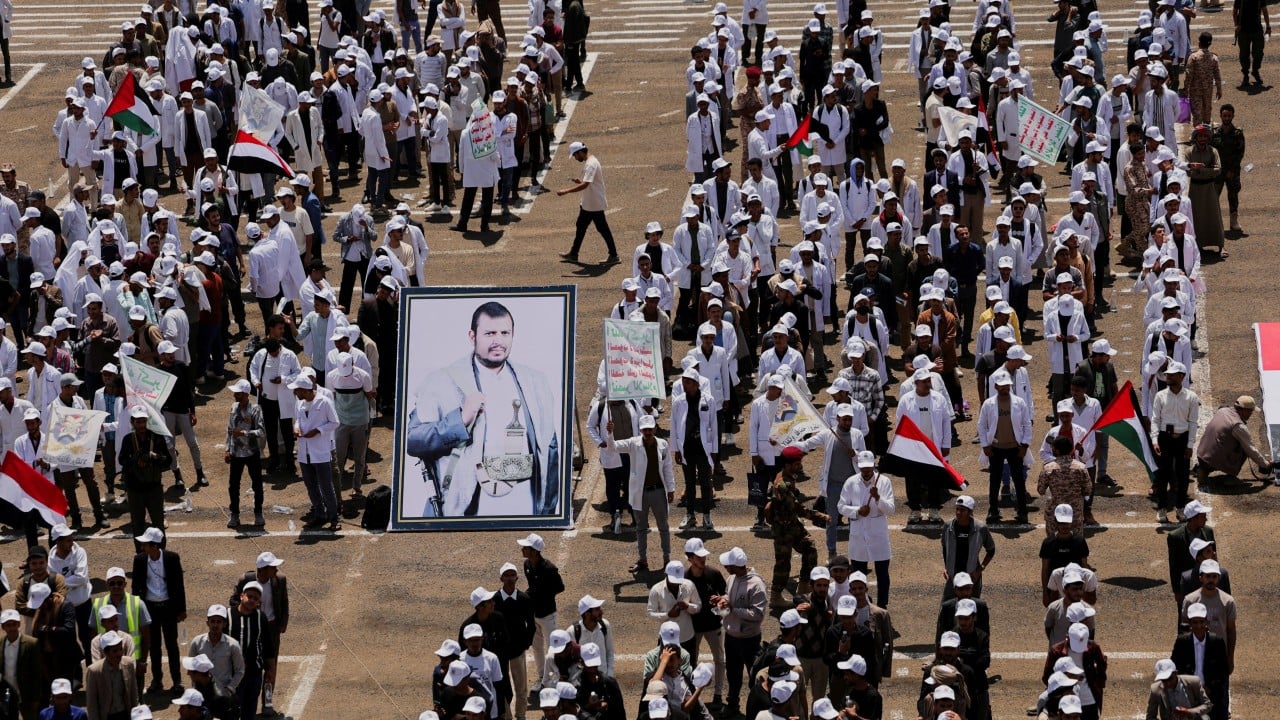
For years, western media painted Abdul Malik al Houthi as a remote, cave-dwelling insurgent with limited reach. That framing is completely wrong. As the leader of the Houthi movement (Ansar Allah) in Yemen since 2004, he has engineered one of the most improbable military transformations of the modern era. He turned a localized Zaydi religious minority group into a de facto government capable of disrupting global trade lanes and challenging regional superpowers.
If you want to understand why shipping companies still bypass the Red Sea and why regional peace talks remain fragile, you have to look past the caricature. You have to look at the actual mechanics of his leadership. Learn more on a related topic: this related article.
The Making of a Reluctant Commander
Abdul Malik didn't start out as the designated heir to the movement. Born in 1979 in the Saada Governorate, he was the youngest of his father's sons. The movement's original ideological and political blueprint belonged to his older brother, Hussein Badr al-Din al-Houthi, who founded the "Believing Youth" revivalist movement in the 1990s.
When Yemeni state forces killed Hussein in 2004, the group fractured and faced intense military pressure. Abdul Malik stepped into the vacuum at a remarkably young age. Observers at the time expected the insurgency to collapse within months. Instead, he decentralized military command, capitalized on rugged terrain, and turned guerrilla tactics into an institutionalized fighting force. Additional journalism by The New York Times explores related perspectives on the subject.
He rarely appears in public. His communications are almost exclusively broadcast via televised speeches. This seclusion isn't just about security. It builds an aura of asceticism and untouchability that resonates deeply within the local tribal context.
Beyond the Saudi Blitz
The 2015 intervention by the Saudi-led coalition was supposed to crush the movement in weeks. It did the exact opposite. Decades of external military pressure forged a hardened command structure under al Houthi's guidance.
Instead of breaking under airstrikes, the group adapted. They developed domestic assembly lines for asymmetric warfare tools—drones, ballistic missiles, and coastal defense systems. They learned how to absorb massive punishment while keeping their core governing apparatus intact across Sanaa and northwestern Yemen.
The campaign against Saudi Arabia wasn't just a defensive skirmish. It served as a massive operational proving ground. By the time the Red Sea crisis erupted, al Houthi's forces had already spent nearly a decade stress-testing their command-and-control networks against modern air defense systems.
The Red Sea Pivot and Strategic Intent
When geopolitical shocks rippled across the Middle East following the outbreak of the Gaza war, al Houthi didn't hesitate to alter the strategic calculus of international commerce. By declaring a blockade on shipping linked to specific nations, he shifted the group's profile from a local Yemeni faction to a self-appointed player in regional geopolitics.
The strategy relies on a simple economic asymmetry. Launching low-cost drones and anti-ship missiles forces international navies to expend million-dollar interceptors. It forces commercial cargo carriers to re-route entirely around the African continent, driving up global shipping costs and insurance premiums.
Domestically, this posture serves a crucial internal function. By framing military actions around popular regional causes, the leadership diverts public frustration away from severe local economic hardship, governance deficits, and humanitarian crises in territories under their control. It is a textbook exercise in using external conflict to cement internal cohesion.
What Analysts Miss About Houthi Resilience
Foreign policymakers often make the mistake of viewing the movement merely as an extension of external powers. While external supply lines and technical assistance have undoubtedly upgraded their military hardware, the movement's survival is fundamentally homegrown.
Al Houthi has maintained power through a mix of tribal co-optation, ideological indoctrination, and internal security crackdowns. The governance model in northern Yemen is deeply authoritarian, but it functions with a brutal efficiency that has outlasted multiple rounds of peace initiatives and localized rebellions.
Understanding Abdul Malik al Houthi means recognizing that he operates with a long-term strategic horizon. He isn't reacting day-to-day to tactical setbacks. He views the movement's survival as an existential, ideological mission, which makes conventional deterrence extraordinarily difficult to apply. Ignore that reality, and you will continually miscalculate his next move.