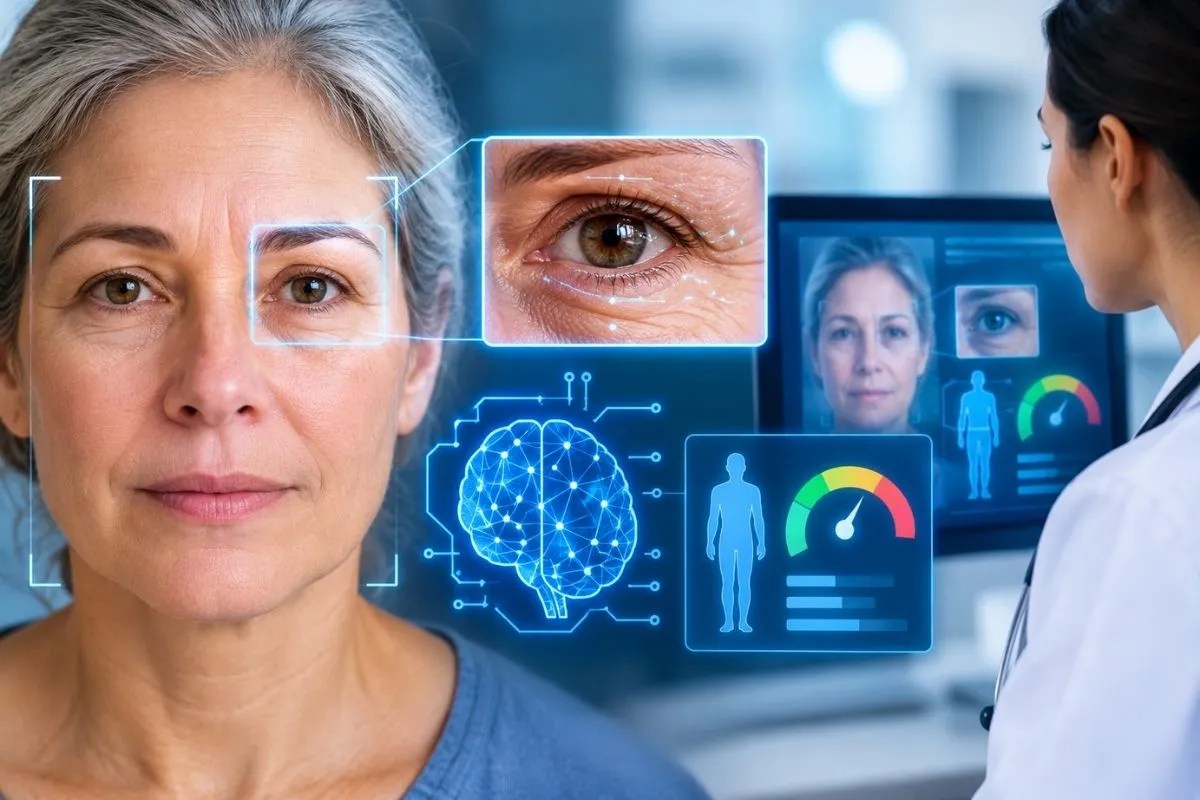
Can a phone camera scan your face and tell you how long you have left to live? No. Anyone selling that exact promise is either exaggerating or flat-out lying.
Still, there is real science hiding behind the hype. Researchers have been training computer vision models on facial photos, retinal scans, and periorbital skin patterns to spot subtle clues about biological aging, cardiovascular risk, and systemic health. The area around your eyes is a big part of that research, mostly because the skin there is thin, reactive, and surrounded by delicate vessels and tissues that shift early when things go sideways inside the body. Meanwhile, you can explore other events here: Shamonda Virus in France Exposed Why Livestock Surveillance Misses Human Spillover.
I have followed health-tech claims for years, and honestly, the gap between a cool research paper and a consumer app is massive. When clickbait headlines say AI can read your lifespan off your face, people start treating a selfie like a medical diagnostic. It isn't. At best, a facial biomarker model gives you a statistical risk nudge or an estimate of biological age based on patterns spotted in large datasets. At worst, it turns normal wrinkles, dark circles, or lighting shadows into fake health anxiety.
Why Your Eye Area Shows Clues Early
Look closely at the skin right around your eyes and you are looking at one of the most revealing zones on your face. Periorbital skin is much thinner than the skin on your cheeks or forehead, which means tiny changes in hydration, collagen breakdown, fluid retention, or blood flow show up faster. To explore the complete picture, we recommend the excellent article by Everyday Health.
Clinicians have long noticed physical signs around the eyes that correlate with broader health issues. Xanthelasma, those soft yellowish plaques near the inner corners of the eyelids, can sometimes point toward lipid abnormalities or elevated cardiovascular risk, though not everyone with them has high cholesterol and not everyone with high cholesterol develops them. Arcus senilis, a grayish or whitish ring around the outer edge of the cornea, is often age-related, yet when it appears earlier in life it has been linked to lipid profiles and vascular risk in certain populations. Even chronic puffiness or persistent dark shadows can reflect poor sleep, allergies, fluid shifts, or habits like smoking and heavy sun exposure.
None of these visual signs work as a standalone verdict. A crow's foot near your eye might mean years of squinting outdoors without sunglasses, laughing a lot, or losing skin elasticity with age. Treating a single crease or shadow as a medical diagnosis misses how messy human biology actually is.
How AI Reads Facial and Eye Biomarkers
When scientists build AI models around facial aging or health prediction, they aren't looking for a magic "lifespan number." They train neural networks on thousands or millions of images paired with health records, lab markers, or longitudinal outcomes to see which visual features correlate with biological age or disease risk.
In research settings, algorithms have analyzed facial geometry, skin texture, wrinkle depth, pigmentation, and ocular images like retinal photographs. Some studies have found correlations between estimated biological age from facial or ocular features and markers of cardiovascular health or mortality risk at a population level. That sounds dramatic in a headline, yet population statistics behave very differently from what happens to one individual sitting in front of a webcam.
A model might notice that people with higher systemic stress or poorer vascular health tend to have slightly different skin texture or periorbital puffiness on average. That is a correlation across a group. It does not mean your exact expiration date is printed beside your eyelids.
The Hype Trap Behind Lifespan Claims
Let's be real about why this topic goes viral so easily. Everyone wants a shortcut to knowing if they are aging well. Paying for complex blood panels takes time and money, while taking a photo takes three seconds.
Viral stories love phrases like "AI reveals how long you will live" or "health secrets hidden around the eyes" because they tap into ancient traditions of face reading and mix them with modern tech. Traditional systems like Chinese face reading or Ayurveda have observed facial features alongside lifestyle and constitution for centuries, which gives cultural context, not clinical proof of lifespan prediction. When tech marketers blur ancient observation, clinical signs, and AI pattern matching into one dramatic pitch, accuracy usually takes a back seat.
Here are the biggest mistakes people make when they buy into facial AI health claims:
- Confusing correlation with certainty. Even if an algorithm predicts biological age within a rough margin on a test set, a prediction interval is not a guarantee. Two people with identical eye wrinkles can have completely different heart health, metabolic markers, and lifespans.
- Ignoring lighting, cameras, and filters. Harsh overhead lights cast deeper shadows under the eyes. Rear cameras vs. front cameras distort proportions. Beauty modes smooth out texture. A model trained on standardized clinical photos can easily get tripped up by everyday phone conditions.
- Skipping real medical tests. No camera app replaces blood pressure checks, lipid panels, HbA1c, kidney or liver function tests, or an actual conversation with a doctor who knows your family history.
What Science Actually Proves Versus What Remains Debatable
Credible institutions like the National Institutes of Health and peer-reviewed journals have explored digital biomarkers and AI in medicine extensively, and the consensus among cautious researchers is pretty clear. AI can be remarkably good at spotting subtle visual patterns in medical imaging—such as diabetic retinopathy screening from retinal photos or dermatological triage—when trained on high-quality, diverse clinical data and validated properly.
When you step outside controlled medical imaging into casual consumer face scans, the evidence gets much thinner. Bias is a real issue too. If a dataset overrepresents certain age groups, skin tones, or lighting setups, the model's accuracy can drop sharply for everyone else. Furthermore, researchers still debate how much "biological age" scores from facial features add beyond basic chronological age and standard clinical risk factors.
That transparency matters. A tool can be interesting without being a crystal ball. If an app gives you a wellness score from a selfie, treat it as entertainment or a loose nudge to check your habits—never as medical gospel.
Practical Ways to Use These Insights Without Falling for Hype
If reading about facial cues and AI health tools got you thinking about your own routine, you don't need a sketchy lifespan scanner to take action. You can use that curiosity in grounded, practical ways that actually help your body.
First, audit your daily habits that visibly affect your eyes and overall health. Chronic sleep deprivation shows up fast around the eyes and wrecks metabolic and cardiovascular recovery over time. Daily broad-spectrum sunscreen protects periorbital skin from UV-driven collagen breakdown and lowers skin cancer risk. Cutting back on smoking and excess alcohol helps both skin quality and long-term vascular health.
Second, pay attention to real changes rather than chasing perfection. If you notice a new, growing eyelid lump, persistent redness or vision changes, yellow plaques near the inner corners of your eyes, or sudden swelling that doesn't match a late night or allergies, get checked by a qualified doctor or ophthalmologist.
Third, pair any curiosity about "biological age" or preventive health with real clinical baseline numbers. Track your blood pressure, get routine blood work recommended for your age and risk profile, and focus on the fundamentals with the strongest evidence: consistent sleep, regular movement, balanced nutrition, and stress management. A mirror and a smartphone camera can spark good questions, while real health is built quietly over years of everyday choices.