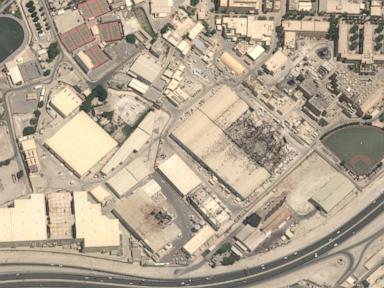
Military analysts spent years insisting that American air defense networks in the Middle East were virtually impenetrable. They were wrong. When Iran launched coordinated strikes across the region, it didn't just lob missiles blindly at hardened hangars or barracks and hope for luck. Instead, Iranian planners executed a cold, two-stage sequence that first blinded and degraded US air defense radars before hammering parked aircraft and critical base infrastructure.
An Associated Press analysis of satellite imagery and strike data confirmed what defense insiders quietly feared. By prioritizing radar arrays and interceptor batteries first, Tehran's forces punched temporary holes through multi-layered shields. Once those sensors went dark or ran dry, follow-on waves struck high-value targets on the ground with disturbing accuracy.
If you've followed regional security debates over the past decade, you know the standard talking point. Billions of dollars spent on Patriot batteries, Terminal High Altitude Area Defense (THAAD) systems, and Aegis destroyers supposedly guaranteed total airspace dominance. That assumption rested on a dangerous blind spot—believing an adversary wouldn't adapt its targeting doctrine to exploit the physical limits of radar coverage and interceptor magazines.
How the Two-Stage Strike Sequence Actually Worked
Modern air defense isn't a magic forcefield. It's a chain of sensors, command nodes, and launch tubes, and breaking just one link blinds the entire battery.
Iran's planners understood this math completely. Rather than wasting their most accurate ballistic missiles against fully alert defense grids, they structured the attacks to strip away protection layer by layer.
Blinding the Sensors First
Every surface-to-air missile system depends on phased-array radars to track incoming threats and guide interceptors to their targets. Without that radar dish actively radiating and processing returns, a multi-million-dollar launcher becomes an expensive paperweight.
In the opening phase of the strikes, incoming drones and low-flying cruise missiles saturated the perimeter of targeted Middle Eastern bases. These weren't random harassment flights. They forced US and allied radar operators to light up their emitters, revealing exact grid coordinates while burning through costly interceptor stockpiles on cheap decoy airframes.
Seconds or minutes later, precision-guided munitions targeted the radar units themselves and their supporting command trailers. Satellite photos analyzed by the AP showed scorched earth and shattered concrete pads precisely where air defense components had been positioned just days earlier.
Hitting Exposed Aircraft and Buildings
Once the local sensor bubble collapsed, the second wave arrived with minimal resistance. Parked military aircraft, maintenance hangars, fuel depots, and administrative buildings bore the brunt of these follow-up impacts.
Aircraft sitting on open tarmacs are notoriously fragile. Even shrapnel from a nearby warhead detonation can puncture fuel bladders, shred composite skins, and knock a frontline jet out of commission for months. Satellite imagery documented damaged airframes and collapsed roofs across multiple installations, proving that hitting the radar first paid immediate tactical dividends.
Why US Air Defenses Struggled Against Saturation
People love debating whether a specific missile system "works" or "fails," as if warfare happens in a sterile laboratory. Real combat is messy, loud, and governed by brutal logistics.
Three harsh realities explain why even top-tier American defenses took hits during these exchanges.
- The cost exchange ratio is upside down. Firing a $4 million Patriot interceptor at a $30,000 one-way attack drone is economic suicide, yet commanders can't afford to let a drone hit a crowded barracks or fuel farm.
- Radar horizons create blind spots. Ground-based radars struggle to spot terrain-hugging cruise missiles until they clear the horizon, leaving defenders mere seconds to react.
- Magazine depth is finite. A battery only holds so many ready-to-fire canisters, and reloading under active bombardment is slow, dangerous work.
Honestly, the Pentagon has known about these vulnerabilities for years. War games run by think tanks like the Center for Strategic and International Studies (CSIS) repeatedly warned that massed drone and missile salvos would overwhelm static base defenses. Knowing a problem exists on a whiteboard and fixing it across dozens of sprawling desert bases are two completely different things.
What Satellite Imagery Revealed About Base Vulnerabilities
Commercial satellite providers like Planet Labs and Maxar have changed how the public understands modern conflict. You don't have to take anyone's press release at face value anymore when high-resolution orbital photos show every crater and burned-out roof.
When AP journalists examined before-and-after imagery of the targeted Middle Eastern bases, several patterns jumped out immediately.
First, fixed infrastructure is impossible to hide. Everyone with a commercial satellite subscription—including Iranian intelligence—knows the exact coordinates of every runway, hardened shelter, and radar revetment across the Persian Gulf. Painting camouflage netting over a giant radar trailer doesn't fool synthetic aperture radar or pre-programmed inertial guidance systems.
Second, aircraft dispersal remains a massive headache. Moving dozens of support planes, drones, and fighters away from primary hubs sounds simple on paper. In practice, bases in the region lack enough hardened concrete shelters to house every airframe, leaving expensive hardware parked in neat, vulnerable rows under open skies.
Third, blast walls protect people far better than equipment. Reinforced concrete barriers saved countless lives by absorbing lateral blast waves around living quarters and command bunkers. Sensitive electronics, satellite dishes, and parked aircraft don't fit neatly behind twelve-foot T-walls.
The Strategic Shift in Iranian Missile Doctrine
For years, Western analysts dismissed Iran's missile force as a crude terror weapon—good for hitting sprawling cities, terrible for pinpoint military strikes. That assessment expired a long time ago.
Tehran spent the last decade quietly upgrading guidance packages, adding terminal seekers, and refining its intelligence-gathering network. By combining commercial satellite imagery with local reconnaissance and electronic intelligence, Iranian targeteers transitioned from area bombardment to precision point-targeting.
Attacking air defenses first demonstrates a level of operational maturity that caught many observers off guard. It requires tight timing, reliable flight-time calculations, and real-time battle damage assessment. You don't pull off a sequenced suppression-of-enemy-air-defenses (SEAD) campaign using ballistic missiles and drones by accident.
What This Means for Future Base Defense
Military planners in Washington and allied capitals are scrambling to adapt to this reality. Relying solely on kinetic interceptors to catch every incoming bullet is a losing strategy when your opponent manufactures munitions faster and cheaper than you build shields.
Real defensive resilience requires changing how bases operate on a daily basis, not just buying another battery of interceptors.
- Harden and bury critical nodes. Radar processors, power generators, and command centers need underground bunkers and decoy emitters scattered miles away from main runways.
- Deploy directed-energy and electronic warfare systems. High-powered microwaves and laser weapons offer a deep magazine against drone swarms without burning through multi-million-dollar missiles.
- Adopt agile combat employment. Air forces must practice scattering small detachments of aircraft across austere airstrips, civilian airports, and highway strips so no single base holds a concentration of irreplaceable jets.
If you're tracking geopolitical risk, defense budgets, or regional stability in the Middle East, watch where the Pentagon allocates its emergency funding over the next twelve months. Pay less attention to flashy announcements about new fighter jets and look closely at contracts for hardened shelters, passive sensors, counter-drone jammers, and dispersed logistics hubs. Those unglamorous investments will determine whether US bases can absorb the next opening salvo without losing their eyes—or their aircraft—on the ground.