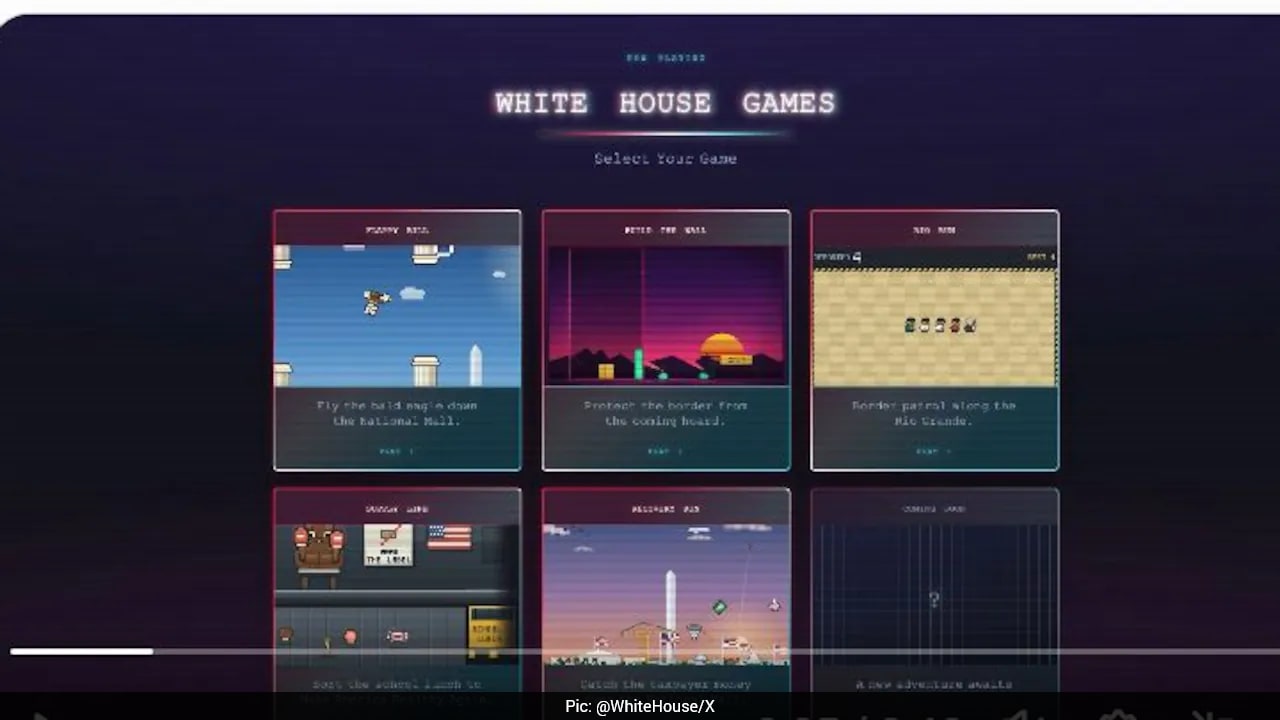
The screen glows in a quiet room, casting a pale, flickering blue light across the desk. It is not the light of a high-stakes financial terminal or an encrypted diplomatic wire. It is the bright, saturated primary colors of an interactive entertainment medium. A cursor hovers over a digital border. A menu clicks. Decisions are made, points are tallied, and policies that usually live in dry, dense federal registers are rendered into immediate, playable choices.
This is the intersection where policy meets pixels.
When the White House apparatus shifts its focus toward unconventional communication channels, it does so with a distinct objective. It wants to bypass the editorial filters of traditional newsrooms. It wants to reach citizens where they already spend their hours. Recently, this strategy took a startling form with the introduction of deportation video games designed to promote and dramatize immigration enforcement agendas. To understand why an administration would turn to interactive media to communicate executive policy, we have to look past the novelty of the medium and examine the mechanics of persuasion in the digital age.
Consider what happens when abstract political concepts are gamified. For decades, political communication relied on speeches, press releases, and televised advertisements. These mediums required passive consumption. A viewer could zone out during a twenty-second spot or skim a newspaper column while drinking coffee. Video games demand something entirely different. They require participation. Even if that participation is as simple as pressing a button or selecting a policy option from a dropdown menu, the brain engages differently when it believes it is steering the outcome.
Imagine a hypothetical user named Marcus sitting at his laptop on a Tuesday evening. Marcus is not a political junkie. He does not read thirty-page policy briefs from think tanks in Washington. But he sees a headline about a new interactive application released through official channels, and curiosity pulls him in. Within minutes, Marcus is managing virtual budgets, allocating personnel, and responding to simulated border crises. The game rewards him for swift, decisive action and penalizes hesitation. Without realizing it, Marcus is absorbing a specific worldview about state sovereignty, resource management, and administrative priorities.
That is the hidden power of this approach. It turns complex, deeply polarizing human crises into math problems.
Human beings are naturally wired to respond to rules, scores, and feedback loops. When complex geopolitical realities involving human lives, legal frameworks, and international human rights are reduced to a digital interface, the edges get sanded down. The messy, agonizing reality of human migration becomes a series of binary choices: secure or do not secure, deport or do not deport. The emotional weight of a family torn apart is replaced by a digital score ticking upward.
This strategy is not entirely unprecedented. Governments have long used educational software, military recruitment simulators, and public service announcements disguised as entertainment to shape public perception. Think of America Army, the tactical shooter funded by the U.S. Army to boost recruitment. It was a video game, yes, but it was also a brilliant, highly effective recruitment tool that bypassed traditional advertising entirely by putting the user directly into the boots of a soldier.
Yet, applying that same logic to immigration enforcement represents a distinct escalation in the culture wars. It signals an era where political persuasion is no longer just about convincing voters through argument, but about immersing them in a simulated reality where the administration's preferred policy choices feel like the only logical solutions to a manufactured crisis.
Critics argue that this trivializes human suffering, turning tragedy into a pastime. They point out that reducing immigration enforcement to a point-and-click exercise sanitizes the visceral, often devastating human consequences of large-scale deportations. To a critic, these digital experiments are callous spectacles designed to inflame partisan divisions and score cheap political points with a base that hungers for aggressive border control messaging.
Supporters, on the other hand, view the move as a stroke of modern media genius. They argue that traditional media outlets are biased, and that utilizing direct-to-consumer digital tools is the only way to cut through the noise and explain executive priorities to a younger, digitally native electorate that has largely abandoned cable television and print journalism. From this perspective, the games are not trivializations at all, but transparent, accessible translations of governance for a generation that communicates in memes, clips, and interactive experiences.
Both views capture a piece of the truth, but they miss the deeper cultural shift occurring beneath the surface. We are living through a period where the boundaries between entertainment, propaganda, and governance are dissolving entirely. Everything is content now. Every political stance must be packaged for consumption, optimized for engagement, and rendered palatable to an audience with an increasingly fractured attention span.
When the state becomes a game developer, the nature of citizenship itself begins to morph. Are we citizens participating in a republic through civic duty and critical discourse, or are we players navigating a pre-designed course, choosing our allegiances based on which platform offers the most satisfying feedback loop?
The blue light from the monitor fades as the application closes. The virtual borders remain secure in the code, but out in the real world, the consequences of these policies continue to unfold in courtrooms, detention facilities, and communities across the nation, far away from any high score screen.


